
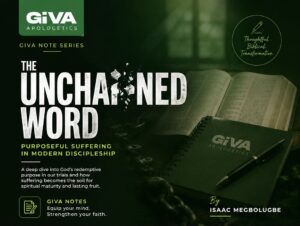
The Unchained Word: Purposeful Suffering in Modern Discipleship
Isaac Megbolugbe
July 11, 2026
Introduction
Paul penned his last letter to Timothy when he was isolated in a Roman prison, awaiting execution. Although shackles restricted his body, he noted that the good news could not be “chained” (2 Timothy 2:9). “Therefore,” Paul said, “I endure everything” to give others the chance to hear and accept the truth about Jesus Christ (v. 10). In a cultural era that aggressively prioritizes self-care, the avoidance of discomfort, and immediate gratification, the concept of purposefully enduring suffering for the sake of faith can seem jarring. Yet, the core of Christian discipleship is fundamentally intertwined with the willingness to embrace hardship for the advance of the Gospel. Understanding how and why modern humanity is called to a purposeful endurance of suffering is essential for authentic spiritual growth.
The Problem with the “Comfort-First” Mindset
Modern humanity exists in an age of unprecedented convenience. Medical advancements, digital connectivity, and technological ease have cultivated a societal expectation that suffering is a glitch in the human experience that can—and should—be completely engineered away.When this “hedonistic” or comfort-first mindset collides with the realities of living in a broken world, it often leads to deep disillusionment. However, the foundational teachings of Christianity make it clear that adversity is not an anomaly to be feared, but an expected reality of a life devoted to Christ. The Apostle Paul explicitly warned Timothy that “everyone who wants to live a godly life in Christ Jesus will be persecuted” (2 Timothy 3:12).
The Missional Purpose of Pain
The difference between mere suffering and Christian discipleship is intention. The secular world views pain as senseless and devoid of meaning, prompting a natural reflex to escape it at all costs. For the disciple, suffering takes on a distinct, missional purpose.Paul’s mindset in his Roman dungeon is the ultimate model for this. His chains were not an endpoint; they were an instrument through which the Gospel was amplified to a group of people he would have never otherwise reached. He endured the worst that the Roman Empire could throw at him for “the sake of the elect, that they too may obtain the salvation that is in Christ Jesus” (2 Timothy 2:10). When a modern disciple intentionally embraces misunderstanding, loss, or hardship to share Christ, their perseverance becomes a megaphone for the Gospel.
The Transformation of Character
Purposeful endurance is not just about advancing a message to others; it is deeply transformational for the believer’s own soul. The Apostle Paul articulated this progression in Romans 5:3-5, noting that suffering produces endurance, endurance produces character, and character produces hope.Purposeful endurance requires believers to actively shift their focus away from temporary, worldly comforts and fix their eyes on eternal realities. As the early church and countless modern believers have discovered, when suffering is faced with active trust in God’s redemptive plan, it acts as a purifying fire. It strips away superficial dependencies, builds spiritual resilience, and deepens reliance on the Holy Spirit. Furthermore, as a theological reality, there is a deep, spiritual fellowship that occurs when a disciple participates in Christ’s sufferings. The Christian community generally agrees that this union with Christ provides profound meaning and strength even in the darkest, most confusing trials.
Discipleship in the Modern Context
For modern humanity, adopting a lifestyle of purposeful endurance doesn’t necessarily mean waiting for physical imprisonment or martyrdom. Discipleship in the modern world requires a willingness to stand firm in truth when it is culturally unpopular, to sacrifice personal resources to serve the marginalized, and to maintain an unwavering hope when facing personal grief, illness, or injustice. Purposeful endurance teaches modern disciples that their pain is not meaningless. Whether navigating the quiet struggles of everyday life or facing overt hostility, Christians are called to entrust themselves to a faithful Creator. In doing so, they demonstrate to a watching, broken world that while human bodies and earthly systems can be restricted or broken, the transformative power of the Gospel will never be chained.
Dr. Isaac Megbolugbe is Director of GIVA Ministries International.

May we find grace to endure hardship