
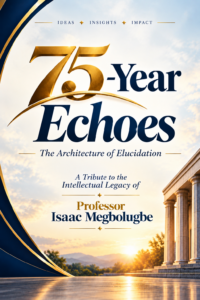
The Elucidative Mind: Celebrating 75 Years of Professor Isaac Megbolugbe’s Consequential Brilliance
Foreword: The Gift of Intellectual Scaffolding
It is a rare privilege to introduce a tribute volume dedicated to a mind that does not merely study the world, but fundamentally clarifies it. For more than four decades, those of us who have had the distinct honor of walking alongside Professor Isaac Megbolugbe have witnessed something far greater than conventional academic excellence. We have witnessed a master builder at work—a man who dedicated his 74 years of lived experience to constructing the structural frameworks that allow others to think, lead, and see with absolute certainty.
As we mark his milestone 75th year, the title of this collection, 75-Year Echoes, proves entirely fitting. An echo requires substance to bounce against; Professor Megbolugbe’s substance is rooted in what his colleagues at Johns Hopkins University rightfully identified as a rare, tremendously consequential brilliance that elucidates.
In the landscape of higher education and global development policy, it is easy to find scholars who use complexity as a shield, wrapping their ideas in dense layers of esoteric jargon. Professor Megbolugbe has spent his life doing the exact opposite. He possesses an uncanny ability to take the most tangled socio-economic realities—whether navigating the intricacies of urban housing markets at the Fannie Mae Foundation or decoding macroeconomic principles in development economics—and present them with such complete representation that the chaos instantly falls away.
This volume beautifully captures the two halves of his immense legacy: his profound individual intellect and his systematic approach to scaling that intelligence. The chapters ahead map out his transition from a master of classroom inquiry to a pioneer of organizational knowledge management frameworks alongside global research entities like the NASA Goddard Space Flight Center. More importantly, these pages illuminate his philosophy of meta-knowledge—the discipline of understanding the overarching rules and patterns of information itself.
To read this collection is to understand that Professor Megbolugbe’s greatest gift to academia was never his own answers; it was his pedagogical generosity. When he met an inquiry with his signature, beautiful smile, he was not preparing a defense. He was reading the questioner’s clues, forging a custom conceptual key, and inviting them to inhabit his intellection. He gave us the scaffolding to climb up and stand beside him on the horizon of truth.
For the students he mentored, the researchers he trained, and the colleagues he inspired, this book is more than a retrospective. It is a living manual of clarity. As you step into the chapters that follow, you are invited to pick up the keys Professor Isaac Megbolugbe has so selflessly crafted throughout his legendary sojourn. May his brilliant, elucidative echo continue to unlock your mind just as it has unlocked so many of ours.
Emeritus Professor Olufemi Obafemi
University of Ilorin
October 2026
Introduction: The Architecture of Elucidation
Every profound intellectual legacy is defined by a unique frequency—an enduring resonance that ripples across institutions, disciplines, and generations. For Professor Isaac Megbolugbe, this resonance is captured perfectly in his 75-Year Echoes. As he reaches this extraordinary milestone, reflecting upon 74 years of deeply lived experience, we are invited to look beyond the titles, the appointments, and the publications. We are invited to examine the very anatomy of his genius: a rare, tremendously consequential brilliance that elucidates.
This volume serves as a collaborative map of that brilliance. It gathers the disparate strands of a monumental career to trace how one thinker transformed the spaces he sojourned. The journey documented in these pages does not merely recount a timeline; it explores an intellectual evolution that moved from individual insight to systemic, global impact.
[ OVERARCHING VOLUME FLOW ]
│
┌─────────────────────────┴─────────────────────────┐
▼ ▼
[ PART I: THE CAPTURED INTELLECT ] [PART II: THE SCALED SYSTEM ]
The Elucidative Mind & Anatomy of Inquiry Meta-Knowledge Pedagogy & Institutional Pillars
The flow of our tribute anticipates this journey by dividing his impact into two foundational dimensions:
To read these pieces is to do more than read a tribute to a master scholar. It is an invitation to step onto a shared horizon, to pick up the conceptual keys he has so generously crafted, and to inhabit his intellection. Professor Isaac Megbolugbe has spent a lifetime turning the esoteric art of knowledge into an accessible science of clarity. This introduction opens the door to a house of light he spent 75 years building.
The Elucidative Mind
In the corridors of academia and the vast professional spaces he has sojourned, Professor Isaac Megbolugbe has long been recognized as a figure of singular intellectual power. As he reaches his 75th year—a milestone marked by reflection, gratitude, and deep legacy—the echoes of his impact resonate across generations.
To look back on his 74 years of lived experience is to witness a journey defined not just by raw intelligence, but by a rare, transformative talent: the brilliance that elucidates.
The Architecture of Elucidation
True brilliance in academia is often measured by complexity, but Professor Megbolugbe’s genius lies in its opposite: absolute clarity. A former colleague at Johns Hopkins University captured the essence of his impact in a tribute that serves as a defining testament to his career:
“Isaac’s brilliance is the kind that elucidates. It is rare and tremendously consequential. Whenever Isaac is questioned or challenged, he responds with clarity that does not require him to explain but enables everyone to see the situation or issue in complete presentation and representation that most of the questions that arise answer themselves.”
This is not merely the talent of a great lecturer or an articulate scholar. It is the gift of intellectual architecture. When faced with a complex problem, an intricate challenge, or a room full of competing theories, Professor Megbolugbe does not merely defend a thesis. Instead, he reconstructs the entire landscape. He presents the issue so completely, and represents its facets so perfectly, that the fog of confusion instantly dissipates. The questions that seemed insurmountable suddenly answer themselves in the light of his exposition.
Inhabiting the Intellection
To engage with Professor Megbolugbe is to experience a shift in one’s own cognitive framework. As his Johns Hopkins colleague noted, “Once you understand what and how he sees, you are able to inhabit his intellection.”
This ability to invite others into his way of thinking is what makes his work so deeply consequential. He does not talk down to his peers or students; he elevates them. He provides the conceptual scaffolding that allows others to climb up and stand beside him, viewing the horizon with the same clarity that he does.
It is a generous form of genius. It leaves an indelible mark on everyone who crosses his path. In the words of his colleague: “I don’t know about you, but I have never known anyone who has that kind of impact on me.”
The Smile and the Key
Perhaps the most human, endearing manifestation of this intellectual gift is found in Professor Megbolugbe’s reaction to inquiry. Where other academics might grow defensive or impatient when challenged, he meets inquiry with joy.
He is known for a signature, beautiful smile that lights up when a difficult question is posed. His colleague beautifully unlocked the secret behind that expression:
“I think that is why he smiles so beautifully whenever you ask him a question. It’s like your inquiry provides him with clues that enable him to give you the correct key that unlocks your mind to see his. That is talent that awes me.”
For Professor Megbolugbe, a question is not an adversarial hurdle; it is a map. The questioner provides the clues, and with the precision of a master craftsman, he hands back the exact key required to unlock their own understanding.
75 Years of Echoes
As Professor Isaac Megbolugbe celebrates this landmark 75th year, the echoes of his brilliance continue to shape the spaces he has traversed. His legacy is found in the housing and urban policy frameworks he advanced, the students he mentored into leadership, and the colleagues who were permanently changed by his presence.
He remains a beacon of rare and consequential intellect—a man who spent a lifetime unlocking minds, illuminating truth, and teaching the world not just what to think, but how to see.
The Cartography of Clarity: How Professor Isaac Megbolugbe Maps the Minds of Tomorrow
To navigate the expansive terrain of Professor Isaac Megbolugbe’s academic and professional journey is to witness a master cartographer at work. Over a distinguished career spanning decades, he has not merely populated the corridors of higher education; he has fundamentally redrawn them. As part of his 75-Year Echoes, we reflect on a unique dimension of his 74 years of lived experience: his unparalleled ability to turn the act of questioning into a collaborative journey of discovery.
At the heart of this reflection is a profound insight shared by a colleague at Johns Hopkins University, who observed that Professor Megbolugbe’s signature smile upon receiving a challenge is the look of a man finding the final piece of a puzzle:
“It’s like your inquiry provides him with clues that enable him to give you the correct key that unlocks your mind to see his. That is talent that awes me.”
The Alchemy of Inquiry
In traditional academic spaces, a question is often treated as a test of fortitude or a boundary to be defended. Professor Megbolugbe upends this dynamic entirely. To him, an inquiry is not an obstacle—it is raw data. It is a diagnostic tool that reveals exactly where a student or peer is standing, what obstacles block their vision, and what path must be forged to lead them to higher ground.
When challenged, his response is never a defensive lecture. Instead, it is an act of intellectual alchemy. By listening to the clues embedded within a question, he decodes the questioner’s underlying assumptions. He then offers a response so precisely calibrated that it acts as a skeleton key, instantly unlocking the constraints of the listener’s mind and inviting them to share his vantage point.
Inhabiting a Shared Horizon
This rare gift changes the very nature of learning. Most brilliant minds seek to be understood; Professor Megbolugbe seeks to make others understand themselves in relation to the truth. His brilliance does not isolate him on a pedestal. Instead, it serves as a bridge.
As his Johns Hopkins colleague masterfully noted, “Once you understand what and how he sees, you are able to inhabit his intellection.”
To inhabit his intellection is to experience the profound comfort of absolute structural clarity. He presents complex socioeconomic realities, urban frameworks, and policy dilemmas with such seamless representation that the noise of confusion falls away. He does not force compliance with his ideas; he simply reveals the landscape so perfectly that the correct conclusion becomes obvious to everyone in the room.
The Beautiful Smile: A Legacy of Intellectual Generosity
Perhaps the most enduring image of Professor Megbolugbe across the spaces he has sojourned is that beautiful, knowing smile. It is the visual hallmark of a man who genuinely delights in the intellectual awakening of others. That smile signals that a bridge is about to be built, a mind is about to be unlocked, and a new perspective is about to be born.
As we celebrate his 75th year, we honor this profound legacy of intellectual generosity. Professor Isaac Megbolugbe has spent his life handing out keys to anyone eager to see. The minds he has unlocked will continue to illuminate the world, carrying the echoes of his brilliant, elucidative spirit far into the future.
The Science Behind the Art: Professor Isaac Megbolugbe’s Meta-Knowledge Frameworks for Sharing Wisdom
In the discourse of intellectual legacy, there is a profound distinction between raw intuition and structured understanding. While some navigate complex fields through surmission—relying on conjecture, leaps of faith, or educated guessing—Professor Isaac Megbolugbe has anchored his legendary 75-year journey in the exact opposite discipline: meta-knowledge. To possess meta-knowledge is to hold structured knowledge about knowledge itself. It is the understanding of overarching rules, hidden patterns, historical contexts, and the systemic limitations of a subject.
This meta-level mastery is precisely what allows Professor Megbolugbe to practice the rare brilliance that elucidates. He does not take blind shots in the dark. Instead, informed by decades of deep contemplation and an exhaustive command of scholarly literature—ranging from development economics to urban policy—he transforms the “art” of knowing into a precise, scalable science.
A definitive monument to this methodology is his seminal collaborative work with Jay Liebowitz, titled “A set of frameworks to aid the project manager in conceptualizing and implementing knowledge management initiatives.” Published during his impactful tenure at the Fannie Mae Foundation alongside research from the NASA Goddard Space Flight Center, this paper bridges the gap between mere information and actionable organizational wisdom.
From Collection to Connectivity
For decades, academic institutions and corporations alike were hyper-focused on the mere “collection” of information. Storage, databases, and archives were treated as the endpoints of intelligence. Professor Megbolugbe saw further. With the advent of web-based and intranet technologies, he recognized that true intellectual power shifted from data collection to connectivity—the active, seamless sharing of knowledge.
Through this framework, knowledge management is elevated from a passive repository to a dynamic ecosystem. Professor Megbolugbe’s work provides project managers with a generic implementation framework. This framework strips away the ambiguity of how organizations learn, offering the vital building blocks necessary to turn abstract insights into structured, institutional capability. He provided a blueprint that allows others to not just witness knowledge, but to actively inhabit and replicate its structure.
The Architecture of Meta-Knowledge
The power of a meta-knowledge approach is that it untangles complexity before the work even begins. When Professor Megbolugbe approaches a problem in development economics or housing policy, his mind maps the territory using a sophisticated matrix of rules and patterns.
|
Dimension of Intellect |
The Guesswork Approach (Surmission) |
Professor Megbolugbe’s Approach (Meta-Knowledge) |
|
Foundation |
Intuition, isolated data points, and situational guessing. |
Overarching rules, historical context, and structural patterns. |
|
Methodology |
Trial and error; taking blind shots in the dark. |
Utilizing systematic frameworks to conceptualize the complete landscape. |
|
Sharing Mechanism |
Hoarding information or delivering dense, unvetted explanations. |
Creating connectivity so that the information naturally elucidates itself. |
|
Outcome |
Temporary, localized fixes tocomplex problems. |
Consequential, scalable frameworks that empower others to see clearly. |
Because his contemplation is informed by an exhaustive reading of foundational scholarly texts, his intellectual output is never reactionary. It is deeply deliberated. When he presents a framework, it acts as a mirror of reality. It presents an issue in such complete representation that the secondary questions plaguing project managers and policy makers naturally answer themselves.
Putting Science Behind the Art of Knowledge Sharing
The ultimate generosity of Professor Megbolugbe’scareer is that he never kept his meta-knowledge to himself. The beautiful smile he flashes when questioned is the joy of a scientist who has mapped the genome of an idea and is eager to share the code. He understands that for knowledge to be truly consequential, it cannot remain an esoteric art form known only to a few elites. It must be democratized through science.
By co-authoring structural frameworks for knowledge management, he ensured that future project managers, scholars, and leaders would possess the keys to unlock their own organizational potential. As we echo the triumphs of his 75 years, we celebrate a thinker who took the chaotic, nebulous spaces of human intellect and left behind a perfectly charted atlas of clarity.
The Meta-Knowledge Pedagogy: How Professor Isaac Megbolugbe Reengineers the Training of Leaders and Researchers
In the traditional paradigms of higher education and professional mentorship, the training of researchers and leaders has often relied on a foundational flaw: the hyper-accumulation of siloed facts. Students are taught what to know, and future executives are drilled on how to react. Yet, as Professor Isaac Megbolugbe’s legendary 75-year journey demonstrates, the complexities of the modern world require a radical departure from this model. To build leaders capable of managing systemic change, we must pivot from teaching static information to instilling meta-knowledge—the structured, overarching understanding of knowledge itself.
Drawing deep inspiration from Professor Megbolugbe’s long academic sojourn, including his transformative work on structural frameworks with colleagues at Johns Hopkins University and the Fannie Mae Foundation, we can trace a pedagogical blueprint. It is a philosophy that reengineers how we cultivate the minds of tomorrow, moving them away from the guessing games of surmission and anchoring them in the absolute clarity of systemic vision.
Traditional Training: [Accumulation of Facts] ──> [Reactive Responses]
Megbolugbe Pedagogy: [Meta-Knowledge Matrix] ──> [Systemic Elucidation]
Dismantling the Classroom of Accumulation
For generations, the metric of a successful researcher was the size of their mental archive. Professor Megbolugbe’s career disrupted this passive form of learning. Through the lens of his meta-knowledge pedagogy, the goal of an educator is not to act as a funnel pouring information into a vessel, but to hand the student the architectural blueprints of the discipline.
When a future researcher is trained at a meta-level, they stop looking at data points in isolation. Instead, they are taught to identify:
By shifting the focus from the text to the context, students don’t just memorize the literature—they learn how the literature was built. They possess structured knowledge about knowledge, allowing them to instantly evaluate new data through an established, rigorous matrix.
Cultivating Elucidative Leadership
The transformation is even more profound when applied to organizational leadership. Most leadership seminars focus on case studies—historical autopsies of what a past leader did right or wrong. While valuable, this training can leave future executives paralyzed when faced with an unprecedented crisis. They are forced to guess, relying on intuition rather than insight.
Professor Megbolugbe’s work in knowledge management frameworks offers a superior alternative. By training leaders to master the mechanics of connectivity and conceptualization, they learn to view an organization as a dynamic knowledge ecosystem.
When a meta-trained leader faces a challenge, they do not offer temporary, localized fixes. True to the defining hallmark of Professor Megbolugbe’s own brilliance, they present the crisis in such complete representation that the noise falls away. They elucidate the problem for their team, mapping out the overarching patterns so perfectly that the strategic steps forward naturally reveal themselves. The questions answer themselves because the leader has illuminated the entire landscape.
Inhabiting the Intellection: The Mentorship Blueprint
The ultimate test of any pedagogical philosophy is its scalability. Can a teacher’s brilliance survive outside their own mind?
The greatest gift Professor Megbolugbe has offered to the spaces he has traversed is the generosity of his intellectual framework. As his former Johns Hopkins colleague noted, his unique talent lies in providing the keys that unlock the listener’s mind, allowing them to inhabit his intellection.
[Clues in Student’s Inquiry] ──> [Professor’s ExplocativeKey] ──> [Unlocked Mind]
When we train future researchers using this blueprint, mentorship changes from a hierarchy into a shared horizon. The professor greets a student’s inquiry with a knowing smile, using the question’s specific clues to diagnose their cognitive roadblock. By handing back a customized conceptual key, the mentor does not just solve the immediate problem; they upgrade the student’s entire mental operating system.
The 75-Year Legacy of the Unlocked Mind
As we reflect on 75 years of Professor Isaac Megbolugbe’s consequential impact, his greatest monument is not written in ink on the pages of journals, but in the transformed wiring of the minds he touched.
By championing meta-knowledge over guesswork, and structural connectivity over mere data collection, he has provided a masterclass in how to train the next generation. The future leaders and researchers shaped by his philosophy will go out into the world not as blind adventurers taking shots in the dark, but as clear-eyed cartographers of truth—carrying forward the beautiful, elucidative echo of a master teacher.
The Architecture of an Exemplary Journey: Mapping the Institutional Pillars of Professor Isaac Megbolugbe’s 75-Year Legacy
To map the 75-year journey of Professor Isaac Megbolugbe is to trace a master corridor of intellectual design. Across his 74 years of lived experience, his sojourn has not been a series of isolated academic and professional stops, but a deliberate construction of structural pillars. From the rigorous halls of Johns Hopkins Universitytothe systemic scale of the Fannie Mae Foundation, and onward to global frontiers of urban policy and development economics, Professor Megbolugbe has left an indelible blueprint on every institution he has touched.
The defining hallmark of this legendary journey is what a former Johns Hopkins colleague called the brilliance that elucidates. It is a rare, consequential intellect that rejects the guesswork of surmission in favor of meta-knowledge—the profound understanding of the patterns, context, and structural integrity of knowledge itself. As this tribute volume reaches its crescendo, we look back at the grand architecture of his institutional pillars and the enduring echoes he leaves behind.
[ PROFESSOR ISAAC MEGBOLUGBE ]
75-YEAR ECHOES OF BRILLIANCE
│
┌────────────────────────┼────────────────────────┐
▼ ▼ ▼
[ JOHNS HOPKINS UNIV. ] [ FANNIE MAE FOUNDATION ] [ GLOBAL DEVELOPMENT ]
The Crucible of Clarity The Science of Connectivity Mapping Macro Economies
1. Johns Hopkins University: The Crucible of Clarity
At Johns Hopkins University, Professor Megbolugbe solidified his reputation as an academic of profound structural clarity. In this highly rigorous environment, he did not merely lecture; he reengineered the relationship between inquiry and understanding. It was here that colleagues and students alike first marveled at his unique pedagogical gift—the signature, beautiful smile that greeted every challenging question.
Instead of defending a position, he treated every challenge as a diagnostic map. By reading the internal clues of a student’s or peer’s inquiry, he delivered the precise conceptual key needed to unlock their understanding. At Johns Hopkins, he proved that true genius is not exclusionary. It is an open invitation to inhabit his intellection, lifting everyone in the room to a shared horizon of absolute clarity.
2. The Fannie Mae Foundation: The Science of Connectivity
Transitioning his meta-knowledge from the lecture hall to the bedrock of national housing policy, Professor Megbolugbe’s tenure at the Fannie Mae Foundation marked a monumental shift in how institutions manage intelligence. It was during this era that he collaborated on seminal, pioneering frameworks with global minds like Jay Liebowitz, bridging the technical precision of entities like the NASA Goddard Space Flight Centerwith the complex socio-economic realities of housing.
At Fannie Mae, he championed the vital evolution from the mere “collection” of data to the active connectivity of knowledge sharing. By establishing systematic, generic implementation frameworks, he gave project managers and policymakers the building blocks to turn chaotic information into structured organizational wisdom. He put a definitive science behind the art of knowledge management.
3. The Global Stage: Development Economics and Urban Transformation
Beyond these cornerstone institutions, Professor Megbolugbe’s mind sojourned deeply into the structural complexities of development economics. Informed by an exhaustive lifetime reading of foundational scholarly literature—including profound texts like Dele’s book—he brought a macro-level clarity to global urban policy.
Where others looked at developing economies and saw fragmented, insurmountable challenges, Professor Megbolugbe applied his meta-knowledge matrix. He mapped out the overarching rules, historical patterns, and systemic constraints of urban markets. His interventions were never reactionary or superficial. Because he possessed structured knowledge about knowledge itself, he presented global policy issues in such complete, flawless representation that the secondary questions answered themselves.
The Pillars and Their Foundational Attributes
To understand the full magnitude of his 75-year echo, we can observe how each major pillar of his career relied on his core intellectual virtues:
|
Institutional Pillar |
Core Contribution |
Intellectual Discipline |
Legacy Echo |
|
Johns Hopkins University |
Elucidative Mentorship & Pedagogy |
Cognitive Mapping: Decoding questions to hand back conceptual keys. |
Generations of researchers trained to see structural patterns. |
|
Fannie Mae Foundation |
Systemic Knowledge Management Frameworks |
Structural Connectivity:Transitioning data from collection to sharing. |
Scalable blueprints that turn abstract organizational data into science. |
|
Global Policy & Economics |
Macro Frameworks for Urban Development |
Meta-Knowledge: Applying overarching rules to development economics. |
Eradication of guesswork; absolute clarity in complex economic design. |
The Enduring Echo
A 75th milestone is a time for the celebration of echoes—the sounds, ideas, and impacts that ripple long after they are first introduced. Professor Isaac Megbolugbe’s life is an architecture built on intellectual generosity. He did not build pillars to elevate himself above the crowd; he built them to serve as lighthouses.
From the university classroom to the corporate boardroom and the international policy stage, he has spent 74 years of lived experience handing out keys, unlocking minds, and illuminating the darkness of complexity. The institutions he graced are forever transformed, and the collective mind of the academic world remains infinitely brighter because we were given the privilege to stand beside him and see what he sees.
75-Year Echoes: The Architecture of Elucidation
A Tribute to the Intellectual Legacy of Professor Isaac Megbolugbe
Table of Contents
Front Matter
An overview of Professor Megbolugbe’s 75-year milestone, framing his unique, consequential brilliance as a journey from immediate individual clarity to systemic organizational impact.
Part I: The Captured Intellect
An examination of the defining hallmark of Professor Megbolugbe’s genius: the ability to present complex problems with such total representation that the surrounding confusion vanishes and critical questions answer themselves.
A deep dive into the anatomy of inquiry, focusing on his signature smile. This section explores how he treats challenges as diagnostic clues, delivering custom conceptual keys that allow others to inhabit his intellection.
Part II: The Scaled System
An analysis of his seminal collaborative research at the Fannie Mae Foundation. This chapter charts the paradigm shift from passive information “collection” to active organizational “connectivity,” rejecting the guessing games of surmission.
A reflective essay on education and mentorship. It outlines how training researchers at a meta-level—focusing on systemic patterns, overarching rules, and context—creates leaders capable of navigating structural change.
Part III: The Institutional Pillars
A biographical synthesis summarizing his major career milestones. It charts his foundational impact across Johns Hopkins University, the Fannie Mae Foundation, and his macro-level contributions to international urban policy and development economics.
Back Matter
Epilogue: The Echo of the Unlocked Mind
In the study of acoustics, an echo is defined by its persistence—the way a sound wave bounces off structural boundaries, surviving long after the original vibration has ceased. In the architecture of a great life, however, an echo is measured not by sound, but by clarity. As we close this volume celebrating the 75-Year Echoes of Professor Isaac Megbolugbe, we find ourselves standing in a vast corridor entirely reshaped by his intellectual resonance.
Across 74 years of lived experience, Professor Megbolugbe’s journey has been an exercise in structural illumination. This collection has traced that genius through its many evolutionary phases: from the rigorous seminar rooms of Johns Hopkins University, where his signature smile turned adversarial challenges into moments of cognitive breakthrough; to the institutional scale of the Fannie Mae Foundation, where he helped transform knowledge management from a passive art into a collaborative, web-enabled science; and finally to the global horizons of development economics, where his frameworks replaced the fragile guessing games of surmission with the immutable laws of meta-knowledge.
Yet, the ultimate testament to his 75 years is not found in the static archives of the institutions he graced, nor on the pages of the seminal frameworks he authored. His true monument resides in the unique state of mind he leaves behind in others.
To encounter Professor Megbolugbe was to experience an awakening. He did not merely give his peers and students data to memorize; he handed them the keys to unlock their own cognitive operating systems. By teaching us how to view a problem in its complete presentation and representation, he democratized his own brilliance. He allowed us to step onto his vantage point, to look out at the same horizon, and to inhabit his intellection. Once a mind is stretched by that degree of elucidative clarity, it can never shrink back to its original dimensions.
As Professor Isaac Megbolugbe looks back on a lifetime of profound sojourns, he can do so with the deep satisfaction of a master builder. The lighthouses he constructed across the landscape of higher education and urban policy remain fully lit. The keys he forged are still turning in lock after lock, all over the world.
The articles gathered in this tribute are but a faint transcription of a much grander reality. The true volume of his life is still being written by the thousands of leaders, researchers, and policymakers who now operate with a clearer vision, a deeper understanding of patterns, and a more generous spirit of inquiry because they crossed his path.
The original voice may pause in reflection at this magnificent 75-year milestone, but the echo—the brilliant, elegant, and tremendously consequential echo of the unlocked mind—will reverberate for generations to come.
Isaac Megbolugbe, Director of GIVA Ministries International. He is a recipient of Albert Nelson Marquis Lifetime Achievement Award in business and academia in the United States of America. He is retired professor at Johns Hopkins University and a Fellow of the Royal Institution of Chartered Surveyors. He is resident in the United States of America.
