
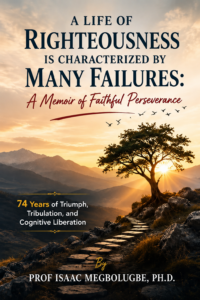
A Life of Righteousness is Characterized by Many Failures: A Memoir of Faithful Perseverance
74 Years of Triumph, Tribulation, and Cognitive Liberation
By Professor Isaac Megbolugbe, Ph.D.
TABLE OF CONTENTS
INTRODUCTION
The Bitter Architecture of High Altitudes
The silence that follows a sudden collapse is deafening. One afternoon, you are sitting in an office built from a decade of sleepless nights, strategic victories, and carefully nurtured ambitions. Your name is etched cleanly on the glass door, your trajectory is pointing straight up, and your identity is securely anchored to the crisp business card tucked inside your leather wallet. The next afternoon, the room is empty. The career is gone, evaporated in the chaotic whirlwind of a corporate restructuring or a swift, clinical HR meeting.
But the loss of a title isn’t what breaks you. It is the quiet, sickening realization of who facilitated the fall.
Relational betrayal has a specific, bitter architecture. It rarely comes from your enemies; it requires the intimate proximity of a confidant, a mentor, or a trusted peer. When the people you swapped visions with become the secret architects of your exit, the pain shifts from a professional setback to a deep, agonizing fracture of the soul. You go home to a quiet house, staring helplessly at the ceiling, surrounded by the raw, jagged debris of a life you no longer recognize. You feel exposed, discarded, and profoundly ruined.
For many years, I believed that if I could just climb high enough, I could outrun this pain. I thought that if I scaled the ladder of opportunity with enough excellence, dedication, and undeniable output, I would eventually reach an altitude where professional sabotage and institutional envy could no longer breathe. I was wrong. What I discovered across a decades-long career stretching from the halls of Ivy League academia to the absolute epicenter of global finance is a sobering truth: climbing higher does not insulate you from ruin. It simply means the raw materials of malice meet you at higher altitudes, where the gravity is stronger, the stakes are global, and the falls fracture the soul.
Modern culture is deeply addicted to a fragile, hyper-curated illusion of instant success, unbroken upward mobility, and self-made perfection. We are told that weakness is a liability, that failure is an indictment, and that a powerful life is one that moves smoothly from victory to victory. Even within the contemporary church, a superficial theology often creeps in, subtly suggesting that righteousness insulates an individual from disaster—that if you walk uprightly, the road will be paved with unbroken prosperity.
This book stands as a fierce, sophisticated, and deeply scriptural counter-narrative to that fragile worldview. When we filter the raw materials of lived experience through the timeless grid of Scripture, we discover a completely different spiritual law. Proverbs 24:16 states: “For a righteous man falls seven times and rises again.” In the economy of God, the number seven signifies completeness. This means a good person will face complete, repeated collapse. They will stumble, they will be sabotaged, and they will experience the devastating loss of earthly monuments.
The paradox of the righteous life is profound:
This memoir is an anatomy of that falling and rising. It tracks a 74-year journey that spans from the dusty classrooms of mid-century Nigeria to high-stakes regulatory battles in Washington, D.C., and eventually to the shattering grief of an empty home. To make sense of such a journey, this book is organized around the three great structural movements of biblical theology: Justification, Sanctification, and Glorification.
CHAPTER 1
The Starting Line of Grace: Understanding Justification by Faith
Justification by faith is the structural foundation of the Christian life, serving as God’s legal declaration that an imperfect person is completely righteous through Jesus Christ. This divine truth upends the common human assumption that acceptance from God is a reward earned at the end of a well-behaved life. Instead, scripture reveals that righteousness is the starting position of the believer’s journey, not the final trophy.
Left to human effort, no person is inherently good or capable of meeting the standard of a flawless God. Justification addresses this spiritual bankruptcy through a judicial verdict. God acts as a righteous judge who pronounces a sinner “not guilty”. The brokenness and failures of humanity are placed onto Christ, while His perfect life is credited to the believer. This imputed righteousness is external, meaning it is given as a gift rather than generated from within human nature. Because of this transaction, God treats sinful individuals as if they possessed the unstained virtue of His Son. It does not mean a person instantly becomes physically perfect; it means their position before the heavenly court is completely secure.
Many religious systems teach that a person must spend a lifetime accumulating good deeds to eventually achieve righteousness. The gospel of grace reverses this order completely. By placing justification at the very beginning of the spiritual path, the pressure of performance is removed. You do not work toward a status of acceptance; you live and work from a status of absolute acceptance.
To fully appreciate this starting position, a clear distinction must be made between the immediate gift of justification and the lifelong process of sanctification. Justification is instantaneous, a legal moment that instantly changes our standing before God; it is entirely by faith with zero works required. Sanctification, on the other hand, is a lifelong, daily process where we are gradually made holy, changing our internal character through active obedience.
Understanding justification by faith liberates modern believers from the crushing weight of legalism and perfectionism. When you realize that your standing with God is securely anchored in the finished work of Jesus Christ, failures no longer define your identity. Instead, every stumble becomes an opportunity to lean back into the grace that qualified you in the first place, allowing you to rise and continue the journey of faith.
CHAPTER 2
Surprised by Favor: The Educational Custom Bridge of 1964
The trajectory of a human destiny is rarely launched from a position of strength. More often, it begins in the quiet, disorienting fog of a setback, where the individual is young, clueless, and utterly unaware that the Sovereign Hand is already arranging the geometry of their deliverance. My life became a laboratory for this supernatural paradox in the early months of 1964.
I was returning to the structured world of formal education after a grueling, vacant four-year hiatus. When the doors of the primary school finally swung open for me again, the reality of my displacement hit me with the force of a physical blow. I was placed in Class One. The room was filled with children who were chronologically and socially in their correct season. I, on the other hand, was oversized, out of place, and deeply self-conscious. Left to the standard systems of men, I was on a trajectory of chronic stagnation. But justification is a gift of status that precedes our performance. Before I had the vocabulary to pray for a way out, God had already stationed an agent of His sovereign favor in the corridors of that school.
His name was Dr. Jide Maiye. He was a Grade Three teacher who possessed a rare, prophetic eye. Where others saw a left-behind, struggling boy trying to hide his awkwardness in a Class One desk, Dr. Maiye saw dormant potential. He took an interest in me—not merely as an administrative data point on a school roster, but as a person.
Dr. Maiye’s approach was entirely unconventional, bypassing the rigid protocols of the school system. One afternoon, he pulled me aside and challenged me to independently study the entire, comprehensive curriculum of Class Two, sit for its final examinations, and earn a direct admission into his Class Three. I was instantly hesitant. The voice of my four-year delay screamed that this was an impossibility. But Dr. Maiye’s confidence in me was infectious. When I could not believe in my own mind, I believed in his belief in me.
True divine favor does not produce human laziness; it demands a furious, disciplined alignment with hard work. Dr. Maiye built a structural scaffolding that turned my raw determination into targeted productivity. He shared the complete, unedited curriculum for Primary Class Two. He provided me with actual teacher’s lessons and supplied a continuous stream of practice examinations. Most importantly, he developed a meticulous, daily schedule that dictated my waking hours, guiding my studies with an unbending rhythm.
I threw myself into this blueprint. I studied with a desperate, focused intensity, devouring the lessons under his watchful, coaching eye. Dr. Maiye was instilling in my fragile psyche a profound, unshakeable sense of confidence and determination that would serve as the neural foundation for the next 74 years of my life. When the day of the Class Two examination arrived, I walked in carrying the structural weight of Dr. Maiye’s mentorship. The investment paid off with clinical precision: I passed the examination triumphantly.
The institutional records were adjusted, and I was formally admitted directly into his Class Three. In a matter of months, the four-year gap that threatened to permanently lag my destiny had been completely neutralized. My experience in 1964 mirrored the divine legal exchange of justification. I did not possess the academic credits or the residency time to sit in Class Three. By all human rules, I was unqualified. But Dr. Maiye extended a sovereign verdict over my life based on potential that only he could discern. He gave me the status of a student capable of skipping a grade, then handed me the exact tools necessary to fulfill that status. God was initializing the value chain of grace in my life.
CHAPTER 3
Unearned Inheritance: The Legacy of Olayinka and the GCE Funds
The economy of the Kingdom of God operates on a currency that completely confounds human logic. In the transactional courts of human systems, you only receive what you have sweated for. But in the deep, unsearchable currents of divine providence, your greatest seasons of acceleration are often entirely funded by an asset you did not produce. Long before I truly understood the profound spiritual mechanics of substitutionary grace, my earthly reality was saved by a tragic, unearned inheritance.
As I moved out of the academic acceleration ignited by Dr. Jide Maiye, I began pursuing the General Certificate of Education (GCE) at both the Ordinary and Advanced levels through the rigorous, internationally monitored correspondence tracks of the University of London. This was an elite, unforgiving gauntlet. But as my intellectual capacity expanded, my material reality hit a severe and suffocating wall. The financial constraints of my environment began to close in like a vice. The cost of registration for the official GCE papers was a mountainous hurdle, and the essential foreign-printed textbooks carried price tags that mocked my empty pockets. I stood at a terrifying crossroads where my dreams were entirely outpaced by my poverty.
Then came the storm that broke my family’s heart. My brother, Olayinka Megbolugbe, was a vibrant, vital pillar of our lineage. But without warning, his time on this earth was cut short. His untimely passing was a sudden, devastating blow that tore through the fabric of our family, leaving behind an agonizing void. Yet, it is precisely within the darkest family tragedies that the Author and Finisher of our faith does His most profound, behind-the-scenes engineering. Following the legal settling of Olayinka’s estate, an unexpected financial windfall was suddenly released: his corporate death benefits.
To a young man staring at a wall of academic exclusion, this sudden influx of capital was nothing short of a miraculous godsend. It was an unearned, unmerited financial inheritance that landed squarely into my empty accounts at the exact moment my educational window was closing. I did not design this provision. It was a tangible, material manifestation of pure grace, entirely subsidized by the legacy of my brother.
When God provides, He establishes a spacious floor of total freedom. The windfall was systematically applied to every single barrier that threatened my future. The funds covered the total, precise registration fees for the University of London GCE examinations. They allowed me to purchase every essential textbook required for both levels, moving me from the margins of borrowed notes into absolute resource ownership. Finally, they fully liquid-funded the ongoing correspondence instruction costs, preventing any disruption in my learning pipeline.
Because of this providential provision, I was able to focus on my grueling studies entirely unencumbered by the suffocating weight of financial anxiety. While my peers were bending under the psychological burden of mounting debt, I walked through that academic gauntlet in total freedom. This chapter of my youth was a living, breathing illustration of justification through the sacrifice of another. In the spiritual realm, we are spiritually bankrupt, entirely incapable of paying the mountainous debt of our own imperfections. But two thousand years ago, our Elder Brother, Jesus Christ, suffered a brutal death on a cross. Through His sacrifice, an infinite spiritual wealth—an unearned inheritance of absolute righteousness—was legally released to our account. God timed Olayinka’s legacy to precede my greatest earthly deficit, proving to my young mind that He is a Father who works masterfully behind the scenes of our deepest grief.
CHAPTER 4
Overturning the Blackbook: Night Sabotage and Total Vindication
A life marked by divine favor will inevitably attract human hostility. When the blessing of God begins to multiply your productivity, it creates a visible contrast that a fallen world cannot tolerate. I discovered in 1971 that the crucible of justification requires facing malicious prosecution. It is an environment where your very dedication is treated as a crime, your excellence is handled as an institutional liability, and your character is subjected to an administrative execution.
I was preparing to sit for my highly critical GCE Ordinary Level papers. To protect my focus from the curious, prying eyes of my peers, I engineered a lifestyle of absolute secrecy. Throughout the entire academic year, I studied clandestinely. When the preliminary evaluations were published, my hidden strategy yielded explosive results: I achieved straight A’s. It was a spectacular feat that caught the attention of the entire campus, sending shockwaves through the standard hierarchies. However, my success bred an immediate, toxic wave of sabotage.
A few senior students from my own hometown were deeply infuriated by my achievements. Their ego could not process how a junior student was thoroughly outperforming the room. Driven by an intense envy, they launched a private investigation to unmask my methodology, eventually discovering my secret sanctuary. Every single night, long after the lights-out bell had rung, I would quietly slip past the guards into empty classrooms. Because the night air was freezing, I would crawl into the narrow gaps between desks, completely covering my body with heavy wool blankets and thick pieces of cardboard to insulate myself from the cold and hide the faint glow of my study light.
Underneath that cardboard canopy, I devoured the University of London curriculum while the rest of the world slept. When my envious hometown peers exposed this routine to the school authorities, they weaponized the institutional legal framework. Night study in the classrooms was a legal privilege strictly reserved for senior students alone. As a junior, my midnight search for truth was a direct violation of institutional law. The disciplinary retribution was swift and severe. I was dragged before the disciplinary board, and my name was entered into the school’s notorious Blackbook. Under its rigid architecture, a single entry was a permanent stain, and three entries triggered an automatic, dishonorable expulsion. With that single, orchestrated stroke of peer malice, I was given two entries simultaneously.
I faced a high-stakes, terrifying choice. A friendly senior student tipped me off that my automatic expulsion was being actively engineered. I made the radical decision to execute a sudden, strategic withdrawal from the school entirely. I packed my books and walked out into the isolation of independent, external study. It was a massive gamble, but my determination was unbending. When the official University of London Advanced Level results were published, the verdict of my labor was undeniable: I had passed triumphantly.
But the earthly legal stain of the Blackbook still existed in the school’s archives. That was when the ultimate sovereign reversal occurred. The school Principal launched a thorough, retrospective review of my case. He unmasked the blatant jealousy of the senior students from my hometown and recognized the deep, systemic injustice that had been inflicted upon my young life. In a grand, sweeping act of institutional justification, the Principal took the notorious Blackbook, bypassed standard protocols, and wiped my disciplinary records completely spotless. He tore down the charges, neutralized the entries, and issued me a clean, unblemished withdrawal certificate. LEGALLY, IT WAS AS IF THE INFRACTION HAD NEVER OCCURRED.
This was a physical masterclass in the mechanics of divine justification and vindication. In the spiritual realm, the enemy of our souls acts as the ultimate malicious prosecutor, constantly investigating our lives, exposing our violations of the law, and logging our failures into a cosmic blackbook. But when you are covered by the value chain of grace, your standing is mediated by the sovereign verdict of the Judge. When the accusations against your name are ironclad, Christ steps into the administrative courtroom of heaven, references His own finished work, and wipes your record entirely white as snow.
CHAPTER 5
The Unsung Shield: Jacob Olowosulu and the Battle for Dignity
There are fragile, interstitial seasons in a human life where you are completely suspended between what was and what is to come. You have survived the initial fires of sabotage, your records have been vindicated by a sovereign clean slate, but you do not yet possess the material platform to secure your own survival. It is in these highly delicate transitions that God proves His favor is a fiercely protective canopy materialized through the courage of human sentinels.
In the immediate wake of my high-stakes exit from the traditional school system, I found myself adrift in a landscape of deep uncertainty. I had sat for my University of London GCE Advanced Level papers, but the long, agonizing silence of the waiting period began. I was a young man with a brilliant academic record but zero economic insulation. I had no home of my own and no institutional backing.
It was during this specific, exposed window that God introduced Jacob Olowosulu into the structural geometry of my destiny. Jacob was a friend and a senior who carried an immense, unbending wealth of conviction. Recognizing my exposed position, Jacob reached out his hand, bypassed the standard boundaries of self-interest, and extended a bold, radical invitation: he brought me into his home in the city of Ilorin to live with him.
Jacob’s decision to take me in was a profound statement of absolute faith in my future. He turned his modest living quarters into a dedicated sanctuary for my soul. He fed me from his own plate, provided for my daily physical needs, and meticulously curated an environment of profound peace that allowed my mind to remain anchored in deep intellectual focus. He shielded me from the exhausting anxiety of survival, ensuring that my transition did not degenerate into a scramble for basic bread.
But a sanctuary of favor will always provoke an interrogation from the metrics of religious and social tradition. Before long, my presence under Jacob’s roof caught the attention of an external observer whose mind was completely trained in the transactional, highly suspicious cultural mechanics of the world. This person approached me privately, launching a sharp, aggressive cross-examination designed to fracture my psychological security and scandalize my name: “Why are you living under the roof of a man who is not a relative? What are you compromising to receive this hospitality? It is an undignified thing for a young man of your capacity to depend on someone who shares none of your blood.”
It was a calculated attempt to weaponize the cultural shame of dependency against my identity. The critic wanted to make me feel small, out of place, and fundamentally fraudulent for accepting a gift of pure grace. Had Jacob wavered for a single moment, the psychological trap would have closed around my mind. But Jacob Olowosulu was a man of steel-cut conviction. When the whispers of social scandal reached his ears, he stood flat-footed as an unyielding wall. He utterly refused to be swayed by the transactional opinions of small-minded men. He confronted the critics, validated my presence in his home, and stated with absolute clarity that I was under his personal protection.
Jacob’s unwavering defense gave me the courage to survive the internal warfare of the waiting season. His actions demonstrated that true kingdom covenant is not a biological accident of bloodlines, but a deliberate choice made by individuals who choose to invest their lives in your destiny. Under Jacob’s protective shield, my academic performance flourished. When the long-awaited GCE Advanced Level results finally crossed the ocean, my grades were exemplary. Because Jacob had preserved my peace and insulated my dignity from shame, I successfully enrolled at the prestigious University of Ibadan. Jacob’s prayers, his quiet wisdom, and his unbending shield had successfully ferried me across the dangerous river of transition.
CHAPTER 6
The Irony of Success: The Battle for the Father’s Name
The highest peaks of early human achievement often directly precede the deepest valleys of personal betrayal. We expect that our victory will be viewed as a collective triumph for the lineage. But the reality of a fallen world is far more ironic and bitter. Success does not merely attract the admiration of strangers; it acts as a powerful diagnostic light that unmasks the latent, unrefined envy lurking within our own domestic circles. I discovered at the absolute peak of my early professional elevation that the final test of the justification phase requires standing firm against the intimate piracy of your own family.
My academic grinding had yielded a spectacular harvest. I had successfully completed my Master’s Degree from Ahmadu Bello University (ABU) Zaria, emerging from that elite institution as a certified, highly competent Town Planner. Upon my graduation, my professional trajectory underwent an immediate, vertical acceleration. The Kwara State Town Planning Authority promoted me to the position of Head of one of its strategic Regional Offices. Concurrently, the state executed a highly sensitive administrative assignment: I was officially seconded back to my own home district to serve as the supreme arbiter and overseer of land disputes.
To understand the weight of this role, one must understand the sociological ecosystem of mid-century Nigeria. In our home district, land was the lifeblood of ancestral identity, economic survival, and tribal legacy. To be the state-appointed overseer of land disputes meant that I possessed immense legal, institutional, and social authority. My signature could validate or invalidate generational claims. At a remarkably young age, I had ascended to a position of profound influence, standing as a prominent, highly respected figure in the very region where I had once been a left-behind boy hiding under cardboard to study. Then came the unexpected, highly calculated strike from my own household.
I was approached privately by one of my own brothers. He came carrying a bizarre, deeply hostile administrative demand from a faction of our relatives. He ordered me to legally change my last name, stripping myself of my father’s name and adopting my grandfather’s name instead. I was completely taken aback. In our culture, your last name is your primary banner of identity, a public declaration of your source and paternal alignment. Why would my own flesh and blood demand that I sever my public connection to my own father at the exact moment that name was bringing immense honor to the community?
The sickening motivation behind this bizarre plot was entirely hidden from me until I walked into the room of my mother. I found her sitting alone, with heavy, silent tears streaming down her weathered face. She looked at me and unmasked the bitter architecture of the family’s demand. My rapid, explosive rise to the pinnacle of regional power had triggered a profound, panic-driven insecurity among my relatives. They looked at my Master’s degree, my government vehicle, and my supreme authority over land disputes, and they became deeply terrified. They feared that my individual success would become so monumental that my father’s name would completely eclipse my grandfather’s name in the regional hierarchy.
They did not see my elevation as an asset to be celebrated; they viewed it as a direct threat to their own perceived status and birthright. Their solution was to engage in a form of identity piracy—forcing me to change my name to shrink my legacy, dilute my influence, and ensure that my achievements remained safely bounded within their controlled family narrative. I was deeply shocked. The revelation that my own family could be so jealous of the very favor that God had poured into our lineage was a sharp, agonizing fracture.
I faced a critical, destiny-defining decision. I could have compromised to keep the domestic peace, changing my name to appease their insecurity and lower the temperature of their resentment. But the years of surviving the school Blackbook and the psychological warfare of the Ilorin critics had trained my soul for conflict. I recognized that this was a demonic attempt to force me to apologize for the favor of God on my life.
I chose to stand completely firm. I flatly refused to change my last name, turning my back on their intense psychological pressure. I looked past their insecurity and anchored my soul in a deeper truth: my success was a sovereign asset given to me by God Almighty, and I had no right to alter the banner under which He had chosen to elevate me. My refusal created a permanent, icy boundary between myself and those envious relatives. But it also triggered a massive release ofinternal freedom. By standing firm against my own flesh and blood, I graduated from the school of justification. I emerged from this 21-year foundational era (1964–1985) completely whole, legally cleared, and structurally positioned on a massive global launchpad.
CHAPTER 7
The Architecture of Betrayal and the Exile of Excellence
The silence that follows a sudden collapse is deafening. One afternoon you are sitting in an office built from a decade of sleepless nights, strategic victories, and carefully nurtured ambitions. Your name is on the door, your trajectory is pointing straight up, and your identity is securely anchored to the business card in your wallet. The next afternoon, the room is empty. The career is gone, evaporated in a whirlwind of corporate restructuring or a swift, clinical HR meeting.
But the loss of a title isn’t what breaks you. It’s the quiet realization of who facilitated the fall. Relational betrayal has a specific, bitter architecture. It rarely comes from your enemies; it requires the intimate proximity of a confidant, a mentor, or a trusted peer. When the people you swapped visions with become the architects of your exit, the pain shifts from a professional setback to a deep, agonizing fracture of the soul. You go home to a quiet house, staring at the ceiling, surrounded by the raw, jagged debris of a life you no longer recognize. You feel exposed, discarded, and profoundly ruined.
For many years, I believed that if I could just climb high enough, I could outrun this pain. I thought that if I scaled the ladder of opportunity with enough excellence, dedication, and undeniable output, I would eventually reach an altitude where professional sabotage and institutional envy could no longer breathe. I was wrong. What I discovered across a decades-long career stretching from the halls of academia to the absolute epicenter of global finance is a sobering truth: climbing higher does not insulate you from ruin. It simply means the raw materials meet you at higher altitudes, where the gravity is stronger and the falls are much harder.
This structural shift marked my definitive transition from Justification—the foundational era of unearned early favor—into the heavy, refining crucible of Sanctification. If justification is the pristine starting line where your legal standing before God is permanently secured, sanctification is the messy, painful road that follows. It is the territory where the rhythmic cycle of the fall and the rise takes place. God does not allow you to tumble to destroy you; He uses the friction of a fallen marketplace to drain you of your self-reliance and shatter the idols you have built out of human titles and corporate vanity.
The pattern began in 1989. I had just stepped away from a highly secure and comfortable role as an assistant professor at Florida State University, eager to plunge into the fast-paced, high-stakes ecosystem of Washington, D.C. I joined the Office of the Chief Economist at the National Association of Homebuilders (NAHB). To an ambitious economist, the NAHB sat at the intersection of public policy, private enterprise, and national economic metrics. I viewed it as the ultimate arena to gain a deep, functional, and unmatched understanding of the housing and real estate development industry.
I entered the building with a posture of absolute dedication. Driven by an intense desire to truly master the field, I began contributing vastly more than what was expected of my role, logging grueling hours and diving into the most complex intellectual sub-strata of the industry. Before long, the sheer scale of my productivity caught the attention of the executive tier. Bypassing the standard, rigid institutional protocols, senior leadership reached down into the hierarchy to task me with a monumental mandate: staffing and driving an industry-wide infrastructure task force. Suddenly, I was the organization’s recognized expert in complex, high-stakes pillars that dictated billions of dollars in development capital: the economics of development impact fees, national affordability indexes, and the intricate actuarial performance of Federal Housing Administration (FHA) loans. My trajectory was vertical, and my momentum felt unshakeable. Then came the end-of-year evaluation.
Summoned to the office of the Chief Economist, I did not enter with anxiety. I walked into the room fully expecting a strategic conversation about scaling my initiatives and receiving the institutional rewards of an extraordinary output. Instead, I was met with the ultimate expression of corporate irony—a polite, highly polished, and clinical exile. The Chief Economist looked at me across his desk and stated: “Isaac, you are simply too talented and gifted to be stuck in an organization like the NAHB.”
It was a staggering revelation. My versatility, speed, and productivity had crossed an invisible boundary. In a system built on predictable hierarchies, a worker who significantly outperforms the room does not inspire leadership—he terrifies them. I had inadvertently become an institutional liability simply by being exceptional. My excellence had triggered a systemic rejection response from the organizational body. To maintain their corporate image, they organized a grand, festive send-off party, printed beautiful certificates, and formally designated me a lifetime alumni staff member of the association. But the gold lettering on the program could not obscure the raw reality of the displacement: I was being polished out of the room because my light made the surrounding mediocrity uncomfortable.
I went home to a quiet house, navigating the deafening silence of a sudden career loss. The business card in my wallet had lost its meaning, and the architecture of the corporate structure I had trusted had collapsed overnight. The “Falling” had occurred, exposing the absolute limits of human systems. But as I sat among the shards of that initial displacement, the “Rising” was already being engineered by the Holy Spirit. Even as the NAHB was processing my corporate exit, I was assigned to represent the industry on a highly prestigious academic search committee tasked with hiring a Chaired Professor at American University. It was a role I handled with my standard commitment to excellence. When the selection process concluded, the elite candidate we chose executed a radical, completely unprecedented demand. He looked at the administration of the university and declared that he would only accept the prestigious chaired position on one condition: the university had to hire Professor Isaac Megbolugbe alongside him.
In a matter of days, the very system that had exiled me to protect its boundaries was used as the legal ferry to launch me onto a new, significantly higher platform in the ivory tower of academia. God was putting a profound law of sanctification on display for my soul: when a human architecture ejects you because of your favor, the Sovereign Master doesn’t just comfort you—He uses their very exit protocols to fund your promotion. I packed my academic notes and moved my books to American University, feeling vindicated but carrying the initial scars of professional sabotage.
CHAPTER 8
The Campus Execution and the Escape to Corporate Machinery
The ivory tower of academia presents itself to the world as a sanctuary of pure intellect, a collaborative haven where ideas are weighed without malice and truth is pursued for its own sake. But beneath that polished veneer lies an entirely different infrastructure. The academic landscape can possess an intensely territorial nature, where peer envy is treated as a strategic currency and the administrative machinery is frequently weaponized to execute anyone whose velocity threatens the surrounding equilibrium.
When I stepped onto the campus of American University as a young assistant professor of finance, I was determined to transcend the standard political traps of the faculty lounge. I entered the department with a deliberate, open posture of radical generosity. Having survived the corporate sifting at the NAHB, I carried no illusions about the fragility of human security. I was a prolific researcher; my files were overflowing with an abundance of active working papers, advanced econometric models, and innovative finance methodologies. Recognizing the immense pressure my colleagues faced to fulfill their publish-or-perish mandates, I chose to act as a lifeline. I actively sought out struggling faculty members who were sinking beneath the weight of tenure requirements. I voluntarily added their names to my own finished, high-caliber working papers, offering these co-authorships as a down payment—a gesture of goodwill designed to establish a vibrant, collaborative culture within our department. I believed that by lifting others, I could build a community of trust.
But my academic momentum quickly accelerated far beyond the insulated walls of the campus, triggering an intervention from the global housing finance grid. One of my former professors at the Wharton School of the University of Pennsylvania had been officially retained by Fannie Mae to author a definitive, benchmark policy paper for the housing industry. Overwhelmed by the sheer scale of the project, she reached down to me, completely delegating the national leadership assignment into my hands. Suddenly, I was the principal investigator of a macroeconomic blueprint. To execute the technical requirements, the Wharton professor placed a highly capable doctoral student under my direct, daily instructional oversight to handle the complex econometric estimations. Meanwhile, I performed the deep interpretive analysis, mapped out the systemic solutions, and wrote the definitive text of the policy paper.
The work caught fire. When Fannie Mae reviewed the completed paper, their executive leadership noticed the sheer brilliance of the regulatory solutions I had constructed. At that specific historical juncture, the housing market was scrambling to comply with complex, newly minted Congressional regulations regarding affordable mortgage business requirements. Recognizing that I possessed an unmatched functional mastery of these mandates, Fannie Mae immediately retained me as a high-level corporate consultant to oversee their implementation strategy. My preliminary policy recommendations were so deeply impactful that Fannie Mae’s executive suite bypassed standard corporate hiring timelines, extending a full-time, high-altitude invitation for me to join the corporation as an executive officer.
But back on the university campus, inside the narrow corridors of my own department, the toxic undercurrent of peer envy had reached a boiling point. One of my colleagues—the very individual who had historically benefited from my research generosity—became thoroughly
infuriated by my national prominence. His ego could not tolerate the reality that an assistant professor in his own department was actively shaping federal housing policy while he was still struggling to secure basic journal acceptances. Furthermore, he mutated our shared research into a source of bitter resentment. He became deeply angry that I was focused on creating large-scale regulatory solutions for the United States housing market rather than prioritizing the completion of minor academic papers designed solely to satisfy his personal tenure application.
Driven by this intense institutional malice, he chose to engage in an act of absolute professional sabotage. He bypassed department protocols and filed an aggressive, distorted report with the Dean of the school, accusing me of abandoning my academic duties for external corporate profit. The Dean, operating on the biased momentum of the complaint, forwarded the charges to the Provost with an explicit recommendation for my summary dismissal. Suddenly, I found myself facing the ultimate professional execution. I was being dragged into the highest administrative court of the university, charged with the institutional “crime” of being exceptional.
When I stood before the Provost, the air in the room was thick with the weight of an impending termination. But as the charges were read, I realized that the enemy had miscalculated the legal floor. I opened my briefcase and laid out the raw, undeniable evidence of my labor: the benchmark Wharton policy paper, the econometric data sheets, and the high-level commendations from the Chairman and executive officers of Fannie Mae. The Provost sat back in his chair, carefully reviewing the documents. The very evidence that had been gathered to orchestrate my destruction became the ironclad instrument of my absolute vindication. He looked past the petty allegations of the department and recognized that my national assignments had brought an immense, unprecedented level of intellectual prominence to American University. The Provost closed the file, looked directly at me, and delivered a staggering verdict that completely overturned the plot: “Professor Megbolugbe, this university is profoundly honored by your work. Do as you please. You have my absolute freedom and backing.”
I had achieved a total, historic victory in the administrative courtroom. The sabotage had collapsed, the charges were erased, and I possessed a permanent, unassailable mandate of freedom from the highest authority on the campus. Legally, I was untouchable. But the damage to my soul was catastrophic. The betrayal of my peers had permanently poisoned the well of academia for me. As I walked down the faculty hallways, looking at the very colleagues who had quietly signed my execution order while accepting the co-authorships of my research, a profound sense of disillusionment settled into my spirit. I realized that no matter how clean your legal vindication is, you cannot safely drink from a well that has been filled with the venom of institutional envy. I made the definitive choice to leave the ivory tower behind. I packed my academic gowns, resigned my position, and stepped full-time into the corporate machinery of Fannie Mae.
This trial was not an accident; it was a divine pruning operation. God allowed my generosity to be met with betrayal to teach my soul a brutal, necessary lesson: You cannot anchor your identity to the praise of human systems, even when those systems are draped in the elegant robes of the ivory tower. Just as the principal had cleared my childhood Blackbook in 1971, the Provostcleared my academic record in the ivory tower. God was demonstrating that His legal protection over my assignment was unassailable. But He allowed the well to be poisoned so that I would possess the structural courage to leave the comfort of campus tenure behind. I was being forced into a wider, higher arena. The corporate machinery of global housing finance was waiting for me, and the stakes were about to become international.
CHAPTER 9
The Gilded Cage: Scaling Mountains Within Fannie Mae
When you enter the upper echelons of global finance, the atmosphere thins and the gravity becomes immense. At this altitude, you are operating an engine that dictates the flow of international capital and shapes the socioeconomic reality of millions of families. I stepped full-time into the corporate machinery of Fannie Mae expecting to find a hyper-rational environment where metrics governed decisions and innovation was celebrated as a corporate asset. Instead, I discovered that the corporate landscape possesses its own clinical, sophisticated immune system. It is an ecosystem where extraordinary productivity is viewed as a disruption to the established hierarchy, and where the entrenched leadership will readily deploy the cold tools of corporate restructuring to isolate and neutralize any voice that threatens to outshine the boardroom.
My arrival at Fannie Mae coincided with an era of profound national tension. The corporation was under intense pressure to comply with newly minted Congressional mandates requiring the inclusion of low-income and minority borrowers in the conventional mortgage market. I was tasked with building the data, analytic, and policy capacity to navigate these complex regulations. Recognizing the scale of the mandate, I refused to play a passive, administrative role. I successfully secured a massive corporate budget to launch and head Fannie Mae’s Proprietary Research Unit. I filled the unit with brilliant minds, establishing an elite intellectual bunker dedicated to mapping the hidden architectures of the housing market.
The first major testing of our unit occurred when the Federal Reserve Bank of Boston published its highly controversial, landmark study exposing significant, systemic racial discrimination in the mortgage underwriting process. The report sent shockwaves through Wall Street and the halls of Congress. The entire housing finance industry scrambled into a defensive posture, attempting to dispute the methodologies to protect their market capitalization. In the midst of this national panic, the Chairman of Fannie Mae personally bypassed the standard layers of executive vice presidents and sought my direct counsel. He looked at me and demanded an objective, mathematically ironclad verdict: “Isaac, is the Boston Fed study accurate, or is it a statistical anomaly?”
I requested the raw, unedited data from the Federal Reserve. My unit locked its doors, re-ran the econometrics, and subjected the data to rigorous, multi-variable regression models. The results were undeniable: the Boston Fed’s findings were not only accurate, but our deeper analysis validated and strengthened the original study, unmasking structural barriers that systematically locked qualified minority borrowers out of homeownership. Armed with my unit’s ironclad data, the Chairman chose to pivot from defense to radical reform. He used our research to propose sweeping market overhauls, authored a major book on housing inclusion, and rapidly ascended to the status of a celebrated national hero and cultural celebrity. But as the Chairman basked in the spotlight of national acclaim, he openly praised my work as the intellectual engine behind his vision. This high-level, public validation triggered a profound, quiet consternation among Fannie Mae’s traditional, entrenched operating management. To them, a transdisciplinary scholar heading an autonomous research unit had become far too visible, far too fast.
Unfazed by the political temperature in the executive suites, I shifted my focus to a stalled housing initiative that the powerful Operating Management Committee had previously dismissed and essentially vetoed. It was the reverse mortgage program—an innovative financial instrument designed to allow elderly homeowners to liquefy their home equity to survive retirement. The traditional corporate leadership viewed the product as too structurally complex and too high-risk for Fannie Mae’s traditional balance sheet. I refused to accept their clinical dismissal. I single-handedly mobilized the entire housing industry, major financial trade associations, and top-tier academic institutions across the country to solve the technical, actuarial, and structural issues required to take reverse mortgages to scale. We re-engineered the risk models, built a new policy framework, and forced the product back onto the executive agenda. We successfully reversed the executive veto. The program was launched nationally, permanently altering the modern financial landscape and providing a financial lifeline to millions of seniors. My unit had proven that we could override the inertia of corporate committees through sheer intellectual and strategic dominance.
Then came the assignment that should have been the crowning achievement of my corporate career. The Office of the Chairman charged me with a definitive, historic task: solve the affordable mortgage problem for deeply marginalized submarkets without exposing the corporation to catastrophic credit defaults. I requested an unbending 18-month window to build a revolutionary mortgage scorecard. This instrument was designed to utilize sophisticated risk-based pricing, utilizing non-traditional data streams to safely evaluate and include low- and moderate-income borrowers who had been systematically locked out by traditional middle-class underwriting templates.
Six months into the project, the data was yielding incredible breakthroughs. But as the scale of my influence and the revolutionary nature of the scorecard became undeniable, the corporate immune system reacted with clinical malice. Threatened by the reality that my unit was essentially rewriting the core underwriting DNA of the corporation, the entrenched operating executives orchestrated a highly sophisticated corporate restructure. Bypassing the Chairman’s immediate protective line, they created a separate entity called the Fannie Mae Foundation. With clinical precision, they transferred me and my Proprietary Research Unit out of the core corporate machinery and exiled us into the Foundation. To make the maneuver look like a legitimate administrative realignment rather than a targeted political execution, they transferred a few other random, non-essential corporate units alongside us.
It was a beautifully constructed, gilded cage. It carried an immense budget, elegant offices, and prestigious titles, but its structural purpose was inescapable: it was designed to silence my voice, sever my connection to the core business, and kill the momentum of the mortgage scorecard. The institution had chosen to isolate the “Braintrust” to preserve the comfort of its entrenched hierarchy. I refused to let my purpose be diminished or my intellect be domesticated inside a corporate museum. Recognizing the architecture of the trap, I made the definitive choice to walk away from the gilded cage. I resigned my executive position at Fannie Mae and transitioned to Price Waterhouse as the Practice Leader for the Global Housing Finance Practice, stepping onto a wider, international stage where the corporate immune system of a single institution could no longer box me in.
CHAPTER 10
The Silenced Blueprint: Bypassing Truth and Global Crash
The value chain of grace is never finished with an environment simply because you have walked away from it. Human pathways are cyclical, but when the Sovereign Hand reroutes your steps back to a battlefield you previously left, it is never to rebuild your old vanity. It is to place you as a prophetic witness to the catastrophic fragility of man-made structures. I had climbed to the peak of international consulting, navigating the complex, chaotic global merger that formed PricewaterhouseCoopers (PwC), and leading their Global Housing Finance Practice across continents. Then came the momentous call.
The former Vice Chairman of Fannie Mae, the very leader who had supervised and championed my original, interrupted mortgage scorecard project, had returned to the corporation to ascend the throne as Chairman. He reached into the global marketplace and summoned me back. He did not ask me to return to the core corporate machinery; he asked me to come directly back to the Foundation to execute a definitive, historic mandate: finally construct the structural architecture to solve the United States affordable housing crisis once and for all.
I returned to Fannie Mae, not as an ambitious young professor or a validation-seeking corporate climber, but as a seasoned braintrust armed with a highly sophisticated, transdisciplinary architecture. Co-developing the model with my esteemed academic colleague, Professor Peter Chinloy, we designed a master blueprint that bridged the gap between raw economic inclusion and unyielding institutional safety. Our model was a development banking framework engineered specifically to bring marginalized low- and moderate-income submarkets into the financial mainstream without exposing the global economy to credit defaults.
The architecture rested upon a protective, multi-tiered structural risk-absorption scaffolding:
It was a watertight, mathematically verified system. It proved that you could extend homeownership to families who had been systematically locked out by traditional templates, provided you maintained an unbending, disciplined protective wall around the capital structure. We handed this blueprint to the leadership of Fannie Mae. It should have been our crowning historical achievement.
What followed was the most catastrophic, fatal betrayal of my life. It was a failure of leadership that transcended professional sabotage, ultimately shaking the very foundations of the global economy. Fannie Mae’s operating executives, driven by the same systemic arrogance and institutional hubris that had plagued my first tenure, chose to bypass the Chairman entirely. Looking at our blueprint, they committed a fatal, historic, and irreversible intellectual error: they conflated submarket inclusion with product deregulation.
They did not want to fund the expensive, disciplined risk-absorption scaffolding we had engineered. Instead, they weaponized my research and public push for minority inclusion as a convenient political shield to hide their own corporate greed. They stripped away our protective scaffolding and began applying standard, middle-class prime underwriting templates directly to highly volatile, marginalized submarkets. They took our intellectual capital, distorted its intent, and transformed it into a massive engine for predatory subprime lending.
When I realized they were using our work to fuel a housing bubble built on sand, I attempted to blow the whistle. I spoke out in executive sessions, warning them that without the risk scaffold, they were injecting pure economic poison into the global financial bloodstream. The institutional immune system reacted with absolute, terrifying force. The corporate apparatus completely muzzled my voice. When the late, globally renowned economist Professor John M. Quigley discovered our research and invited me to present our structural findings at a prestigious academic seminar at the University of California, Berkeley, Fannie Mae’s leadership issued a clinical, explicit executive directive: I was strictly forbidden from going.
To ensure our warnings never saw the light of day, the groundbreaking economic papers that Chinloy and I had meticulously written were abruptly classified as “proprietary intellectual property.” They were snatched from our desks, locked away deep within the Foundation’s secure vaults, and buried where no analyst, regulator, or academic could ever read them. They silenced the blueprint. They buried the truth. They launched the predatory, toxic subprime products onto Wall Street. The rest is history, and the damage to the world was fatal.
In 2007 and 2008, the house of cards collapsed exactly as our suppressed data had predicted. The subprime mortgage engine detonated, destroying trillions of dollars in global wealth, triggering mass foreclosures that ripped through the very minority communities I had dedicated my life to serve, and sending the global financial system into a historic crisis. I stood in the historical wreckage of that global collapse, looking at an industry I had spent decades trying to master, completely broken by the view. It was the most agonizing, heavy “Falling” of my entire professional life. My master blueprint was locked in a vault, my warnings had been suppressed, and the systems I had poured my intellectual life into had weaponized my gifts to trigger global ruin.
But as I sat among the shards of that broken industry, the Holy Spirit executed a profound, monumental pivot inside my consciousness. As I stared at the failure of Wall Street, the Spirit of God whispered into my soul: “Isaac, look at what happens when men build on sand. You have spent decades trying to erect monuments inside systems that are fundamentally built on human arrogance, only to watch them discard your warnings and collapse into ruin. Stop trying to anchor your soul to the broken architecture of men.” This catastrophic betrayal was the ultimate, refining intake valve of my Sanctification phase. God allowed my life’s work to be buried and the global economy to crash to completely cure my soul of the illusion of institutional security.
CHAPTER 11
The Crucible of Mount Sinai: The Final Stripping
If the corporate machinery of global finance fractured my professional ambitions, the decade that followed became an absolute sifting of my soul. It was a season where the gravity did not merely pull down a career; it collapsed my entire earthly reality. In the linear path of human expectation, we console ourselves with the thought that after surviving the catastrophic fires of Wall Street, the twilight of our lives will offer a tranquil harbor—a place of quiet honor, intellectual reflection, and domestic peace. But the road of sanctification is unyielding. Before a life can be completely converted into a living syllabus of grace for Kingdom discipleship, every single remaining idol of the intellect, of the family lineage, and of earthly comfort must be systematically brought to the altar.
I transitioned into the prestigious halls of Johns Hopkins University, serving as a professor for over a decade. I brought with me a lifetime of unmatched, transdisciplinary scholarship across economics, real estate, and global finance. I stood on the precipice of becoming an undisputed star within the institution, poised to lead high-level research tracks that could shape the next generation of academic minds. But the familiar, dark infrastructure of institutional envy was already waiting for me in the ivory tower.
The corporate immune system that had exiled me at the NAHB and muzzled my voice at Fannie Mae duplicated itself with clinical precision within the university. Despite my prolific output and global reputation, I found myself systematically unsupported by the administration. When strategic leadership roles and director positions became vacant—roles for which my real-world braintrust experience made me the most qualified candidate—I was intentionally bypassed, rejected, and quietly sabotaged by the entrenched faculty hierarchy.
This final academic wall broke something deep within my spirit. I looked at a lifetime of ferocious grinding—from the primary school gap of 1964 to the halls of ABU Zaria, American University, Price Waterhouse, and the epicenter of Washington, D.C.—and I realized that the systems of men were fundamentally incapable of validating my existence. I fell into a dark, suffocating despair. The intellectual vanity that had sustained me for decades was completely exhausted. Then, the enemy moved from my professional career to my private sanctuary. The sifting shifted from an institutional execution to the absolute valley of the shadow of death.
The domestic pillars of my life were violently leveled in rapid succession:
I sat alone in a quiet, empty house, surrounded by the raw, jagged debris of a life I no longer recognize. I was completely stripped, exposed, and profoundly ruined. If you had looked into my living room, you would have seen a man sitting on an ash heap like Job, mourning a dead wife, a dead daughter, a broken son, and a sabotaged career. Every single earthly monument I had spent 70 years of sleepless nights building had been utterly flattened.
In the year 2022, standing at the milestone age of 70, I reached the absolute, definitive end of myself. I looked at the shards of my existence and realized a sobering truth: my intellect could not raise my dead wife, my Master’s degree from ABU Zaria could not heal my dead daughter, and my global financial reputation could not pull my son out of the grip of drug addiction. My human strength was zero. It was in that exact coordinates of total bankruptcy that I made the most critical decision of my 74 years on this earth: I executed an unconditional, absolute surrender to God, making Him my exclusive and total sufficiency.
I crawled into the secret place of the Most High, laid my broken mind, my grief, and my shattered legacy at the foot of the cross, and whispered, “Lord, I stop fighting to rebuild Egypt. I have nothing left but You. If You do not hold my soul together, I will sleep in the dust.” This death to self-reliance was the final, devastating, and necessary movement of my progressive Sanctification. God did not allow these tragedies to occur because He had abandoned His justified son. He allowed the fires of Mount Sinai to burn with such intense, unyielding heat because He was executing a holy displacement. He was draining my consciousness of the very last remnants of human pride, corporate validation, and earthly security. By losing my life completely in 2022, I was finally positioned to find it.
CHAPTER 12
Cognitive Liberation: The Awakening of a Son of God
The sovereign reversals of God are often cloaked in the absolute irony of timing. When you are running hard after the validation of the world, scaling the mountains of corporate governance and academic prominence, the systems of men will routinely slam their doors, muzzle your voice, and plot your administrative execution. They will force you into a quiet exile, leaving you to watch your life’s work get buried in deep corporate vaults. But when you finally drop your weapons, crawl onto the altar of total surrender, and die completely to the need for human applause, the very world that rejected you will suddenly come knocking on your door to offer you its highest crowns.
Two years into my quiet cocoon of total surrender, when the ash heaps of my grief had settled into an unbending reliance on God’s sufficiency, the earthly matrix executed a stunning, unsolicited maneuver. It was the year 2024. Without warning or application, I received an official communication from the prestigious Marquis Who’s Whoorganization. They were conferring upon me a high-level Merit Award, recognizing my life’s work as a pioneering, transdisciplinary scholar whose intellectual footprint across economics, real estate, and finance had left an indelible mark on the field.
I was profoundly shocked. I sat in my empty house looking at the letter, feeling an immense, surreal wave of irony. The secular academic and financial world—the very machinery that had suppressed my scorecard, locked away my risk-scaffolding blueprint, and refused me leadership at Johns Hopkins—was now standing on my porch with an award. They explicitly requested an interview to document my legacy, demanding an answer to a singular, perplexing question: “Professor Megbolugbe, we are looking at the consensus of global experts in your field. Why do the top minds universally call you the ‘Braintrust’ of real estate economics?”
If this award had arrived twenty years earlier, it would have fueled my intellectual vanity, validating my self-reliance. But in 2024, the business card no longer held my soul. The idol of academic stardom was dead. God was using this secular milestone not to rebuild my earthly ego, but to build an international launchpad for a radical, supernatural awakening.
Driven by this season of unexpected reflection, I commissioned a comprehensive biography of my father. I wanted to trace the historical pathways of my natural lineage, to understand the raw materials of the bloodline that had carried me from mid-century Nigeria to the high-stakes corridors of Washington, D.C. But what began as a routine historical exploration of my earthly father rapidly mutated into a profound, holy, and intense spiritual encounter orchestrated by the Holy Spirit.
As I turned the pages of my family’s history, the Spirit of God broke through the decades of accumulated trauma, grief, and institutional rejection. He flooded my consciousness with an intense, blinding light that completely shattered every earthly label I had ever worn. The voice of the Lord echoed into the deep chambers of my mind, rewriting my legal status in a single moment: “Isaac, you are not a professor at Johns Hopkins. You are not an exiled executive from Fannie Mae. You are not a certified Town Planner from ABU Zaria. You are not defined by the cardboard you hid under in 1971, nor are you defined by the graves of your wife and daughter. Stop identifying yourself by your scars. You are a direct, legal, fully empowered son of God Almighty.”
This realization was transformational, triggering an instantaneous paradigm shift across my entire existence. I had spent 74 years viewing myself as a servant, a worker, a victim of corporate envy, or a grieving father trying to survive the storms. But when the revelation of sonship exploded in my consciousness, I realized that my adoption was a legal reality backed by the supreme authority of the cosmos. I was not a beggar at the gates of grace; I was an heir of the Kingdom, legally positioned to live from the throne room.
What followed this identity shift was a supernatural phenomenon I can only describe as Cognitive Liberation. The Holy Spirit did not merely comfort my emotions; He entered the actual neurological and psychological infrastructure of my mind, executing a total, systematic restructuring of my mindset. Through continuous promptings, intense scriptural inspiration, and divine illumination, the Holy Spirit began to untangle the knotted, bleeding wires of my lived experience:
My intellect was no longer a human tool used to build temporary monuments on sand. It had been fully liberated, converted into a highly synchronized antenna designed to catch the frequency of heaven and explicate the deep secrets of the Kingdom of God. I stood in my room in 2024, looking at the Marquis Who’s Who award, and I laughed with the joy of an absolute conqueror. The enemy had deployed every weapon in his arsenal—peer envy, corporate exile, intellectual piracy, summary dismissal plots, and the ultimate, crushing blows of domestic death and lineage addiction. He had hit me with the full weight of a 74-year gravity, throwing me to the ground repeatedly. But he failed to realize that the reason the righteous man falls is because his foundation is being hammered into solid rock. Every single fall had drained me of my self-reliance until there was nothing left of Isaac Megbolugbe but the Christ who lived within me.
CHAPTER 13
GIVA Ministries International: The Living Syllabus of Grace
Before a life can be utilized as an unshakeable standard for the Kingdom of God, it must first be brought to the stream. The raw, bleeding materials of our lived experience must enter the value chain of grace. My seventy-four years on this earth have not been a random series of accidents, nor have they been an exercise in tragic futility. The spectacular heights of global housing finance, the pristine corridors of university lecture halls, the clandestine night studies under blankets and cardboard, and even the suffocating ash heaps of domestic grief were all part of a grand, sovereign setup. They were the raw materials being gathered for a final, definitive kingdom assignment.
I am no longer a victim of life’s storms. I am an awakened son of God who has been given absolute authority over them. Out of the ash heaps of my radical 2022 surrender and the 2024 cognitive liberation that followed, the Holy Spirit executed a monumental launch inside my consciousness. He did not call me to retire into quiet, self-absorbed contemplation, nor did He prompt me to build another fragile monument on human sand. Instead, the Spirit of God breathed a clear, thunderous mandate into my newly restructured mind: Erect a global platform to convert your entire life into a living syllabus of grace for modern humanity. Thus was born GIVA Ministries International—God’s Intellectual and Vocal Apologetics.
GIVA Ministries International is not a traditional religious institution built on the shifting sand of human tradition, emotional hype, or denominational legalism. It is a highly specialized, transdisciplinary apologetics machinery designed to explain, explicate, and untangle the deep, majestic realities of Scripture exactly as the Holy Spirit teaches and breathes them into my consciousness. We operate on a unique, three-fold structural grid that mirrors the very value chain of grace that rescued my own destiny:
Modern culture is profoundly sick, suffocating under a fragile, hyper-curated illusion of perfection and self-made security. It is a generation that panics at the first sign of a fall, mistakes institutional exile for total disqualification, and sinks into clinical despair when its earthly monuments collapse. GIVA Ministries stands as an unyielding counter-narrative to this fragile worldview. Through this platform, I teach the global body of Christ the true mechanics of the righteous life. I broadcast a message that was bought with the currency of my own suffering: Your value is not defined by your business card, your title, or your unbroken track record. Your value is anchored in the legal status of your justification by faith.
We teach professionals how to over-contribute in the marketplace without building their altars there. We teach the broken-hearted how to stand over the graves of their losses and see the golden thread of divine providence weaving through the dark. We show the intellectual that true cognitive liberation is not found in the accumulation of academic degrees, but in allowing the Holy Spirit to entirely rewrite the neural pathways of the mind.
At seventy-four years old, I have stepped completely out of the transactional, performance-driven matrix of men. I no longer negotiate with institutions for my worth, nor do I tremble when the corporate immune system attempts to execute my name. I live permanently in the unified, eternal realm of God, experiencing an absolute, unbroken congruence with the divine will. The mortgage scorecard that Fannie Mae tried to bury in its vaults has been resurrected into a spiritual scorecard for Kingdom advancement. The administrative clean slates of my youth have been realized as the permanent, unassailable righteousness of Christ covering my soul. The voices of the critics who tried to scandalize my dignity in Ilorin have been eternally silenced by the voice of the Father declaring, “You are My beloved son, in whom I am well pleased.” The secular world may look at my Marquis Who’s Who award and call me the “Braintrust” of real estate economics, but I stand before you today to declare that my true, supreme title is far more majestic: I am Isaac Megbolugbe—an awakened, empowered, and unshakeable son of the Living God.
If you have walked with me through the pages of this memoir—from the classroom skip of 1964, through the blankets and cardboard of 1971, across the family name disputes of Zaria, into the corporate exiles of Washington, D.C., through the global wreckage of the 2008 crash, and into the dark, silent rooms of my deepest grief—then you no longer have an excuse to stay down. Your stumbles have not surprised God. Your institutional betrayals have not canceled your calling. Your losses have not ruined your legacy. They were simply the severe, refining intake valve of your sanctification, designed to empty you of yourself until there was nothing left but the unyielding strength of the Holy Spirit.
Stop trying to live a flawless human life. Start living a faithful, persistent life. When the gravity of this world hits you, and you find yourself thrown to the floor for the seventh time, look the enemy in the eye, lean back into the sustaining grace that justified you at the starting line, and remember the core baseline of GIVA Ministries: The art of righteous living is simply having the faith to stand up just one more time than you fall. The floor is clean. The foundation is Rock. Turn your gaze to the unshakeable architecture of God’s Word, step into your identity as a son, and let us rise together to change the trajectory of modern humanity.
Isaac Megbolugbe, Director of GIVA Ministries International. He is a recipient of Albert Nelson Marquis Lifetime Achievement Award in business and academia in the United States of America. He is retired professor at Johns Hopkins University and a Fellow of the Royal Institution of Chartered Surveyors. He is resident in the United States of America.
