

Empowered to Choose: Understanding Spiritual Agency vs. The Priesthood of the Believer
Isaac Megbolugbe
April 28, 2026
In Christian theology, empowerment is a central theme—the idea that God does not merely save individuals, but equips them for a life of purpose and action. However, the nature of this equipping is often confused. Two distinct, yet deeply intertwined, constructs are foundational to a robust Christian life: Spiritual Agency and The Priesthood of the Believer.
While both concepts focus on the empowerment of the individual, they operate in different spheres. Understanding the distinction between them is crucial to avoiding a lopsided spiritual life—one that either focuses solely on internal emotion or solely on external religious activity.
The Priesthood of the Believer: Position and Function
The “priesthood of the believer” is a Reformation-era doctrine that broke down the medieval hierarchy between clergy and laity. It is essentially a doctrine of position and access.
Direct Access: It declares that every Christian has direct access to God through Jesus Christ, our High Priest, without needing a human mediator.
Positional Right: Every believer is a priest and a king in the kingdom of God.
Functional Ministry: Every believer is called to minister to others, offering spiritual sacrifices through prayer, service, and proclaiming the gospel.
This doctrine empowers the individual with the theological and positional right to stand before God. It emphasizes what we are in Christ and how we function within the community of faith.
Spiritual Agency: The Enabled Capacity to Act
Spiritual Agency, by contrast, is not merely about access or title; it is about the internal capacity to make voluntary choices that align with God’s will. It is the capacity to act, enabled by the Holy Spirit.
Free Will Enabled by the Spirit: Spiritual agency is the God-given capacity to exercise free will, not in a raw, humanistic sense, but as a will liberated by grace. It is the power to choose faith over fear, holiness over sin, and God over the world.
Capacity to Act: Agency focuses on the “willingness” or the active capacity to turn our wills toward God, to repent, and to follow the promptings of the Spirit.
Individual Responsibility: It implies that each believer is accountable for their actions and has the capacity—via the indwelling Spirit—to make righteous choices.
While the priesthood gives us the right to enter the throne room, spiritual agency gives us the power to make the choice to enter.
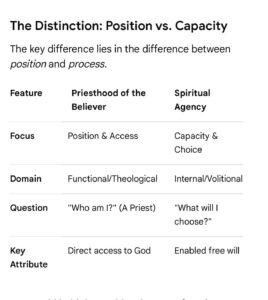
One could hold the positional status of a priest (priesthood of the believer) but fail to exercise the spiritual willpower to walk in holiness (agency). Conversely, spiritual agency without the framework of the priesthood might lead to a works-based mentality, trying to earn God’s favor rather than operating from a position of secured access.
How They Work Together
These two constructs find their perfect balance in the Christian life. Spiritual agency is what allows us to “work out our salvation” (Phil 2:12), which is, in turn, authorized by our position as priests.
The Priest Negotiates God’s Will: As priests, we have direct access to understand God’s truth through Scripture, enlightened by the Holy Spirit.
The Agent Acts on God’s Will: As agents with free will enabled by the Spirit, we act upon that truth, making choices that transform our lives and service.
Conclusion
Spiritual agency and the priesthood of the believer are closely related but distinct concepts. While the priesthood empowers us with the right to access God and minister to others without human mediators, spiritual agency provides the capacity to make choices including faith.
When we grasp that we are authorized priests who are also empowered with the agency to make holy choices, we stop living as spiritual orphans and begin to operate as effective, active participants in the Kingdom of God.
