
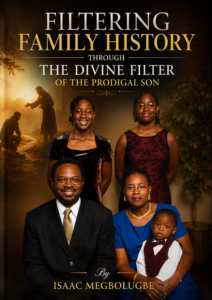
Filtering Family History Through the Divine Filter of the Prodigal Son
By Isaac Megbolugbe
The Living Parable: Filtering Family History Through the Lens of the Prodigal Son
What do you do when the home you built on faith becomes a spiritual battlefield?
For decades, university professor Isaac Megbolugbe watched his family dismantle under the weight of an unseen spiritual war. His eldest daughter spiraled from childhood hyperactivity into the brutal margins of homelessness. His brilliant second daughter rebelled through academic perfection, weaponizing the state against her own parents before her tragic, sudden passing on an Oregon highway. His youngest son dropped out of engineering school, disappearing into the dark grip of drugs and psychiatric wards.
Faced with SWAT invasions, legal assaults, and public humiliation, Isaac made a radical choice: he refused to defend himself. He chose the sovereignty of silence. Anchored firmly in Romans 8:28, he resolved to endure every trauma as if unto the Lord, sustained entirely by future grace.
Then, after years of agonizing silence, the phone rang.
The Living Parable is a breathtaking, contemporary testament that the ancient Gospel is writing its pages in real time. It is a raw, fiercely honest blueprint for any parent standing at the threshold of an empty horizon, waiting for a wandering child. Moving from the trauma of the modern pigpen to the hidden shadows of the “Elder Brother,” this book proves that no distance is too far for the tracking device of prayer—and that God’s grace always gets the final word.
The Living Parable: Filtering Family History Through the Lens of the Prodigal Son
Table of Contents
Dedication
To the memory of my beloved wife, who carried the heavy, exhausting burdens of our home with steadfast devotion, and who labored tirelessly to preserve the peace of our family altar. Your legacy of love remains written in the hearts of our children.
To the memory of my younger daughter, a brilliant soul who fought fiercely for her own identity. Though our journey took us through valleys of deep sorrow and legal storms, I honor the final altar of your repentance. You are wrapped eternally in the Father’sreconciliation.
To my eldest daughter, whose quiet victory, stability, and enduring gratitude fill my father’s heart with joy. Thank you for the transparent openness we share.
To my son, whose return this week proved that no distance is too far for the tracking device of prayer. Welcome home.
And to the family friends in Indianapolis, who acted as the hands and feet of divine protective custody when the road was darkest.
Above all, this book is dedicated to the Almighty God, whose absolute sovereignty is an amazing solid anchor, and whose future grace sustains us in perfect congruence.
Preface
I am releasing this book now as first iteration of our family story because the divine script has just executed its final, long-awaited movement in real time. For decades, my family’s lived experience was a landscape of deep spiritual warfare, hidden generational fractures, public trials, and agonizing silent waiting. I watched my firstborn daughter battle the trauma of homelessness, endured the heartbreaking loss of my brilliant second daughter on an Oregon highway, and bore the heavy silence of a son lost to the grip of drugs and psychiatric hospitals.
Through every wave of distress, I did not strike back, nor did I demand answers from heaven. I anchored my soul completely in the absolute sovereignty of God, standing firmly on the promise of Romans 8:28. I chose to live in perfect congruence, trusting that the endurance required of me was logistically sustained by future grace.
Then, just this week, the silence broke.
The phone rang, and it was my son. Speaking entirely in the spirit of the prodigal son, he reached out across the miles, breaking through years of isolation to simply say: “Thank you for praying for me, Dad.” In that singular, breathtaking microsecond, the waiting was vindicated. The identity of the “religious nut” that he had once hurled at me as an insult was beautifully transformed into a badge of eternal tracking—proving that my prayers had followed him into his darkest “distant country” and safely guided him home.
I am writing this book because families in the contemporary era are fracturing under the quiet weight of identical storms. Parents are giving up on their altars, drowning in the self-defense of their own pride, and buckling under the agonizing silence of estranged children. I release this testimony as an urgent, living proof that the ancient Parable of the Prodigal Son is a breathing manuscript for our times. Do not give up your position at the threshold. The waiting is sacred, God’s sovereignty is an amazing solid anchor, and the script is always beautifully fulfilled in His perfect timing.
— Isaac Megbolugbe
June 2026
Introduction: The Divine Script of Redemption
The divine script of God’s redemption story is a profound masterpiece of grace, justice, and restoration. While the depth of this script can sometimes be hard to fully fathom, it reveals a meticulous plan designed to rescue humanity and manifest God’s ultimate glory. Beneath this narrative lies a massive divine price tag and a transformative framework that alters the eternal destiny and daily reality of every believer. By breaking down the core elements of this script, we can better understand the immense weight and beautiful outcome of God’s redemptive work.
Beneath this cosmic narrative lies a four-part blueprint:
The Parable of the Prodigal Son is more than an ancient story about a broken family; it is a perfect earthly reflection of this divine script. When filtered through a family’s modern-day lived experiences, it ceases to be mere theology and becomes a breathing, contemporary testament that the ancient script of redemption is still active, powerful, and breaking chains today.
Chapter 1: The Gathering Storm
The script of a family, much like the divine script of redemption, never begins in the pigpen. It begins in the home, under the warmth of the father’s roof, where the first quiet fractures of independence and rebellion begin to show. In the Parable of the Prodigal Son, the departure is marked by a sudden, jarring request for independence. In our contemporary family narrative, the departure was not a single dramatic exit, but a slow, agonizing unraveling that began with our firstborn daughter. She was the first sign of a gathering storm we did not yet understand.
The Illusion of Potential
From her earliest years, our eldest daughter possessed an unmistakable, vibrant talent. She was intelligent and full of life, but that life was driven by a restless, hyperactive energy. Seeking to anchor her and channel that intensity into purpose, we poured our resources into her world. We enrolled her in competitive sports, fine arts, and music lessons. She possessed the raw ability to excel in any of them, but she lacked the devotion to commit. She would step up to the edge of greatness, only to refuse to practice and drop out of her enrollment activities.
When she took up swimming, the pattern became fully visible. She loved the water and loved being in the environment, but she was far more interested in spectating from the sidelines than pushing herself to compete. This pattern bled heavily into her education. We moved her from several different schools during her primary school years, desperately searching for an environment that could hold her focus, but nothing worked. The gift of potential was there, but the heart to cultivate it was entirely absent.
The Disruption of the Family Altar
As a father striving to anchor my household in the divine script, my deepest desire was to establish a firm spiritual foundation. I instituted regular family Bible studies and home worship sessions, knowing that a family that worships together stays together. But our family altar quickly became a spiritual battlefield.
Our daughter’s presence in these sessions was entirely disruptive and chaotic. She resisted the structure, fought the stillness, and shattered the peace of the room. Her mother carried the heavy, exhausting burden of trying to settle the children so that I could lead. The atmosphere grew so tense and adversarial that, eventually, I gave up. Losing those home worship sessions felt like a profound defeat. The enemy had successfully targeted the spiritual core of our home, using the chaos of one child to disrupt the spiritual covering of the entire family.
The Lagos Exile and the Label of Deficit
By the time she reached middle school, our daughter simply stopped learning. Her mind had completely checked out of the traditional academic system. In a desperate, loving attempt to break this cycle of apathy, I made a radical decision: I sent her to a high-end, highly structured boarding school in Lagos, Nigeria. I intended it as a rescue mission—a way to shock her system, instill discipline, and pull her out of her destructive drift. But she did not see it as a rescue. She viewed the move as an aggressive punishment, dug her heels in, and utterly refused to cooperate with the faculty.
When she returned home, we pivoted and enrolled her in a local public school. It was there that her struggles were targeted by the system. She was labeled as a hyperactive and attention-deficit child. Her high school years became a blur of clinical intervention, spending her time in both continuous therapeutic counseling and ongoing psychiatric medication throughout her high school years just to cross the graduation finish line.
The Demand for the Inheritance
In the parable, the prodigal demands his inheritance while his father is still very much alive, equating his father’s worth strictly to his bank account. Upon graduating high school, our daughter mirrored this exact spirit. She flatly refused to go to college. Instead, she looked at my professional success and made an audacious demand: because I was rich, she expected me to rent her an upscale apartment and purchase her a sports car. She wanted the lifestyle of fulfillment without any of the labor, sacrifice, or responsibility.
When we refused to fuel her self-destruction, her downward spiral accelerated into a terrifying rock bottom. The contemporary distant country is brutal. Within a short span of time, our firstborn daughter went from a home of abundance to being hospitalized, entirely homeless, and lost in the margins of society.
The Interception of Grace
God’s script, however, is never finished at rock bottom. In our darkest hour, the Lord provided an unexpected sanctuary. Our daughter chose to move to Indianapolis to live with a trusted family friend. This friend, alongside his wife—who happened to be a licensed psychiatrist—became the human instruments of God’s protective custody. They supervised her, coached her through the rigors of college, and provided the clinical and emotional scaffolding she desperately needed.
It was during this structured exile in Indianapolis that the first signs of the long journey home began to bloom. After years of estrangement, she reached out. She did not just ask for money; she asked to be reconnected and reconciled with the family so that she could spend three weeks during Christmas at home.
I agreed to her return immediately, my father’s heart leaping at the chance to see my daughter under my roof again. Her mother stood firmly by my side, ready to support the reconciliation. But redemption is a disruptive force, and its arrival often exposes hidden fractures in those who stayed behind. Our younger daughter did not share our joy. Watching the sibling who had caused years of chaos, broken worship sessions, and parental grief suddenly be welcomed back for Christmas triggered something deep and visceral within her. She turned utterly rageful. Just like the elder brother in the parable who stood outside the feast, furious that the fatted calf was being slaughtered for a rebel, our younger daughter stood at the threshold of this reunion, her anger exposing a whole new layer of brokenness that our family would have to face.
Chapter 2: The Christmas Feast and the Elder Brother’s Shadow
When the prodigal returned from Indianapolis for those three weeks of Christmas, she did not step across the threshold as the chaotic, demanding child of the past. The contemporary distant country had broken her, but the shelter of grace under a psychiatrist’s care had begun a quiet work. She returned calm, anchored by medication, and deeply aware of the fragility of the moment. She treated her stay in our home exactly for what it was: a supreme gift of unmerited grace. She offered to help with chores, rested her weary mind, and worked tirelessly to build a bond with her mother. But while one daughter was learning to walk in the light of forgiveness, she was forced to walk on eggshells within her own home.
The Fracture of the Siblings
The climate inside the house during those three weeks was a stark study in contrasts. Our youngest child, a son still early in his youth, knew nothing of bitterness. He welcomed his big sister back with open arms, providing a pure, uncomplicated joy toher return. But his older sister—our second daughter—flatly refused interaction with her. She erected an invisible wall, projecting a cold, unyielding hostility that filled the common spaces with suffocating tension.
Desperate to restore peace and establish a righteous community under my roof, I invoked my role as the leader of the home. Three separate times, I called a family reconciliation meeting so that everyone could air their grievances. My instruction was clear: every person was to sit at the table and allow us to process the pain together. Everyone cooperated and complied with my instructions and leadership—except for my younger daughter.
The Replay of the Old Blueprint
With the benefit of hindsight, the spiritual mechanics of that Christmas season are now devastatingly clear. My younger daughter was not merely throwing a teenage tantrum; she was operating out of a historical blueprint. Years earlier, the chaotic behavior of her older sister had successfully forced me to abandon our family Bible studies and home worship sessions. Now, seeing her sister restored to favor, the younger daughter weaponized that exact same strategy. She was determined to cause the same chaotic outcome. She wanted to break my leadership, shatter the peace, and force me to abandon the reconciliation meetings just as I had given up on the family altar.
And she succeeded. She was blindingly rageful and utterly disruptive. She blew up the meetings, leaving me paralyzed and completely unsure of what to do. At the time, I lacked the psychologicalself-awareness to recognize the classic Elder Brother shadow dynamics playing out in front of me. I could not see that her rage was the bitter cry of the child who stayed, looking at the returning rebel and screaming inside at the unfairness of grace.
A Misplaced Priority
Faced with a war on two fronts, I made a definitive, tactical choice. I decided that my first daughter’s psychological and spiritual survival was the absolute priority. She was the one who had been homeless; she was the one who was fragile. I poured my protective energy entirely into ensuring she received the deep, uninterrupted nurturing she needed before her three weeks expired and she returned to Indianapolis. My first daughter was my priority, not the younger daughter. I didn’t understand or have the self-awareness of the elder brother shadow dynamics at the time. I just endured and remained patient.
Recognizing my emotional withdrawal, my younger daughter tried to test me whether I would serve her, and I did. I stepped into those moments and served her, trying to keep the peace, completely blind to the fact that she was testing the validity of my love.
The Brilliant, Lonely High Achiever
The tragedy of the Elder Brother dynamic is that the child who stays is often extraordinarily gifted, yet their achievements become armor to hide their deep sense of rejection. Our younger daughter was a force of nature. She was highly gifted. She was the captain of her high school ball team and her club sports team, and she was a deeply gifted cellist. She accumulated accolades and victories, but in her heart, she was keeping a silent, bitter ledger. Years later, she accused me of never truly loving her because I didn’t do for her what I did for her sister, such as taking pictures at her games. I had been too busy managing the volatile fires of her sister’s crises to celebrate her steady, faithful presence.
Yet, despite the emotional warfare raging inside her, her brilliance could not be suppressed. She completed high school with fantastic, flawless academic results. When the college admission season arrived, she achieved the unthinkable: she was the single, solitary student admitted to Johns Hopkins University from her entire high school. She had won the world’s highest praise, but she was stepping onto the grand stage of her future with a heart deeply wounded by the very grace that had rescued her sister.
Chapter 3: The Rebellion of Perfection and the Ultimate Sacrifice
The departure of the Elder Brother is often silent, masked by the applause of the world. When our younger daughter was accepted into Johns Hopkins University, it looked like a triumph of intellect and ambition. But beneath the surface, her departure perfectly mirrored her older sister’s rebellion. While the prodigal rebelled through chaos, the elder sister rebelled through a systematic, brilliant refusal to submit to the path laid before her.
Resisting the Father’s Shadow
Our younger daughter did not want to go to Johns Hopkins University. The reason was heavy and close to home: I was a professor there. She felt stifled by my legacy and desperately wanted to go to American University instead. Because of this resistance, she refused to devote herself to the extracurricular activities needed to win scholarships, such as choosing a major early so that she could earn accolades. For example, she was great at math, but she flatly refused to join the math club and travel with them to tournaments.
This internal warfare bled heavily into her athletic leadership. As the captain of her basketball teams, her character was openly questioned by coaches and parents. I vividly remember a coach pulling me aside and telling me plainly, “Isaac, her attitude is going to affect her altitude.” Because of this friction, he refused to recommend her for scholarships despite her athletic prowess. When she defiantly insisted on attending American University, I told her I would not pay for her to go to AU when the doors to an elite institution like JHU were wide open. She later accused me that I forced her to JHU.
The Trapping of Success
For her first two years at JHU, I stayed with her to provide a structural anchor. Academically, her brilliance exploded. She achieved an elite status as a student; both the Economics and Philosophy departments recognized her genius and wanted her to major in their fields. She said she was attending JHU and I worked with her to excel, but she felt it was largely because of my own reputation. Every corner of the campus felt haunted by her father’s shadow. My colleagues at the Carey Business School embraced her warmly each time she visited me and praised her as a family protégé to her brilliant father.
She was not happy about being compared to her father. In a desperate bid to establish an identity separate from mine, she complained to the Dean of Student Affairs because she thought she was only doing so well because of the reputation of her father. Recognizing the profound depth of her pain, I immediately cut back on my visits and visibility to give her space. It was not enough. In her junior year, without a single word of discussion with me, she dropped out.
The Grace that Angered the Soul
True to the divine script, my response to her collapse was not anger, but a blanket of unconditional understanding. I supported her decision to take a year off. I purchased a comprehensive library of Western Philosophy books for her in case she wanted to read during her time away, and I also suggested travel if she wanted to relax. But all of that didn’t work. Grace can be an agonizing mirror for a heart trapped in an Elder Brother mindset.
With the benefit of hindsight, I now realize she came home for the explicit purpose of engineering the sabotage of my son’s education career, who was a highly gifted and talented kid. She openly whispered sedition into his ear, later saying to me with chilling malice, “If your son rebelled, what would you do?” Ultimately, she stayed to cause her brother to rebel, turning to me in triumph and saying this proved that I was the worst father in the world.
The Courtroom and the Cosmic Cost
The spiritual warfare escalated into terrifying extremes. She promised to send me to prison or wished that I would die early. She took me to court, forcing her own father into a legal battle. Yet, throughout the entire ordeal, the divine script held fast inside my heart. I was too full of grace and understanding. I refused to match her rage with rage, remaining completely patient. This patience drove her to madness. All in all, she was mad that nothing she did upset me, interpreting my absolute composure as a sign that I simply did not care about her.
But the divine script of redemption always requires a closing act of cosmic weight. A few years later, out of nowhere, the breakthrough arrived. The wall of bitterness inside her finally collapsed. She sat down and wrote to apologize for all that she had done to our family. It was her moment of coming to herself.
A few weeks after that letter of apology arrived, she was involved in a ghastly car accident at Oregon. She died instantly. The shockwave of her death tore through our family, but it left behind a profound, holy revelation. Her final act on this earth was not the rebellion of the courtroom, but the repentance of her letter. The Father had allowed her to pour out her rage, but in His infinite sovereignty, He ensured she was clothed in the garment of reconciliation before she crossed the final threshold.
Chapter 4: The Sovereignty of Silence and the Sacred Aftermath
When the news of the fatal accident on that Oregon highway reached us, it did not break my faith. To the human eye, a father losing his brilliant, deeply troubled daughter in an instant is a tragedy beyond words. But when you are fully anchored in the divine script, your perspective ceases to be merely human. Romans 8:28 was my absolute anchor. I trusted God completely. I believed that God allowed her tragic death for a purpose. Because of this posture of surrender, I didn’t ask questions and I didn’t mourn. I simply trusted in the absolute sovereignty of God who gives and takes away.
Grace Under Siege
Long before that final highway, the warfare under our roof had reached staggering extremes. My younger daughter had sought to dismantle my life entirely, weaponizing the state against her own family. She had sent SWAT police to our home on false charges two times. The first time, heavily armed officers arrived at our house ready to arrest me or my wife, only for God to intervene supernaturally in our driveway. The police sergeants would talk to me calmly instead of arresting me or my wife.
Rather than demanding justice or pressing charges against my daughter for a false report, I would end up pleading for her and blamed the behavior on mental illness. I prayed constantly, but I just didn’t understand her rage, and I knew her accusations against my character were not true. Yet, mirroring the silence of Christ before His accusers, I didn’t defend myself. I reached a point of absolute surrender where I chose to go to jail if that would calm her down.
The Hijacked Memorial
The climax of her earthly provocation came during our family’s darkest hour of grief—the passing of her own mother. Even the sacred space of her mother’s memorial service was not immune to her campaign of sabotage. She arrived determined to hijack the memorial service and humiliate me in front of our community. Yet, fueled by a deep reverence for the Lord, I did not resist efforts made by the church to accommodate anything she wanted. My fear and reverence for the Lord did not allow me to react to all her provocations. I focused entirely on my ability and capacity to respond as if unto the Lord, completely yielding my rights and my pride.
The Illusion of the Hardened Heart
In her final years, she had a daughter, believing that the birth of a daughter would finally soften my heart toward her. But this was the ultimate tragedy of her Elder Brother blindness. I knew that my heart was not hardened at all. It had never been hardened against her. It was a heart flowing with an agonizing, patient love that she simply could not comprehend because it didn’t speak the language of conditional, performance-based affection.
I believe in retrospect that God used my unique mindset and attitude to assuage her anger and calm her spirit before she died. That steady, unyielding grace slowly wore down her defenses from afar, creating the spiritual clearance she needed to write that final letter of apology before the accident claimed her life.
Yet, a father’s heart always carries the quiet ache of hindsight. Now that I fully understand what I know now about the elder shadow dynamics—the deep, hidden agony of the faithful child who feels unseen and overshadowed by the crises of the weak—I look back with fresh eyes. I realize that if I had possessed this awareness in the heat of the battle, I might have been able to reach her heart before the highway did. But what is done is done, and it has been sealed by the sovereignty of God.
Chapter 5: The Geography of Healing and the Midnight Call
The final movement of the divine script is never a neat, Hollywood ending where every scar vanishes. Instead, contemporary redemption is a landscape where quiet stability coexists with lingering trauma, and where the dead are miraculously called back to life in the literal span of a single phone call. As the dust of our family’s great spiritual war began to settle, the reality of my surviving children took two entirely different paths.
The Firstborn: A Quiet, Guarded Peace
Our eldest daughter—the original prodigal whose early hyperactivity began the storm—now lives a life of carefully managed boundaries. The distant country left a lasting toll, and she continues to be haunted by her memories of the past. She has suffered a few relapses over the years, but her medication keeps her calm for a few years now. She has courageously embraced her limitations and expectations. Choosing a path of solitary protection, she chose not to date or have children, and she keeps very few trusted people in her circle.
Surprisingly, our father-daughter relationship has never been affected too much by all that has happened through the years of chaos. She looks exactly like my mom, so my affinity for her is pronounced, and she realizes that completely. She respects and is deeply grateful for our open, transparent relationship. Overall, she is stable and happy, but she is still traumatized. A few weeks ago, noticing her memories leaking now and then, I had encouraged her to write down some of her memories as a form of healing. She said absolutely no. She told me plainly that she did not want to remember, choosing to leave those doors permanently closed.
The Son: Trapped in the Strategic Sedition
While the firstborn found her baseline of survival, our son was forced to walk through a psychological wilderness manufactured by his younger sister. She had relentlessly pursued him so as to sabotage him and convince him that I was a terrible dad and alsouseless. I tried desperately to shield him, but he did not listen to my warnings. Ultimately, he began to echo her exact talking points, looking at my devotion and telling me that I was a religious nut and all I ever talked about was prayer.
The sabotage was devastatingly effective. He dropped out of college while studying software engineering at Southern Illinois University at Edwardsville (SIUE). He got heavily into drugs and was hospitalized in a mental hospital for years at a time. In his broken state, he completely cut me out, denying me permission to advocate for him or even inquire about his safety. The silence was absolute and agonizing. Recently, when I began to see his name hijacked by others online, a cold terror gripped my heart. I actually thought he might be dead.
The Phone Rings: Inhabiting the Father
Then, just this week, the divine script executed a plot twist that only the Holy Spirit could orchestrate.
The phone rang, and it was my son. He called this week entirely in the spirit of the prodigal son, broken by the husks of the world and reaching out to the source of his life. In that exact microsecond, I did not hesitate. I instantly inhabited the spirit of the Father in the Prodigal Son parable. I threw my arms around his neck from across the miles without an ounce of condemnation.
As soon as I mentioned the parable and extended that grace to him, the spiritual chains snapped. He began to talk like my true son again, thanking me genuinely for praying for him through all those dark years. Sitting there, listening to the voice of the boy I thought was dead, I remembered the days he had mocked my faith. I remembered him calling me a religious nut, and I said to myself with a smile, maybe it was not too bad an identity after all. My prayers had been his invisible tracking device in the distant country, keeping him alive when his name was being hijacked, and finally guiding him home.
Epilogue: Future Grace and the Congruence of the Kingdom
The midnight phone call from my son did not just signal the return of a lost child; it served as the definitive, ultimate validation of a lifetime of silent endurance. In the economy of God’s kingdom, nothing is ever wasted. When the world demands immediate self-defense, the divine script demands a sacred, agonizing waiting.
The Logistics of Future Grace
To endure the systematic dismantling of your family over decades requires a power that is entirely external to human willpower. God’s sovereignty is an amazing, solid anchor that keeps the soul from drifting into bitterness. In Him, our congruence is entirely assured. Congruence means that who we are in the secret place of prayer aligns perfectly with how we respond when the world throws its worst at us. It means reacting to public humiliation and private betrayal not according to the flesh, but as if unto the Lord.
The waiting is sacred, and the endurance is logistically sustained in future grace—the unmerited favor and strength that arrives exactly when the next wave of trouble hits. When my son called and thanked me for the very prayers he once mocked, the loop of congruence was closed. The identity of the “religious nut” was vindicated.
The Completed Tapestry
Looking across the landscape of my family’s lived experience, the four components of the divine script stand as a completed monument of modern-day revelation:
The waiting was sacred. The endurance was sustained. And the script is finally, beautifully fulfilled. Glory and honor to our Almighty God in the Highest
Isaac Megbolugbe, Director of GIVA Ministries International. He is a recipient of Albert Nelson Marquis Lifetime Achievement Award in business and academia in the United States of America. He is retired professor at Johns Hopkins University and a Fellow of the Royal Institution of Chartered Surveyors. He is resident in the United States of America.

Emotion- ladened with real life lessons
A transforming package for this generation ——Down to earth