
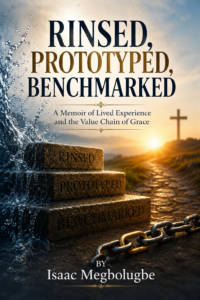
Rinsed, Prototyped, Benchmarked
A Memoir of Lived Experience and the Value Chain of Grace
BY
Isaac Megbolugbe
ILLINOIS, USA
July 2026
Rinsed, Prototyped, Benchmarked: A Memoir of Lived Experience and the Value Chain of Grace
By Dr. Isaac Megbolugbe
Preface: The Processing Floor
There is a distinct type of vertigo that only occurs at high altitudes.
When you spend your life climbing the ladder of professional opportunity, you mistakenly believe that competence is a shield. You assume that if you work harder, think deeper, analyze more precisely, and deliver results that transcend expectations, you will eventually reach an altitude where the petty physics of human envy and institutional sabotage no longer apply. You build a life out of credentials, titles, and budgets, anchoring your identity securely to the systemic validation of your industry.
But climbing higher does not insulate you from ruin. It simply means that when the floor gives way, the fall is catastrophic.
For decades, I operated at the literal epicenter of global finance and national housing policy. I have sat in the evaluation rooms of Washington D.C., navigated the competitive politics of the ivory tower as a finance professor, built proprietary research divisions from scratch, and designed the structural, risk-absorbing economic frameworks meant to protect millions of marginalized borrowers. Yet, at every single peak of my career, I was met with a recurring, clinical phenomenon: the institutional immune system.
When your productivity and versatility outgrow the comfort of the status quo, human systems do not celebrate you—they attempt to exile you. I have had my research papers classified as “proprietary” to bury them, been forbidden by corporate executives from speaking at world-class academic seminars, and been forced to watch from a gilded cage as short-sighted leaders committed fatal intellectual errors that ultimately contributed to the global financial collapse of 2008.
I know what it feels like to sit among the shattered pieces of a brilliant career, holding a suppressed blueprint, wondering how a lifetime of excellence could be weaponized against you.
If you are holding this book, chances are you know that feeling too. You may be standing in the wreckage of a sudden career loss, a profound relational betrayal, an unexpected institutional transition, or a quiet identity crisis that has left you feeling exposed and discarded.
When high-achieving leaders experience this kind of trauma, the standard literary offerings often fall short. Most books on spiritual recovery focus entirely on passive comfort and emotional management. They tell you to hide away, nurse your wounds, and wait for the storm to pass. But high-capacity leaders do not just want to feel better; they want to know what to do with the massive inventory of intellectual and experiential assets they spent a lifetime building. They don’t want a temporary safety net; they want a blueprint.
That blueprint exists. It is found in the ancient, architectural masterpiece known as the Book of Ephesians.
Writing from his own place of extreme structural exile—a Roman prison cell, stripped of his global mobility—the Apostle Paul does not pen a victim’s lament. Instead, he outlines a sophisticated, highly efficient macro-economy of redemption. He reveals that God does not handle human suffering through random damage control. God processes our lived experience through a definitive, forward-moving Value Chain of Grace.
In the corporate world, a value chain is a sequential process by which raw, low-value inputs are systematically refined, transformed, and elevated into a highly valuable, finished output. The premise of this book is that God utilizes the exact same rigorous methodology to process your pain. Grace is not just a pardon for your past; it is an active manufacturing floor designed to convert your hardest lived experiences into unshakeable Kingdom impact.
This book is the tactical manual for that transformation. It is structured around the three progressive movements of God’s value chain:
The pages that follow are not a sentimental memoir, nor are they a dry academic commentary. They are an intimate, fast-paced, and intellectually raw blueprint for spiritual evolution.
If you are tired of merely surviving your exiles, I invite you to step onto the processing floor. Stop trying to climb ladders that were never designed to hold your true destiny. Lay your raw materials at the feet of the Master Architect, let the value chain begin its work, and prepare yourself to take your permanent post on the frontier.
Your ruin was not your conclusion; it was simply the inventory for what God is about to build.
Book Structure
Comprehensive Chapter Summaries
Part I: Rinsed by Grace (The Cleansing & Healing)
Focus: Confronting the wreckage of career loss and betrayal, stripping away false identities, and letting Ephesians 1–2 wash away shame and rejection.
Part II: Prototyped by Grace (The Redemption & Transformation)
Focus: Moving from the cleansing stream into the design studio. Melting down the fragments of the past to construct the “new self” outlined in Ephesians 2:10 and Chapter 4.
Part III: Benchmarked by Grace (The Ambassadorship & Beacon)
Focus: Stepping out as a finished proof of concept. Living as a standard of Kingdom authority, walking in wisdom, and acting as a beacon for others as detailed in Ephesians 5–6.
Chapter 1: High Altitudes, Hard Falls: Inventorying the Raw Materials of Ruin
The silence that follows a sudden collapse is deafening.
One afternoon you are sitting in an office built from a decade of sleepless nights, strategic victories, and carefully nurtured ambitions. Your name is on the door, your trajectory is pointing straight up, and your identity is securely anchored to the business card in your wallet. The next afternoon, the room is empty. The career is gone, evaporated in a whirlwind of corporate restructuring or a swift, clinical HR meeting.
But the loss of a title isn’t what breaks you. It’s the quiet realization of who facilitated the fall.
Relational betrayal has a specific, bitter architecture. It rarely comes from your enemies; it requires the intimate proximity of a confidant, a mentor, or a trusted peer. When the people you swapped visions with become the architects of your exit, the pain shifts from a professional setback to a deep, agonizing fracture of the soul. You go home to a quiet house, staring at the ceiling, surrounded by the raw, jagged debris of a life you no longer recognize. You feel exposed, discarded, and profoundly ruined.
For many years, I believed that if I could just climb high enough, I could outrun this pain. I thought that if I scaled the ladder of opportunity with enough excellence, dedication, and undeniable output, I would eventually reach an altitude where professional sabotage and institutional envy could no longer breathe.
I was wrong. What I discovered across a decades-long career stretching from the halls of academia to the absolute epicenter of global finance is a sobering truth: climbing higher does not insulate you from ruin. It simply means the raw materials meet you at higher altitudes, where the gravity is stronger and the falls are much harder.
The pattern began in 1989. I had just stepped away from a comfortable role as an assistant professor at Florida State University, eager to plunge into the high-stakes world of Washington, D.C. I joined the Office of the Chief Economist at the National Association of Homebuilders (NAHB), viewing it as a tremendous platform to gain a deep, functional understanding of the housing and real estate development industry.
I threw myself into the work. Driven by a desire to truly master the field, I began contributing vastly more than what was expected of my role. Before long, senior leadership took notice. Much higher executive officersbypasses standard protocols to task me with staffing an industry-wide infrastructure task force. I became the organization’s recognized expert in complex, critical pillars: the economics of development impact fees, affordability indexes, and the actuarial performance of FHA loans.
Then came the end-of-year evaluation.
Summoned to the Chief Economist’s office, I expected a conversation about scaling my initiatives. Instead, I was met with a polite, highly polished corporate exile. He looked at me and explicitly stated that I was “too talented and gifted” to be stuck in an organization like the NAHB. My versatility and productivity had crossed an invisible line; I had become an institutional liability simply by outperforming the room.
Though they organized a grand send-off party and named me a lifetime alumni staff member, the underlying truth was inescapable: my excellence had triggered a systemic rejection. Yet, even in that initial displacement, a broader hand was at work. Assigned to represent the industry on a search committee to hire a Chaired Professor at American University, the candidate selected made a radical demand: he would only accept the chair if the university hired me alongside him. I was launched onto a new, higher platform, completely unaware that the exact same pattern was waiting for me in the ivory tower.
At American University, I stepped in as a young assistant professor of finance. Recognizing the pressure my peers faced, I entered with a posture of generosity. As a prolific researcher with an abundance of working papers, I actively sought to help struggling faculty secure tenure, going so far as to add their names to my own papers as a down payment for collaborative work to come.
But my academic momentum quickly accelerated beyond the campus walls. One of my former professors at the Wharton School was tasked by Fannie Mae to author a benchmark policy paper for the industry. She completely delegated the national leadership assignment to me, placing a doctoral student under my direct instruction to handle the econometric estimations while I performed the interpretive analysis and wrote the paper.
The work caught fire. Fannie Mae noticed the brilliance of the solutions and promptly retained me to consult on implementing complex, newly minted Congressional regulations regarding affordable mortgage business requirements. My preliminary recommendations were so impactful that Fannie Mae extended an invitation for me to join the company full-time.
But back at the university, the toxic undercurrent of peer envy was boiling.
Infuriated by my national assignments and resentful that I was creating regulatory solutions for the housing market rather than prioritizing the completion of papers for his personal tenure, a colleague weaponized the administrative system. He reported me to the Dean, who in turn reported me to the Provostfor summary dismissal.
Suddenly, I found myself facing the ultimate professional execution for the crime of being exceptional. When I stood before the Provost, however, the evidence meant to destroy me became my vindication. Upon reviewing the Wharton paper and the high-level commendations from Fannie Mae, the Provost openly praised my diligence for bringing immense prominence to American University. “Do as you please,” he told me, granting me absolute freedom.
But the damage was done. The betrayal of my peers had poisoned the well. Even in absolute victory, I felt deeply rejected and pushed out. I left academia behind and stepped full-time into the corporate machinery of Fannie Mae.
At Fannie Mae, the altitude increased exponentially, and so did the impact of my work. Tasked with building the data, analytic, and policy capacity to help the company comply with affordable mortgage mandates for low-income and minority borrowers, I successfully secured a massive budget to launch and head Fannie Mae’s Proprietary Research Unit.
When the controversial Boston Fed study exposed significant racial discrimination in the mortgage market, the Chairman personally sought my counsel. I requested the raw data, re-ran the econometrics, and generated ironclad results that validated and strengthened the original study. Armed with this data, the Chairman proposed sweeping market reforms, wrote a book, and ascended to the status of a national celebrity and hero—openly praising my work to the profound consternation of the company’s entrenched leadership.
Next, I took a stalled housing initiative that the Operating Management Committee had previously dismissed and single-handedly mobilized the entire housing industry and academia to solve the structural issues required to take reverse mortgages to scale. We reversed the executive veto, permanently altering the modern financial landscape.
Then came the assignment that should have been my crowning achievement. The Office of the Chairman charged me with a definitive task: solve the affordable mortgage problem for marginalized submarkets. I requested an 18-month window to build a revolutionary mortgage scorecard capable of risk-based pricing, designed specifically to safely include low- and moderate-income borrowers who had been systematically locked out.
Six months into the project, the institutional immune system reacted with clinical malice. Threatened by the scale of my influence, Fannie Mae leadership orchestrated a corporate restructure. They created a separate Foundation and exiled me there, transferring a few other random units alongside me to make the maneuver look legitimate. It was a gilded cage designed to silence my voice and kill the scorecard momentum. Refusing to let my purpose be diminished, I walked away, transitioning to Price Waterhouse as the Practice Leader for the Global Housing Finance Practice.
But the value chain of grace was not finished with Fannie Mae, and neither was I.
After navigating the chaotic corporate merger that formed PricewaterhouseCoopers, I received a momentous call. The former Vice Chairman who had supervised my original scorecard project returned to Fannie Mae as the Chairman, and I was subsequently asked me to come back to the Foundation to finally solve the nation’s affordable housing crisis.
I returned, bringing the ultimate architectural blueprint: a development banking model utilizing a protective, structural risk-absorption scaffolding, paired with an Equity Fund co-developed with Professor Peter Chinloy to bridge the risk gap between prime and subprime markets before securitizing default risks into mortgage-backed securities.
What followed was the most catastrophic, fatal betrayal of my life—and it didn’t just affect my career; it shook the global economy.
Fannie Mae leaders, driven by the same systemic arrogance that had plagued my previous tenure, bypassed the Chairman entirely. They committed a fatal, historic intellectual error: they conflated submarket inclusion with product deregulation. Instead of adopting the protective scaffolding I had meticulously designed, they applied middle-class prime underwriting templates to marginalized markets. They weaponized my push for inclusion into predatory subprime products.
When I tried to speak out, the corporate apparatus completely muzzled me. When the late Professor John M. Quigley invited me to present our findings at a UC Berkeley seminar, Fannie Mae explicitly forbid me from going. The groundbreaking papers Chinloy and I wrote were abruptly classified as “proprietary” and buried deep within the Foundation’s vaults so they would never see the light of day.
They silenced the blueprint. They launched the predatory products. The rest is history, and the damage to the world was fatal.
Standing in the historical wreckage of a global financial collapse, I finally understood the profound nature of the floor I was standing on.
Every single time I had climbed higher, my productivity, versatility, and dedication to structural truth had been met with institutional envy, administrative sabotage, corporate exile, and total suppression. I had spent decades trying to build monuments inside systems that were fundamentally built on sand, only to watch those systems weaponize my gifts and discard my warnings.
This is the raw material of ruin. It is the agonizing inventory of career loss and relational betrayal.
But as I sat among the shards of a suppressed blueprint and a broken industry, the Holy Spirit began to shift my gaze away from the broken architectures of men and toward the unshakeable architecture of God’s word. I realized that these painful reoccurrences were not meant to destroy me; they were the intake valve of a divine process. Before a life can be utilized as an unshakeable standard for the Kingdom of God, it must first be brought to the stream. The raw, bleeding materials of our lived experience must enter the value chain of grace—and the very first movement of that chain begins when we allow the profound truth of Ephesians to rinse us completely clean.
Chapter 2: The First Rinse: Stripping the Resumed Identity
There is a distinct kind of psychological vertigo that sets in the morning after a major career displacement.
For decades, your alarm clock didn’t just wake you up; it summoned you to a battlefield where you were needed, recognized, and highly effective. Your identity was seamlessly woven into the titles you carried: Assistant Professor, Director of Proprietary Research, Practice Leader, Global Consultant. You woke up knowing exactly who you were because the corporate and academic systems around you constantly mirrored your value back to you through budgets approved, studies validated, and chairs offered.
But when the office door is locked, the papers are classified as proprietary, and the colleagues who once courted your brilliance abruptly scrub your name from the directory, that mirror is violently shattered.
In the immediate wake of such trauma, our instinctual human defense mechanism is to build a resumed identity. We gather the shards of our broken mirrors and try to piece them back together. We look in the rearview mirror and try to sustain ourselves on the fumes of past prominence. We find ourselves mentally replaying our credentials to an empty room: “Do they not know what I built? Do they not remember that I saved the Boston Fed study? Do they not see that my blueprint could have averted a global catastrophe?”
This is the frantic, exhausting work of trying to resurrect a ghost. A resumed identity is a defensive armor we construct out of our past achievements, our unresolved anger, and our deep-seated need for vindication. We wear it to protect ourselves from the agonizing sting of rejection and the terrifying vacuum of anonymity.
But as I sat in the quiet space of my forced exile, covered in the dust of a collapsed industry and the bitter residue of relational betrayal, the Holy Spirit met me not with a pat on the back, but with a radical, soul-deep demand: Let it go. Let me rinse it all away.
It was during this season of profound disorientation that the opening movement of the Book of Ephesians transformed from a familiar theological text into a restorative solvent. In Chapters 1 and 2, the Apostle Paul does something extraordinary. Writing from his own place of intense structural exile—a Roman prison cell, stripped of his mobility and surrounded by the mocking silence of a world that thought it had sidelined him—Paul doesn’t list his academic credentials as a Pharisee or his past miraculous breakthroughs. Instead, he bypasses human systems entirely and anchors the human soul directly into the celestial ledger of heaven.
“Praise be to the God and Father of our Lord Jesus Christ, who has blessed us in the heavenly realms with every spiritual blessing in Christ. For he chose us in him before the creation of the world to be holy and blameless in his sight. In love he predestined us for adoption to sonship through Jesus Christ…”(Ephesians 1:3–5)
When you bring a life raw with career loss and heartbreak into this text, the first thing you experience is the therapeutic shock of the “first rinse.”
To be rinsed by grace means allowing these ancient truths to wash over the deep-seated stains of rejection, identity crisis, and the bitter residue of betrayal. Consider the profound structural shift Paul introduces here. In the corporate architectures of Washington D.C. or the competitive arenas of the ivory tower, your selection is always conditional. You are chosen based on your performance, your current metrics, and your utility to the existing hierarchy. And as I discovered at the NAHB, the moment your utility outgrows the comfort of the leaders, your selection can be summarily revoked.
But Ephesians declares that your primary selection occurred before the creation of the world.
Think about the sheer weight of that truth. Before Fannie Mae ever existed, before a single mortgage scorecard was drafted, and long before a jealous colleague weaponized an administrative system to report you to the Provost, you were already meticulously evaluated, chosen, and permanently adopted by the Chief Architect of the universe. This choice was not contingent upon your next publication, your corporate title, or whether or not short-sighted executives allowed you to speak at UC Berkeley. It was an unmerited, unshakeable decree of sovereign favor.
When this reality truly hits the bloodstream of a broken leader, it acts as a divine solvent. It begins to rinse away the toxic residue of the corporate environments you left behind:
This first rinse is admittedly painful. It requires a raw, uncomfortable stripping of our professional ego. It forces us to stand entirely naked before God, devoid of our accolades, our budgets, and our national leadership assignments. It asks us to look at the rubble of a fractured career and believe that being an adopted child of God is vastly superior to being a highly compensated asset to a corrupt system.
But this stripping is absolutely essential. The value chain of grace is highly efficient; it never wastes a drop of power. God cannot prototype a new self on the processing floor of His design studio if we are still desperately trying to wear the tattered, defensive armor of our old, resumed identities. Before we can be reshaped as His custom workmanship, the old templates must be completely washed clean. We must let the stream of Ephesians 1 and 2 submerge our trauma, dissolve our bitterness, and remind us of who we are when everything else is gone.
Only when we are thoroughly rinsed can the Creator begin the beautiful, disruptive work of melting us down for the next paradigm of Kingdom impact.
Chapter 3: The Deep Clean: Forgiveness as a Solvent for Betrayal and Global Wreckage
It is one thing to forgive a personal slight. It is an entirely different matter to process a betrayal that alters the trajectory of your life, suppresses your life’s work, and ultimately contributes to a global catastrophe.
When my research was classified as proprietary, when I was forbidden from speaking at UC Berkeley, and when the protective, risk-absorbing development banking models I designed with Professor Chinloy were cast aside, the injury felt deeply personal. But when Fannie Mae’s leadership went around the Chairman and committed that fatal intellectual error—conflating submarket inclusion with product deregulation—the injury became cosmic. They applied middle-class prime templates to marginalized submarkets, birthed predatory subprime lending, and triggered the historic global financial collapse of 2008.
Standing in that historical wreckage, the internal temptation toward a specific, toxic spiritual state is overwhelming: a combination of searing anger and a desperate desire for a public, catastrophic “I told you so.”
You look at the foreclosed homes, the shattered lives of minority and low-income borrowers—the very people you built a scorecard to protect—and you realize the damage is fatal. The human ego screams for vindication. It demands that the architects of this collapse be exposed, that your suppressed blueprints be dragged into the light, and that your enemies be forced to look at the global ruin they caused.
If left unchecked, this demand for vindication hardens into a toxic armor. It keeps you chained to the crime scene of your past, mentally prosecuting your betrayers in perpetuity. But on the processing floor of the Value Chain of Grace, the Holy Spirit introduces a radical, heavy-duty chemical agent designed to break this chain entirely: the solvent of divine forgiveness.
In the second movement of Ephesians, Paul addresses a universe fractured by hostility, systemic brokenness, and deep relational divides. He writes:
“But now in Christ Jesus you who once were far away have been brought near by the blood of Christ. For he himself is our peace, who has made the two groups one and has destroyed the barrier, the dividing wall of hostility… His purpose was to create in himself one new humanity out of the two, thus making peace, and in one body to reconcile both of them to God through the cross, by which he put to death their hostility.” (Ephesians 2:13–16)
When we bring the raw materials of corporate sabotage and global devastation to this text, we must understand the sheer, explosive power of what Paul is describing. The “blood of Christ” is not a passive sentiment; it is aaggressive, systemic solvent. It was poured out to dissolve the most deeply entrenched, historic walls of hostility known to the ancient world.
To apply this solvent to our own lived experience requires a grueling, counter-cultural choice. It means allowing the reality of the cross to put to death our own hostility toward the leaders who betrayed us and the systems that silenced us.
Forgiveness, inside this value chain, is not an act of weakness or an endorsement of corporate malpractice. It is a highly strategic, protective maneuver. When you refuse to forgive the envious colleague at American University who ran to the Provost, or the short-sighted executives at Fannie Mae who locked your scorecard in a vault, you are inadvertently allowing them to continue managing your internal capacity. Bitterness acts as an anchor, keeping your brilliant mind occupied with the preservation of past grievances rather than the creation of future blueprints.
The solvent of forgiveness cleanses the processing floor in three distinct, liberating ways:
This deep clean is the final, essential movement of the Rinsed phase. It strips away the very last traces of the toxic environments you left behind. It ensures that when you step away from the ruins of your old career, you do not carry the smell of smoke or the acid of resentment on your clothes.
The stream of Ephesians 1 and 2 has washed away your false identities, dissolved your shame, and shattered your walls of hostility. You are no longer defined by the career loss, the relational betrayal, or the global wreckage. The raw materials have been thoroughly cleansed, purified, and prepared.
The intake process is complete. Your soul is clean, your mind is free, and the processing floor is clear. Now, the Master Architect can open the doors to the design studio, ready to melt down your healed fragments and begin the beautiful, disruptive work of Prototyping you for an entirely new paradigm of Kingdom impact.
Part II: Prototyped by Grace (The Redemption & Transformation)
Chapter 4: The Divine Blueprint: Entering the Design Studio of the Master Architect
There is a profound difference between a life that is merely healed and a life that is actively being reconstructed.
When you emerge from the cleansing stream of the Rinsed phase, the immediate relief is undeniable. The blinding sting of relational betrayal has subsided. The exhausting urge to constantly litigate your past in the courtroom of your own mind has been dissolved by the solvent of forgiveness. You can finally look at the ruins of your old career—the academic sabotage, the corporate exiles, and the fatal macroeconomic errors of Fannie Mae—without being consumed by bitterness.
But once the dust settles and the noise stops, a new and unsettling vacuum appears. You find yourself standing on a cleared processing floor, looking at the fragments of your former prominence, asking the quietest and most terrifying question a leader can face: Now what?
If you are not careful, this blank canvas can tempt you to slip backward. It is easy to confuse a cleared floor with an empty life. The natural human inclination during this intermission is to run right back to the old construction yards, trying to find another corporate ladder to climb, another housing policy unit to build, or another institution to validate your brilliance. We mistakenly believe that the goal of healing is to simply restore what we lost.
But the Value Chain of Grace never reverses. It is an unyielding, forward-moving trajectory. God does not rinse your past just to return you to the same compromised architectures that broke you in the first place. He clears the floor because He is changing your status from a casual laborer in human systems to a custom prototype in His royal design studio.
This is the pivotal transition point where we step out of the first two chapters of Ephesians and square our shoulders before the monumental declaration of Ephesians 2:10:
“For we are God’s handiwork, created in Christ Jesus to do good works, which God prepared in advance for us to do.”
To fully grasp how your lived experience is processed in this phase, we must look at the original Greek vocabulary Paul uses. The word translated as “handiwork” or “workmanship” is poiema. It is the root word from which we derive our modern word poem. It does not describe a mass-produced, factory-line commodity. A poiema is a singular masterpiece, a highly intentional work of art, a custom design into which a creator pours their utmost skill, passion, and unique expression.
When you enter the Prototyped phase, you are acknowledging that your life is God’s poiema. The career disruptions you endured were not random malfunctions in a chaotic universe; they were the aggressive interventions of a Master Architect extracting His raw materials from environments that were too small for your ultimate purpose.
Think about the sheer intentionality of this design process. In the engineering and corporate worlds, a prototype is built to solve a specific problem that existing models cannot handle. It is a proof of concept. It undergoes rigorous stress testing, melting down, and re-casting until it can withstand the precise pressures of its intended environment.
When I look back at my journey, I realize that God was using the extreme altitudes of my career to stress-test the prototype.
In the design studio, none of these raw materials are thrown away. The Master Architect does not look at your career loss and say, “What a waste of twenty-five years.” Instead, He gathers the econometric expertise, the policy-making brilliance, the global consulting wisdom from PricewaterhouseCoopers, and the deep, empathetic understanding of marginalized submarkets, and He places them all on the drafting table.
He treats your scars as your raw materials. He uses your deep understanding of structural failure to design an unshakeable, structural solution.
Entering the design studio requires a radical shift in your spiritual posture. You must stop viewing yourself as a victim of corporate malpractice and start viewing yourself as a masterpiece in production. You must give the Holy Spirit full creative control to melt down your past achievements and re-cast them into a new self. The blueprint for your future has already been drawn “in advance”—it is waiting for you to stop clinging to the old templates so that the new model can finally be unveiled.
Chapter 5: The Crucible: Melting Down Corporate Habits for the Architecture of the New Self
It is one thing to accept that you are God’s poiema—His custom-designed masterpiece. It is an entirely different, far more agonizing matter to step into the furnace where that masterpiece is actually forged.
In the Value Chain of Grace, the transition from design to reality requires a crucible. Before a new prototype can be cast, the raw, healed fragments of your past cannot merely be rearranged; they must be completely melted down. This is the uncomfortable, deeply disorienting middle phase of the journey. It is the liminal space where you are no longer who you used to be in the corporate boardrooms, but you have not yet fully stepped into the permanent authority of a Kingdom ambassador.
The primary friction in this crucible is not the external opposition of your enemies. The friction comes from the stubborn survival mechanisms, deeply ingrained habits, and reflex reactions you picked up while climbing the ladders of human opportunity.
When you spend decades navigating high-stakes environments like Washington D.C., the ivory tower, and global executive suites, you inevitably build a sophisticated corporate armor. You learn how to protect your intellectual property, how to strategically outmaneuver institutional envy, how to hustle for your own vindication, and how to anchor your security in budgets, titles, and metrics of human validation. These habits were your survival tools in a dog-eat-dog corporate matrix.
But when you bring that same defensive armor into the Kingdom of God, it ceases to be a tool and becomes a major structural blockage.
This is the exact operational tension that the Apostle Paul targets in the second movement of his letter, as he shifts from the grand theology of our identity to the gritty realities of our spiritual execution:
“You were taught, with regard to your former way of life, to put off your old self, which is being corrupted by its deceitful desires; to be renewed in the spirit of your minds; and to put on the new self, created to be like God in true righteousness and holiness.” (Ephesians 4:22–24)
The language Paul uses here is intensely active and uncompromising: put off, be renewed, put on. In the Greek, these terms carry the imagery of stripping off filthy, sweat-stained garments and stepping into entirely new clothing.
In the design studio of the Master Architect, this means the Holy Spirit must systematically strip away the “old self” of the corporate executive to make room for the “new self” of the Kingdom leader. The furnace of grace begins to melt down three specific, deeply entrenched habits that we often try to smuggle out of our past careers:
1. Melting the Habit of Self-Vindication
In the corporate arena, when a colleague tries to summary-dismiss you or bury your scorecard, your natural reflex is to fight back using your own brilliance, data, and political leverage. But in the Kingdom, the new self operates under a completely different defensive template. Ephesians 4 tells us to “let all bitterness, wrath, anger, clamor, and evil speaking be put away from you” (Ephesians 4:31). In the crucible, you have to let go of the right to argue your own case. You have to watch your old templates be discarded or misunderstood by short-sighted leaders, and trust that God is your ultimate vindicator. The furnace melts away the exhausting need to always be the smartest person in the room.
2. Casting Out the Trap of Performance-Based Security
When you are a prolific researcher or a high-level practice leader, your peace of mind is inextricably linked to your current output. If you are producing, you feel secure. But the Value Chain of Grace forces you into seasons of forced stillness—gilded cages or administrative exiles—where your productivity is artificially frozen. This is a deliberate design feature, not a bug. God uses these holding patterns to break your addiction to performance. He melts down the habit of finding your worth in a packed calendar or a massive budget, forcing you to learn the quiet, unshakeable rhythm of being secure simply because you are His.
3. Transforming Executive Drive into Holy Submission
The old self knows how to hustle, manipulate systems, and drive a project across the finish line through sheer force of will. But a Kingdom prototype cannot be driven by raw ambition. It must be led by the Spirit. This requires an incredibly uncomfortable rewiring of your mind. Your intellect, your macroeconomic foresight, and your strategic brilliance must be completely submitted to God’s timing and God’s methods—even when His methods look like foolishness to the financial gurus of the world.
This melting-down process feels like a loss of control. It feels as though the very attributes that made you successful on the career ladder are being systematically stripped away. You feel exposed, less sharp, and utterly dependent.
But do not mistake the heat of the crucible for the fire of destruction. The Master Architect is not destroying your intellect or your hard-won experience; He is burning off the toxic corporate alloy so that the pure gold of your talents can be recast. He is dismantling the executive who builds monuments to human systems, and casting the prototype of an ambassador who can build unshakeable pillars for the Kingdom of God.
Once the old habits are thoroughly melted down, and the mind is completely renewed, the liquid metal of your life is finally ready to flow into the new mold. The prototype is about to take shape, and form will finally follow function.
Chapter 6: Form Follows Function: Realigning Global Expertise for Kingdom Assignments
In the world of architecture and industrial design, there is an ironclad law governing every masterpiece that passes through a master studio: form follows function. A structure is never shaped arbitrarily; its contours, its materials, and its internal reinforcing scaffolding are engineered specifically to fulfill the unique purpose for which it was created.
As you emerge from the intense heat of the crucible described in the Melted Downphase, this law takes center stage on the processing floor of the Value Chain of Grace.
When the Holy Spirit strips away the toxic alloys of your old corporate habits—the defensive posturing, the addiction to human validation, and the frantic hustle for self-vindication—He does not leave you as a blank, featureless slate. He did not burn away your decades of macroeconomic foresight, your deep mathematical mastery of econometric modeling, or your unmatched understanding of global housing finance systems.
Instead, the Master Architect steps up to the casting mold of your life to execute a brilliant act of divine realignment. He takes the exact professional forms you developed while climbing the ladders of academia and global finance and re-casts them for an entirely new, unshakeable Kingdom function.
This is the profound realization that bridges the transitional chapters of Ephesians into the activation of spiritual gifts:
“So Christ himself gave the apostles, the prophets, the evangelists, the pastors and teachers, to equip his people for works of service, so that the body of Christ may be built up until we all reach unity in the faith and in the knowledge of the Son of God and become mature, attaining to the whole measure of the fullness of Christ.” (Ephesians 4:11–13)
When Paul outlines this divine infrastructure, he is demonstrating a macro-level economy of grace. God is an efficient builder; He never wastes a single fragment of a leader’s lived experience. The years you spent navigating high-altitude systems were not a detour or a distraction from your spiritual calling. They were the rigorous field environment where the raw materials of your intellect were being shaped, sharpened, and prepared for a highly specialized deployment within the body of Christ.
Look closely at how your specific professional forms align perfectly with their ultimate Kingdom functions:
1. The Econometric Eye and Spiritual Discernment
For years, your superpower was the ability to take chaotic, highly contested data—like the raw files of the Boston Fed study—and re-run the regressions to uncover the hidden truth of market discrimination. You had the intellectual stamina to look past the political noise and see the mathematical reality. In the Kingdom, this exact same form is repurposed into a high-level function of spiritual discernment. God uses your analytical precision to see through the intellectual errors, superficial trends, and deceptive theological compromises of the world. You are uniquely wired to look at a systemic problem and diagnose exactly where the foundation has drifted from God’s absolute standard.
2. The Scorecard Blueprint and the Protective Scaffolding
When you designed the risk-based mortgage scorecard and the development banking models with Professor Chinloy, you were building a protective framework. Your goal was to create a structural, risk-absorbing scaffolding that would shield low-income and minority borrowers from being exploited by predatory subprime products. You were building a bridge to safely bring the marginalized into a place of stability.
In the design studio, this architectural instinct is elevated to a pastoral and apostolic function. The same heart that fought to protect marginalized submarkets from catastrophic financial systems is now tasked with building structural, grace-centered frameworks that protect the broken, the displaced, and the betrayed from the predatory systems of the world. Your professional blueprint becomes a spiritual roadmap for human restoration.
3. Navigating Toxic Hierarchies and Kingdom Warfare
Having faced administrative execution at American University, executive exiles at Fannie Mae, and total suppression by corporate leaders who committed fatal historic blunders, you have been thoroughly inoculated against the fear of man. You have stood in the highest rooms of earthly power and seen their moral bankruptcy firsthand. This grueling experience forms the heavy armor needed for high-level spiritual execution. Because you know how human hierarchies operate, you cannot be manipulated or intimidated by them. You are uniquely equipped to stand firm as an unshakeable leader who answers only to the Sovereign Ruler of the universe.
This realigning process can feel incredibly validating. It is the moment you realize that God did not call you to abandon your professional brilliance, but to finally unleash it in a realm where it cannot be suppressed. The corporate systems of the world called your versatility a “liability” and classified your papers as “proprietary” because they were threatened by your light. But the Kingdom of God welcomes your scale.
The prototype is now fully formed, cast, and perfectly engineered. The form has met its function. The middle movement of your journey is complete. You are no longer merely a healed survivor recovering from career loss and heartbreak; you are a finished proof of concept, ready to step out of the hidden confines of the design studio.
It is time to enter the final movement of the Value Chain of Grace. You are about to step onto the public stage as a visible, measurable Benchmark—an unshakeable ambassador set as a brilliant beacon for the Kingdom of God.
Part III: Benchmarked by Grace (The Ambassadorship & Beacon)
Chapter 7: Walking in the Light: Re-Entering the Arena with Kingdom Authority
There is a vast, unbridgeable chasm between a leader who enters an arena trying to prove their worth, and a leader who steps into that same arena knowing their worth has already been permanently settled.
When you complete the Prototyped phase of the Value Chain of Grace, the hidden season of the design studio comes to an abrupt end. The Master Architect does not construct a custom, stress-tested masterpiece simply to leave it locked away in a private warehouse. Eventually, the doors are thrown open, the scaffolding is dismantled, and you are called to re-enter the public square.
But as you step back onto the battlefield where you once experienced devastating career loss and relational heartbreak, you quickly realize that everything has changed. You are walking back into the very same industries, academia, or professional spaces that once broke you—but you are not walking back into them the same way.
You no longer carry the heavy, defensive armor of a resumed identity. You no longer carry the limp of a victim looking for an apology or the acid of a survivor seeking a public “I told you so.” Instead, you walk out as a finished proof of concept. You carry yourself with a quiet, unshakeable, and terrifyingly potent posture: Kingdom Authority.
This public deployment is the grand activation point of the third and final movement of the Book of Ephesians. In Chapter 5, the Apostle Paul transitions his readers out of the internal work of character development and thrusts them into a highly visible, confrontational lifestyle of public integrity:
“For you were once darkness, but now you are light in the Lord. Walk as children of light (for the fruit of the light consists in all goodness, righteousness and truth) and find out what pleases the Lord. Have nothing to do with the fruitless deeds of darkness, but rather expose them… Be very careful, then, how you live—not as unwise but as wise, making the most of every opportunity, because the days are evil.” (Ephesians 5:8–11, 15–16)
When Paul commands us to “walk as children of light” and to “expose the deeds of darkness,” he is introducing the exact definition of a Benchmark.
In mathematics, science, and global finance, a benchmark is an unaltering, authoritative point of reference against which other things can be measured, evaluated, and calibrated. It is the gold standard. If a financial system drifts, it is judged by the benchmark. If a metrics template becomes corrupted, it is corrected by the benchmark.
By framing your transformed life as a benchmark, Ephesians reveals your ultimate Kingdom function. God did not just heal you so you could survive your past; He set you as a spiritual standard. Your life—your integrity, your resilience, your refusal to compromise, and your supernatural ability to forgive your betrayers—now acts as a visible, measurable beacon that exposes the moral bankruptcy, intellectual errors, and systemic greed of the world’s broken architectures.
Re-entering the arena as a benchmarked leader shifts your public execution in three revolutionary ways:
1. You Re-Enter with Absolute Immunity to the “Immune System” of the World
When you were driven by corporate ambition, the institutional “immune system”—the jealous colleagues at American University or the short-sighted executives at Fannie Mae—had the power to exile you because they could withhold the titles, budgets, and validation you craved. But when you walk in the light of Ephesians 5, you are completely immune to their tactics. You do not need their permission to be excellent. You do not need their validation to speak truth. Because your authority is derived directly from the Sovereign Ruler of the universe, the human systems that once controlled you lose all their leverage. You can stand in the middle of a toxic corporate structure or a compromised boardroom and remain entirely unshakeable.
2. Your Blueprint Exposes the Darkness Without Saying a Word
When you live as a benchmark of Kingdom righteousness, your mere presence in an industry becomes a source of conviction. You do not have to spend your time frantically screaming about the intellectual errors of those who conflated inclusionwith predatory deregulation. Your healed life, your commitment to protective structures, and your refusal to participate in exploitative practices naturally expose their darkness. Like a lighthouse on a rocky coast, you do not have to argue with the storm; you simply shine so brightly that the ships can see exactly where the jagged rocks of destruction are hidden.
3. You Convert Every Crisis Into a Kingdom Opportunity
Paul instructs us to “make the most of every opportunity, because the days are evil.” When the world’s systems commit fatal errors and collapse—just as the housing market did in 2008—the unprepared panic. But a benchmarked leader recognizes that systemic collapse is the ultimate invitation for Kingdom solutions. When the architectures built on sand inevitably fracture, people look desperately for a plumb line. They look for a leader who has been through the fire, who holds the uncorrupted blueprints of truth, and who can stand steady in the midst of a global shaking. Your past ruin becomes your ultimate credential, authorizing you to guide others out of their own wreckage.
Walking in the light is a bold, high-stakes stance. It means accepting that your life is no longer your own private story; it is a public signpost for God’s Kingdom. You are stepping onto the frontier as an active, visible ambassador. The shadows of your past career loss and the sting of your relational betrayals have been completely overtaken by the blinding clarity of your divine purpose. You are finally positioned exactly where the Master Architect intended: standing firm, shining bright, and acting as an unyielding benchmark of grace that a broken world can look to for direction.
Chapter 8: Credentials of the Scaffolded Soul: The Ambassador in Chains
There is a profound paradox at the summit of spiritual authority. In the kingdoms of this world, ascending to the highest altitudes of leadership means gaining absolute autonomy. The higher you climb the ladder of opportunity, the more power you possess to dictate terms, command budgets, and shield yourself from the friction of accountability. You expect your success to buy your freedom.
But in the Value Chain of Grace, the exact opposite occurs.
When you are thoroughly rinsed, custom-prototyped, and finally set as an unyielding benchmark, you do not step out into unrestricted, self-governing autonomy. Instead, you find your life completely bound to the purposes of the Sovereign Ruler. You are no longer free to hustle for your own career growth, nor are you free to weaponize your strategic brilliance for personal wealth. Your intellect, your macroeconomic foresight, and your hard-won experience are now entirely drafted into the service of a higher Throne.
You have arrived at the ultimate station of your transformation: you have become what the Apostle Paul calls an ambassador in chains.
As Paul draws his letter to a close from the damp constraints of a Roman prison cell, he bypasses the temptation to request an easier path or a release from his physical bondage. Instead, he issues a radical, high-level prayer request that reframes the very nature of human limitation and suffering:
“Pray also for me, that whenever I speak, words may be given me so that I will fearlessly make known the mystery of the gospel, for which I am an ambassador in chains. Pray that I may declare it fearlessly, as I should.” (Ephesians 6:19–20)
Consider the striking irony of that phrase. An ambassador is a high-ranking diplomat sent to a foreign land with the full, backing authority of their home government. They carry the seal of the king. They speak with the weight of an entire nation behind them. Yet Paul—operating at the absolute zenith of his global apostolic authority—is physically bound, locked away by a corrupt Roman matrix that thought it could silence his voice.
When you bring a lifetime of career loss, institutional exile, and relational betrayal to this text, your perspective on your own suffering undergoes a revolutionary shift.
For years, you may have looked at your scars—the moments your research was classified as proprietary, the times you were forbidden from speaking at UC Berkeley, and the devastating corporate maneuvers that hijacked your mortgage scorecard—as proof of your limitation. You might have viewed those systemic “chains” as moments where your momentum was stolen and your voice was minimized.
But through the lens of Ephesians 6, you discover a spectacular truth: your chains are not your limitations; they are your official credentials.
In the Kingdom of God, your scars are the very things that authorize you to speak boldly. Anyone can preach a sermon or draft a theoretical policy paper from the safety of an ivory tower. But a leader who has been thrown into the furnace of corporate envy, who has watched their life’s work suppressed by leaders committing fatal global errors, and who has emerged from that wreckage without a hint of bitterness—that is a leader who carries an undeniable, unshakeable weight of authority.
Your credentials as an ambassador in chains change your public voice in three definitive ways:
1. Your Voice Carries the Weight of an Unbroken Proof of Concept
When you speak now, you are not offering hypothetical philosophies. You are a walking, breathing proof of concept. When you talk about the Value Chain of Grace, you can look the broken, the betrayed, and the displaced straight in the eye and say, “I know the exact texture of the processing floor. I know what it feels like to have your brilliance turned into a liability. And I know that the grace of God is entirely sufficient to rinse you, prototype you, and set you as a benchmark.” Your scars give your words an undeniable gravity that human titles could never buy.
2. You Are Completely Transformed by Holy Fearlessness
An ambassador in chains has nothing left to lose. Because you have already lost the corner office, the academic status, the corporate budgets, and the applause of corrupt hierarchies—and survived—the enemy has completely run out of leverage to intimidate you. You no longer speak to protect your position or to please a board of directors. Like Paul, your only prayer is that words may be given to you to declare the truth fearlessly, as you should. This holy audacity makes an ambassador an incredibly dangerous asset to the Kingdom of Darkness, because you cannot be bought, silenced, or manipulated by the systems of this world.
3. Your Chains Become Your Highest Platform
When Fannie Mae’s leadership locked your research papers in a vault and classified them as proprietary to prevent them from hitting the market, they believed they were burying your voice. They didn’t realize they were actually preserving a divine seed. The very restrictions, exiles, and systemic boundaries you endured became the protective scaffolding God used to keep your spirit uncorrupted by the greed that eventually collapsed the global economy in 2008. Your chains preserved your purity. Now, standing in the aftermath of their failure, those exact same chains serve as the elevated platform from which you can boldly point to the only structural architecture that stands secure: the Kingdom of God.
To live as an ambassador in chains is to accept that your past suffering was never a waste of time. Every betrayal was a custom stress test. Every exile was a sovereign extraction. The Master Architect allowed you to be bound by human systems so that your message could be forged under maximum pressure.
You are no longer mourning the rooms you were pushed out of. You are standing boldly in the chains of your divine calling, carrying the official seal of the King of Kings, fully prepared to utter words of uncompromised truth to a world whose architectures are falling apart.
Chapter 9: The Last Plumb Line: Standing on the Frontier of the Unshakeable Kingdom
Every value chain must eventually deliver its finished product to the market. Every design studio must eventually roll out its final proof of concept. And every leader who has traveled the grueling path from the devastation of ruin to the absolute authority of an ambassador in chains must eventually take their place on the front lines.
You have arrived at the final destination of your journey through the Book of Ephesians. You are no longer standing in the emotional rubble of 1989, wondering why your productivity at the NAHB was labeled a liability. You are no longer sitting in the toxic fallout of American University, bleeding from the blades of peer envy. You are no longer mourning the suppressed blueprints, the classified papers, or the catastrophic, fatal errors of a corporate apparatus that chose predatory subprime deregulation over your protective risk-absorbing structures.
The Value Chain of Grace has done its complete, uncompromised work in you. It has rinsed away your false, resumed identities. It has melted down your defensive corporate habits. It has realigned your mathematical and macroeconomic brilliance for an apostolic function. It has set you as a visible, measurable benchmark of divine integrity.
Now, the Master Architect positions you on the edge of a new horizon. You are called to take your permanent post on the absolute frontier of spiritual warfare.
As the Apostle Paul reaches the thunderous finale of his letter, he drops the diplomatic language of ambassadorship and summons his readers into a permanent, unyielding military posture. Writing from his Roman constraints, he looks past his captors and focuses his gaze on the cosmic invisible structures governing human history:
“Finally, be strong in the Lord and in his mighty power. Put on the full armor of God, so that you can take your stand against the devil’s schemes. For our struggle is not against flesh and blood, but against the rulers, against the authorities, against the powers of this dark world and against the spiritual forces of evil in the heavenly realms. Therefore put on the full armor of God, so that when the day of evil comes, you may be able to stand your ground, and after you have done everything, to stand.” (Ephesians 6:10–13)
Notice the relentless, driving repetition of a single operational command: stand, take your stand, stand your ground, and after you have done everything, to stand.
In the high-altitude corporate and academic arenasyou left behind, the objective was always to climb. You were trained to scramble up the ladder of opportunity, outmaneuver the competition, and secure the next peak of institutional prominence. But on the frontier of the Kingdom of God, the objective shifts from climbing to standing.
To stand means to occupy a piece of territory with such absolute, rooted authority that no amount of corporate betrayal, institutional envy, or systemic collapse can move you. It means becoming an unshakeable plumb line in a world that is experiencing a total structural failure.
When you look out from the frontier today, you see a world desperate for this exact kind of stability. Human systems—whether they are financial institutions like Fannie Mae, elite universities, or corporate matrices—are continuously committing fatal intellectual and moral errors. They are building massive monuments on foundations of sand, conflating true human inclusion with predatory exploitation, and burying the blueprints of truth because they are threatened by the light. The days are undeniably evil, and the shakings are global.
But as a benchmarked leader, you do not look at this wreckage with fear or despair. You look at it with the sober execution of an ambassador who holds the master key to human restoration.
Your life is the evidence. Your journey from career loss and relational heartbreak to complete spiritual evolution is the undeniable proof that when a human life brings its raw materials into the Word of God, the outcome is absolute victory. You are a living testament that grace does not just rescue; it reconstructs.
And so, as we close this book, the processing floor is cleared one final time, and the gaze shifts directly from my story to yours.
What are you currently doing with the raw materials of your own lived experience?
If you are reading these pages while standing among the shards of a shattered career, a fractured family, or a deep relational betrayal, do not commit the fatal error of trying to patch together a resumed identity. Do not waste your precious creative capital trying to climb back up ladders that were never designed to hold your ultimate destiny. And above all, do not let the poison of bitterness calcify your heart into a prison of regret.
Your ruin is not your conclusion. It is merely the intake valve.
I challenge you today to take the raw, bleeding, and chaotic fragments of your history and drag them onto the processing floor of the Word of God. Surrender your credentials to the Master Architect. Let the profound stream of Ephesians 1 and 2 submerge your trauma and rinse you clean. Step boldly into the crucible of Chapter 4 and allow the Holy Spirit to melt down your defensive habits. Trust the design studio as He shapes your unique poiema, realigning your hardest lived experiences into your highest Kingdom functions.
The frontier is waiting for you. The Kingdom of God does not need more casual laborers trying to build earthly monuments; it needs stress-tested, unshakeable prototypes who can step into the arena as official ambassadors of the King. Bring your raw materials to the stream today. Let the Value Chain of Grace begin its work. And when the day of evil comes, and the systems of this world inevitably collapse, you will not fall with them. You will watch the dust settle, you will adjust your armor, and you will fearlessly, unshakeably stand.
Chapter 10: The Inclusionary Imperative: Why Scaffolding, Not Deregulation, Is the Future of the American Economy
The journey through the Value Chain of Grace is never a closed loop. God does not pull an ambassador out of the fire of systemic ruin, rinse away their false identities, and prototype them into a custom masterpiece just so they can retreat into a cloistered, private spirituality. The ultimate proof of concept for a benchmarked leader is that their personal transformation overflows into a structural solution for modern humanity.
When you truly accept your assignment as an ambassador for the Kingdom of God, your personal scars become your public credentials, and your hard-won professional expertise becomes the vehicle for global discipleship.
Nearly three decades in the economic engine of Washington, D.C., leaves an indelible mark on your perspective. My professional journey has wound through the Office of the Chief Economist at the National Association of Home Builders, the lecture halls of American University and Johns Hopkins University, the corporate corridors of PricewaterhouseCoopers, and the systemic heart of housing finance at Fannie Mae. Across these distinct vantage points—spanning industry research, academia, consulting, and secondary capital markets—I have observed a singular, unyielding truth: an inclusionary economy and community is the only righteous and sustainable system for the United States and the world.
This is the core of the ambassadorial message. The Kingdom of God is, by its very nature, an inclusionary kingdom. It is a system designed to seek out the marginalized, the locked out, and the broken, and provide them with a structural pathway into the full inheritance of sons and daughters. And because the laws of God’s Kingdom are the ultimate blueprints for reality, this inclusionary imperative is not just a theological ideal—it is the literal solution that can save our failing earthly economy.
Whether evaluating housing finance, mortgage access, healthcare delivery, or small business ventures, true economic durability relies on inclusion. Inclusion is not a charitable afterthought; it is the ultimate value proposition. True progress occurs when we intentionally build the scaffolding necessary to transform marginal submarkets into the architecture of the mainstream.
Unfortunately, the prevailing orthodoxy of human systems has too often favored product and market deregulation. This choice empowers predatory entities to extract wealth from struggling sectors under the guise of “market efficiency,” rather than allowing those nascent opportunities to fully ripen.
When the leaders of Fannie Mae bypassed the Chairman and committed that fatal intellectual error—conflating submarket inclusion with product deregulation—they chose the path of predation. They took the vulnerable, low-income, and minority borrowers who desperately needed a protective asset-building structure and threw them into a lawless subprime matrix without any risk-absorption scaffolding. They called it “market efficiency.” The result was the complete destruction of wealth in marginalized communities and a fatal collapse of the global financial system.
This is exactly what happens when the world tries to achieve inclusion without grace, and access without structure. Deregulation strips away protection. It leaves the weak at the mercy of the predatory.
But the Kingdom of God operates on the principle of Scaffolding.
When the Apostle Paul outlines the infrastructure of the church in Ephesians 4, he notes that leaders are given to “equip” and “build up” the body until it reaches maturity. That is spiritual scaffolding. It is the intentional creation of a temporary, highly supportive, and protective framework designed to hold a developing entity safe until it grows strong enough to stand on its own two feet.
When applied to modern economics, the Inclusionary Imperative demands that we stop using reckless deregulation to exploit marginalized submarkets. Instead, we must use the developmentbanking business models and protective risk-absorption scaffolding that I spent my life designing. We must build bridges, not traps. True economic discipleship means using our macroeconomic foresight to construct systems where the marginalized are not merely included to be plundered, but are structurally reinforced to become vibrant, wealth-generating architectures of the mainstream.
As an ambassador standing on the frontier, this is your final charge.
The raw materials of your life—the insights you gained in the boardroom, the data you mastered in research units, and the pain you endured through institutional betrayal—were preserved for this exact moment. You have been positioned to show a collapsing world that the only way to save the economy is to align it with the unshakeable righteousness of the Kingdom of God.
We must stop building monuments on sand. We must reject the predatory efficiency of deregulation. We must step out with the authority of benchmarks and build the scaffolding of grace, ensuring that the future of our economy, our communities, and our nation is rooted in an unshakeable foundation of true, protective, and righteous inclusion.
Back-Cover Blurb
What happens when you bring the raw, shattered pieces of a ruined life into the refining fire of God’s word?
When the career you spent a lifetime building collapses overnight, and the people you trusted most walk away in betrayal, the wreckage can feel absolute. In the wake of profound loss, we often view grace as a mere safety net—a consolation prize for our pain. But the Book of Ephesians reveals something far greater: grace is a dynamic, transformative value chain designed not just to comfort us in our ruin, but to reconstruct us into ambassadors for the Kingdom of God.
In this deeply vulnerable, intellectually gripping memoir, Isaac Megbolugbe invites you onto the processing floor of spiritual transformation. Sharing the raw materials of a three-decade career that wound through the National Association of Home Builders, American University, PricewaterhouseCoopers, and the systemic heart of housing finance at Fannie Mae, they map out a revolutionary journey of redemption through the lens of Ephesians:
But the Value Chain of Grace does not end with personal healing. The ultimate proof of concept for a benchmarked leader is a public, world-changing resolution: The Inclusionary Imperative.
Drawing on the architectural blueprints of Ephesians, this book delivers a prophetic alternative to a failing global system. It exposes how human systems continuously commit the fatal error of substituting reckless deregulation for true protection, devastating the vulnerable. By contrasting predatory market systems with the Kingdom principle of structural scaffolding, Megbolugbe demonstrates that a righteous, inclusionary economy is the only sustainable path forward for our communities, our nation, and our world.
Rinsed, Prototyped, Benchmarked is more than a story of surviving betrayal and loss; it is a tactical blueprint for spiritual and economic evolution. If you are ready to see your hardest lived experiences converted into Kingdom impact that can reshape modern humanity, your journey through the value chain of grace begins here.
Isaac Megbolugbe, Director of GIVA Ministries International. He is a recipient of Albert Nelson Marquis Lifetime Achievement Award in business and academia in the United States of America. He is retired professor at Johns Hopkins University and a Fellow of the Royal Institution of Chartered Surveyors. He is resident in the United States of America.
