
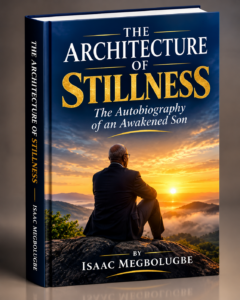
The Architecture of Stillness:
The Autobiography of an Awakened Son
BY
Isaac Megbolugbe
ILLINOIS, USA
October, 2026
The Architecture of Stillness:The Autobiography of an Awakened So
By Dr. Isaac Megbolugbe
The Architecture of Stillness: The Autobiography of an Awakened Son
By: Isaac Megbolugbe
Founder and President of GIVA Ministries International
Preface: The Twin Pillars of the End-Game—An Ambassador’s Final Report
The compilation of any multi-volume work requires an understanding of trajectory. When I first received the divine mandate to pen ten digital books, I knew I was not embarking on a journey of casual religious reflection. I was entering a theater of deployment. The first eight volumes of this series served a specific, diagnostic purpose: they were designed to filter seventy-four years of lived empirical experience through the strict, unyielding lens of Holy Scripture, exposing the fault lines of a modern civilization that is fracturing, decaying, and actively drawing upon itself the righteous wrath of God.
But diagnosis without direction is a half-measure. As I stand in the twilight of my seventies, operating in the absolute solitude and celibacy I have chosen to protect my assignment, the Lord has demanded the release of the final two blueprints.
Volumes 9 and 10 are the twin pillars of this entire mandate. They do not merely analyze the collapse; they provide the administrative and strategic machinery required to survive and triumph within it. If the first eight books taught you how to see the world through God’s eyes, these final two volumes teach you how to execute King Jesus’s agenda while stationed on an increasingly hostile planet.
In Volume 9: The Ambassador’s Ledger, we address the mechanics of order. True kingdom work is never chaotic. Drawing upon the foundational disciplines of my youth—from the structured responsibilities of a headmaster’s houseboy to the rigorous self-reliance of living entirely alone at twelve in Mopa-Ileteju—I lay out the administrative frameworks necessary to govern your time, your mind, and your resources. This is a manual for the structural execution of divine directives inside human institutions that are actively rotting away.
In Volume 10: The Sovereign Blueprint, the narrative shifts from internal administration to external, high-level diplomatic warfare. Here, we explore the legalities of our heavenly citizenship. As an awakened son of God, you are not a victim of this decaying century; you are an ambassador with diplomatic immunity, backed by the full weight of a celestial government. This final volume provides the prophetic and apologetic strategies required to disciple the remnant, holding your ground with an unshakeable, self-contained confidence until your ledger is balanced and your race is run.
To the reader who has journeyed with me this far: do not look at the decay around you with fear. A fracturing world is simply the backdrop against which the sovereignty of God shines brightest. Read these final pages not as a textbook, but as an operational briefing. The King has issued the mandate. The blueprints are in your hands. It is time to execute.
Introduction: The Misunderstood Fortress
They called it pride. For as long as I can remember, that word has drifted toward me from the edges of crowded rooms, from well-meaning relatives, and from a society that measures a man’s worth by the volume of his voice and the size of his crowd. I never argued with them. When you are genuinely content within your own skin, you feel no burning need to correct another person’s flawed draft of your life. What they mistook for arrogance was actually something entirely different: discipline, an uncompromising self-sufficiency, and a quiet, unshakeable contentment.
I have always been a man of small circles. Even as a young man, I guarded my privacy like a rare currency and cherished my autonomy above social acceptance. Yet, it took the heaviest silence of my life to show me that the boundaries I had built were never meant to shut the world out—they were designed to keep my true self intact.
When my wife passed away, the world immediately rushed forward with its mandatory script for grief. Well-intentioned onlookers expected the predictable trajectory: the desperate reaching out, the frantic filling of empty spaces, and the eventual search for a new companion to ward off the dark. Instead, I stepped backward into the quiet. I made the conscious, deliberate choice to embrace absolute solitude and celibacy.
To the outside world, this looked like a retreat—a tragic surrender to sorrow. But as the months turned into years, and those years carried me into my seventies, a profound reality unveiled itself. This stillness was not a reaction to death; it was an arrival. The loss of my spouse, devastating as it was, stripped away the final external expectations of who I was supposed to be. In the raw, unfiltered quiet that remained, I did not find a broken stranger. I found the man I had always been, finally fully realized.
Chapter 1: The Soil of Self-Assurance in Kabba
To understand the solitary man standing in the twilight of his seventies, one must travel back to the dawn of his life in Kabba, Nigeria. The foundation of my self-sufficiency was laid early, born out of a sudden absence. My father died when I was only three years old. For a brief window before primary school, it was just my mother and me. But survival demanded her presence elsewhere; she was a trader, constantly traveling to rotating markets across our local marketing region.
Left to navigate the world, I did not falter. Instead, I built my first sanctuary: a tightly knit playgroup of about seven boys. We operated on an unwritten code—a strict quorum of at least four was required before the game could begin, and as their leader, I anchored them. While my mother traded on the road, the neighborhood adults and community elders watched over us with a communal vigilance. We were fiercely protected, deeply loved, and entirely secure.
This environment did not make me lonely; it made me bulletproof. The profound village care of my early years injected me with a deep-seated self-confidence and an unshakeable self-assuredness. I knew exactly who I was, and I knew I was safe in my own skin. That internal anchor stayed with me throughout my entire childhood and youth.
When primary school finally arrived, the pull of my sanctuary was too strong. I drifted away from the classroom to play with two members of my group. My mother, recognizing my fierce independence, chose a structured path to harness it. She placed me in the home of the school’s Headmaster, where I became his houseboy. Rather than resenting the placement, I leaned into it. I embraced the rigid roles and heavy responsibilities of the household with a quiet pride.
The following year, my mother sent me further away to Ifaki-Ekiti to live with a trusted friend. It was here that my apprenticeship in autonomy truly intensified. My guardian didn’t just give me chores; she trained me in the fine arts of survival. Under her watchful eye, I mastered running errands, homemaking, cooking, and laundry. She also took me to the fields, embedding the grueling, rhythmic discipline of farming deep into my muscles.
By the time I returned home to Kabba, the boy had become entirely self-contained. My mother recognized this evolution, and at the tender age of twelve, she allowed me to live completely alone in Mopa-Ileteju while attending school.
Living on my own at twelve would have broken many, but for me, it was a profound liberation. I established a rigorous daily rhythm that I guarded fiercely. Every single evening, without fail, I studied for exactly two hours. That discipline yielded a flawless reward: I maintained the first position throughout my entire elementary school career.
I financed my own life. I hired myself out to local farms to earn money, sweating under the sun to secure my bread. Later, I was hired as a gardener to maintain the pristine grounds of the Christian Mission compound at Mopa. I learned to cut the grass, tend the soil, and respect the labor of my own hands. This early molding created a lifelong baseline. Whether I was a bachelor navigating university, a student managing meager resources, or a married man building a household with my wife, I remained entirely hands-on. I never relied on others to do for me what I could do for myself.
Chapter 2: The Ledger of Excellence and Partnership
True discipline is not a temporary shield; it is a permanent posture. The same twelve-year-old boy who studied for two hours every evening in the quiet rooms of Mopa-Ileteju grew into a man who approached every milestone of his adulthood with an identical, quiet ferocity. The world often looks at a successful career or a resilient marriage and calls it luck. But looking back from the vantage point of my seventies, I see a single, unbroken thread of focused labor, self-reliance, and an absolute dedication to excellence.
My education was the first major testing ground for this lifelong commitment. From the rigid structures of secondary school through the intense intellectual demands of my undergraduate, graduate, and doctoral studies, I experienced an exceptional educational career. I remained ruthlessly studious and hardworking. I did not view higher education as a mere stepping stone, but as a sacred duty to my own potential. I worked while others slept, refining my mind with the same precision I once used to tend the grounds of the Mopa Christian Mission compound.
This unyielding work ethic seamlessly translated into my professional life. Across a multifaceted career that spanned academia, private industry, and ministry, my hands-on approach became my signature. I remained dedicated and accomplished much, refusing to relegate my responsibilities to others or seek the easy path. In every boardroom, lecture hall, and pulpit, I poured my full self into the work.
The corporate and academic worlds measure success through tangible markers, and my dedication did not go unnoticed. My career was punctuated by consistent merit awards, bonuses, and institutional recognition. Yet, the culmination of this lifelong pursuit of excellence arrived when I was named a recipient of the Albert Nelson Marquis Lifetime Achievement Award in business and academia in the United States of America—a distinction recognizing significant contributions to both fields globally. To the outside world, this award was a crowning glory. To me, it was simply the ledger balancing out. It was validation that the self-assuredness born in a childhood playgroup in Kabba, and the domestic discipline forged in Ifaki-Ekiti, were powerful enough to command respect on the world stage.
When a man who values privacy, autonomy, and self-sufficiency enters a marriage, the world often expects a clash of values. They wonder how a “small circle” person can share a life without losing himself. But my marriage was never a dilution of my identity; it was a beautiful alignment of two distinct worlds.
Because I had already mastered homemaking, cooking, laundry, and financial independence by the age of twelve, I did not enter marriage looking for a caretaker. I did not need a wife to manage my daily survival. Instead, my hands-on nature allowed me to be a true partner. I shared the physical and emotional weight of maintaining our home, bringing the same discipline I applied to my doctoral studies into the quiet rhythms of our domestic life.
My love for privacy and deep contentment meant that our marriage did not rely on social noise, constant entertaining, or external validation. We built our own small sanctuary, protected from the opinions and expectations of the outside world. It was a partnership grounded in mutual respect for space, quiet strength, and shared devotion.
When death eventually dissolved that partnership, the world assumed I would collapse without a co-pilot. They did not understand that the love we shared was built on the foundation of two complete, self-contained individuals. Her absence left a profound, aching void, but it did not leave me helpless. The domestic mastery and deep-seated confidence that made me a strong partner are the very same tools that allow me to thrive in total solitude today. I do not look back on my career or my marriage with regret or a sense of unfinished business; I look back on them as complete, beautiful structures built by a boy from Nigeria who knew how to stand entirely on his own two feet.
Chapter 3: The Sovereign Mandate of GIVA Ministries
Turning seventy is a milestone where the secular world expects a man to quietly retreat, to fade into the background of a society obsessed with youth, and to let his hands rest. But when you have spent an entire lifetime being molded by an internal fire of discipline, self-sufficiency, and deep-seated confidence, seventy is not an end. It is a launching pad.
Upon crossing that generational threshold, I did not look for a rocking chair; I looked for my assignment. Guided by a profound spiritual clarity, I established GIVA Ministries International. As its Founder and President, I do not operate merely as a retiree filling his days with religious hobbies. I move, breathe, and write as an awakened son of God and an ambassador of Jesus Christ.
The Lord gave me a direct, sovereign task: to take the raw materials of my 74 years of lived experience—from the dusty trading paths of Kabba to the global stages of academic and business excellence—and use them to disciple modern-day humanity. My life’s journey is no longer just my own history; it is a lens through which truth is filtered directly through the Holy Scriptures.
This ambassadorial assignment was formalized through a divine mandate: to author and release ten digital books engineered for the modern era. In a world that is rapidly fracturing, culturally decaying, and increasingly positioning itself as an object of the wrath of God, the body of Christ requires uncompromising, strategic leadership.
To date, through the rigorous discipline that has defined me since my boyhood in Mopa-Ileteju, I have completed eight of these volumes.
I am currently pouring the full measure of my remaining strength into the final two books. These concluding texts are not passive theological reflections. They are urgent, tactical blueprints focusing squarely on the administrative and strategic frameworks required to execute ambassadorial responsibilities for the Kingdom of God. They are manuals for how a believer can stand firm, self-contained, and spiritually unshakeable in a modern world that is rotting from its own moral compromises.
Looking at the totality of my 74 years, the grand design of the Almighty becomes blindingly clear. The boy whose father died when he was three, who led a tight quorum of seven boys in Nigeria, and who lived entirely alone at twelve, was being prepared for this exact hour of solitary spiritual warfare. The fierce love of autonomy and privacy that others mistook for pride was actually God building a fortress that could not be breached by worldly peer pressure or modern cultural decay.
My choice of absolute solitude and celibacy in my seventies is the ultimate optimization of this ministry. I have no distractions. I have no need for external validation. My small circle has narrowed to the ultimate communion: the Ambassador and the King who sent him.
The hands-on discipline that allowed me to cook my own food, tend the grounds of the Mopa Christian Mission, and secure the Albert Nelson Marquis Lifetime Achievement Award is the very same discipline driving my pen through these final chapters. I am not a lonely man waiting out his days. I am a fully realized, self-contained son of God, completing a divine ledger, and executing a heavenly mandate with absolute precision in the twilight of my life.
An introductory page for the website of GIVA Ministries International
Mandated for the Hour: Discipling Humanity Through Scriptural Truth
In a modern world that is rapidly fracturing, culturally decaying, and increasingly drifting from its divine foundations, the Body of Christ does not need passive observation. It requires strategic, uncompromising, and spiritually awake leadership.
GIVA Ministries International was established by divine assignment to serve as a global beacon of Christian apologetics, spiritual alignment, and kingdom strategy for this exact hour.
Our Foundation: An Awakened Son, A Sovereign Assignment
Founded by an awakened son of God and Ambassador of Jesus Christ, GIVA Ministries is built upon a lifetime of unyielding discipline, global academic distinction, and deep spiritual configuration. Having navigated over seven decades of lived experience—from early beginnings in Nigeria to global recognition in the United States as a recipient of the Albert Nelson Marquis Lifetime Achievement Award in business and academia—our leadership operates with a singular focus: utilizing the raw materials of a 74-year journey to disciple modern humanity by filtering history, culture, and experience strictly through the Holy Scriptures.
Operating from a posture of absolute focus, solitude, and unwavering commitment to the King, this ministry exists to strip away the noise of a compromised world and return believers to a state of self-contained, spiritually unshakeable confidence in Christ.
The Core Mandate: The Ten-Book Strategy
GIVA Ministries operates under a direct, divine mandate to release ten strategic digital volumes engineered to navigate, confront, and overcome the unique spiritual challenges of the modern era.
Connect With the Mission
Whether you are looking to deepen your apologetic foundation, understand the strategic times we live in, or access uncompromising scriptural truth, you have arrived at the designated space. Step out of the chaos of the world’s noise and anchor yourself in the architecture of kingdom stillness.
Appendix I
Volume 9: The Ambassador’s Ledger
Subtitle: Administrative Frameworks for Kingdom Governance in a Fracturing World
Book Purpose
To establish the structural, administrative, and practical frameworks required for an awakened son of God to systematically execute celestial directives while embedded within earthly systems. This volume focuses on order, stewardship of time, and the mechanics of spiritual administration.
Chapter Outline
Chapter 1: The Principle of Celestial Order
Chapter 2: The Stewardship of Lived Experience
Chapter 3: Navigating the Fractured Systems of Men
Chapter 4: The Architecture of the Solitary Command
Appendix II
Volume 10: The Sovereign Blueprint
Subtitle: Strategic Frameworks for Executing Ambassadorial Responsibilities under Divine Wrath
Book Purpose
To serve as the final, tactical capstone of the ten-book mandate. This volume outlines the high-level prophetic strategies required to advance the Kingdom of God in a modern world that has become an object of divine judgment, providing the ultimate blueprint for the church’s survival and triumph.
Chapter Outline
Chapter 1: Diagnosing the Dying Century
Chapter 2: The Ambassadorial Credentials
Chapter 3: The GIVA Strategy: Discipling the Remnant
Chapter 4: The Final Position: Arrival and Handoff
Isaac Megbolugbe, Founder and President of GIVA Ministries International. He is a recipient of Albert Nelson Marquis Lifetime Achievement Award in business and academia in the United States of America. He is retired professor at Johns Hopkins University, Former Vice President at Fannie Mae, Former Practice Leader at PricewaterhouseCoopers, and a Fellow of the Royal Institution of Chartered Surveyors. He is resident in the United States of America.
