

The Intelligence Spectrum: From Logic to Divinity
Isaac Megbolugbe
April 19, 2026
Introduction
The hierarchy of human intelligence—ranging from Cognitive Intelligence (IQ)to Divine Intelligence (DQ)—represents a progression from processing data to understanding the ultimate meaning of existence. While IQ deals with logic, Emotional (EQ) and Social (SI) intelligences manage human interactions, and Spiritual (SQ) and Divine (DQ) intelligences connect these experiences to a broader purpose. Understanding this ordering provides a framework for personal growth, mature leadership, and navigating complex life challenges.
The Hierarchy of Intelligences
This framework, often described as a, moves from the tangible to the intangible, with each level building upon the previous one.
1. Cognitive Intelligence (IQ): The Rational Base
At the bottom of the hierarchy lies IQ, representing general mental abilities such as reasoning, logic, problem-solving, and information processing. It is the “serial processing” of the left brain, necessary for mathematical abilities, memory, and analyzing facts. While crucial for professional tasks, it is generally considered insufficient on its own for high-level success or wisdom.
2. Emotional Intelligence (EQ): The Internal Rudder
EQ is the ability to recognize, understand, and manage our own emotions and those of others. It serves as a bridge between thinking and feeling, allowing individuals to navigate complex social dynamics, empathize, and relieve stress. Experts suggest that IQ gets you hired, but EQ often gets you promoted.
3. Social Intelligence (SI): The Interpersonal Navigator
While intimately linked to EQ, SI focuses on the ability to read social contexts, manage relationships, and act wisely in human interactions. It is the capacity to connect with others, navigate political landscapes, and influence people with empathy, acting as a crucial component for effective leadership.
4. Spiritual Intelligence (SQ): The Meaning Maker
SQ is positioned higher, acting as the “integrative” intelligence that allows individuals to act with wisdom and compassion, regardless of circumstances. It is the ability to assign meaning and purpose to life, moving from ego-based living to a deeper connection with a “power larger than ourselves”. SQ underpins both IQ and EQ, helping individuals to “think out of the box” and find purpose in life.
5. Divine Intelligence (DQ): The Ultimate Wisdom
DQ is often considered the highest form of intelligence, representing a “genuine desire to do the right thing” and aligning personal actions with a divine or ultimate, loving source. It goes beyond SQ by connecting to an “All-Loving, All-Knowing Creator,” which in turn helps regulate emotions and actions throughout a person’s life. It is characterized by acting with grace, love, and a desire for positive outcomes for all.
Interaction and Development
These intelligences are not independent; they are interconnected and strengthen each other.
SQ guides EQ: Spiritual development enhances emotional awareness, providing a, more stable and compassionate reaction to challenges.
Integrating the Hierarchy: Mature leadership and personal growth require a balance of all four, as SQ provides an ethical worldview that guides social (SI) and emotional (EQ) actions.
The Engine of Thought: Decoding the Nature of Cognitive Intelligence
Cognitive intelligence, often referred to as general mental ability or ”
,” is the brain’s capacity to process information, learn from experience, and solve complex problems. While often measured by IQ, its “nature” is far more dynamic, functioning as
a high-speed integration system for several distinct mental faculties.
The Core Mechanisms: How It Works
Cognitive intelligence works through a “bottom-up” and “top-down” information processing cycle. It treats the mind as a system that transforms environmental stimuli into actionable knowledge.
Sensing and Perception: The brain first detects raw stimuli and interprets them, assigning meaning to light, sound, and touch.
Selective Attention: To prevent overload, the brain filters out irrelevant data, focusing only on information critical to the task at hand.
Working Memory: This is the “mental workbench” where information is briefly held and manipulated—for example, holding a phone number in your head while searching for a pen.
Encoding and Retrieval: Important information is moved to long-term storage, while relevant past experiences are retrieved to help solve current problems.
Executive Functioning: Acting as the “control center,” these higher-order processes coordinate memory and attention to plan, organize, and make final decisions.
The Nature of Intelligence: Key Theories
Psychologists define the nature of intelligence through different lenses, primarily focusing on how acquired knowledge interacts with raw mental power.
Fluid vs. Crystallized Intelligence (
Fluid intelligence is the raw ability to solve new, abstract problems without prior knowledge. Crystallized intelligence is the library of knowledge and skills you accumulate over your lifetime.
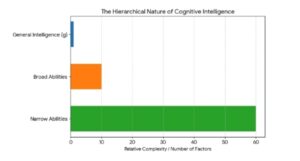
The Three-Stratum Theory: This model organizes intelligence into a hierarchy: over 60 narrow abilities (like reading speed) roll up into broad abilities (like visual perception), which ultimately form one general intelligence factor.
Triarchic Theory: Proposed by Robert Sternberg, this view suggests intelligence has three parts: Analytical(problem-solving), Creative (dealing with new situations), and Practical (adapting to everyday life).
The Biological Blueprint
The physical “workings” of intelligence are found in the brain’s frontoparietal network.
The Prefrontal Cortex: The primary hub for executive function, logic, and planning.
Neurotransmitters: Chemicals like Dopamine regulate working memory and mental flexibility, while Glutamate is essential for the synaptic changes required for learning and long-term memory.
Brain Efficiency: Highly intelligent brains often show higher “information processing capacity” through more densely packed neurons and faster signal conduction speeds.
The Heart of Leadership: Understanding the Nature of Emotional Intelligence
Emotional Intelligence (EQ) is the ability to recognize, understand, and manage your own emotions while also influencing the emotions of others. While Cognitive Intelligence (IQ) handles logic and data, EQ serves as the “interpersonal glue” that determines how effectively we apply that logic in the real world.
The Five Pillars: How It Works
According to the framework popularized by psychologist Daniel Goleman, EQ functions through five distinct but interconnected components:
1. Self-Awareness (The Foundation)
This is the ability to recognize a feeling as it happens. It involves monitoring your “gut reactions” and understanding how your moods affect your thoughts and behavior. Without self-awareness, emotions control you rather than you managing them.
2. Self-Regulation (The Control Room)
Once an emotion is identified, self-regulation is the process of managing it. This isn’t about “suppressing” feelings; it’s about choosing how to express them. It involves:
Impulse control: Thinking before acting.
Adaptability: Staying flexible in changing situations.
Integrity: Taking responsibility for your actions.
3. Internal Motivation (The Driver)
People with high EQ are driven by goals beyond external rewards like money or status. They possess a deep-seated passion to fulfill their own inner vision. This manifests as a strong “need to achieve” and a “can-do” attitude even in the face of failure.
4. Empathy (The Social Radar)
Empathy is the ability to recognize the “non-verbal” signals others send. It’s about sensing what people are feeling without them having to say it. This allows for better conflict resolution and stronger teamwork because you can see the world from another person’s perspective.
5. Social Skills (The Navigator)
This is the “result” of the other four pillars. Social skills involve moving people in the direction you desire—whether that’s toward a business goal or a peaceful resolution. It includes active listening, persuasive communication, and the ability to build rapport.
The Biological “Hijack”
To understand how EQ works, you have to look at the brain’s anatomy. Information enters the brain through the Thalamus. From there, it goes to two places:
The Amygdala (Emotional Center): The “fight or flight” hub that reacts instantly.
The Prefrontal Cortex (Thinking Center): The part of the brain that analyzes data rationally.
Emotional Intelligence is essentially the communication loop between these two centers. High EQ allows the “thinking brain” to intercept an “emotional hijack” from the amygdala, allowing for a measured response instead of a knee-jerk reaction.
Why It Matters
In the modern world, EQ is often the primary differentiator in leadership. While IQ can get you through the door, EQ allows you to build the alliances and resilience necessary to stay in the room.
The Social Radar: Understanding the Nature of Social Intelligence
Social Intelligence (SI) is often described as “street smarts” for the soul. While Emotional Intelligence (EQ) focuses on the internal management of feelings, Social Intelligence is the external application of those insights. It is the ability to decode the unspoken rules of human interaction and navigate complex social environments with ease and influence.
The Nature of SI: “Space” and “Grace”
The essence of Social Intelligence lies in two distinct capacities:
Social Awareness: What we sense about others (sensing their inner state, understanding their motives).
Social Facility: How we use that awareness to have smooth, effective interactions.
Unlike IQ, which is relatively stable, SI is a learned set of skills developed through observation, failure, and adaptation.
How It Works: The SI Framework
Psychologist Karl Albrecht popularized a model known as S.P.A.C.E., which explains the functional components of social intelligence:
1. Situational Radar (S)
This is the ability to “read the room.” It involves scanning the environment to understand the social “vibe,” the power dynamics at play, and the cultural norms of a specific group. A socially intelligent person notices if a joke is inappropriate or if a colleague is feeling excluded before a word is spoken.
2. Presence (P)
Presence is the physical and verbal “flavor” you bring to a room. It includes your posture, eye contact, and tone of voice. It is the difference between being perceived as approachable and confident or cold and insecure.
3. Authenticity (A)
This is the “anti-manipulation” factor. Social intelligence isn’t about “faking it”; it’s about being honest while remaining tactful. High SI individuals are seen as “real” because their behaviors align with their values, which builds long-term trust.
4. Clarity (C)
This is the ability to explain ideas and feelings in a way that others can easily digest. It involves active listening—ensuring you understand the other person’s point before trying to make your own. Clarity prevents the misunderstandings that derail relationships.
5. Empathy (E)
In the context of SI, empathy is the “social glue.” It is the bridge that allows you to connect with someone else’s experience. By making others feel understood, you create a sense of psychological safety that allows for collaboration and influence.
The Biological Mechanism: Mirror Neurons
On a biological level, Social Intelligence relies heavily on Mirror Neurons. These are specialized brain cells that fire both when we perform an action and when we observe someone else performing that same action.
When you see someone win a prize, your mirror neurons fire as if you won it; when you see someone trip, you wince. Socially intelligent people have a highly attuned “mirror system,” allowing them to “sync” with others almost instantly, a process known as limbic resonance.
Why SI is the “Ultimate Multiplier”
Social Intelligence takes your IQ and EQ and makes them visible to the world. You can be a genius (IQ) and have a stable heart (EQ), but without SI, you may never find the right words or timing to share your gifts with others.
The Ultimate Compass: Understanding the Nature of Spiritual Intelligence
Spiritual Intelligence (SQ) is often called the “ultimate intelligence.” While IQ helps us process logic and EQ helps us manage emotions, SQ allows us to navigate the meaning behind them. It is the capacity to access higher meanings, values, and purposes to live a more integrated and visionary life.
The Nature of SQ: The Integrative Center
Spiritual Intelligence is not necessarily about religion, though it can be expressed through it. Rather, it is the “soul’s intelligence.” It is the central, guiding force that sits at the top of the cognitive and emotional pyramid, providing a sense of direction.
According to Danah Zohar, a pioneer in the field, SQ is what we use to develop our longing and capacity for meaning, vision, and value. It allows us to determine which path in life is most worth following.
How It Works: The 12 Principles of SQ
Unlike IQ, which is measured by puzzles, or EQ, measured by social cues, SQ functions through a set of internal principles that dictate how we interact with existence:
Self-Awareness: Knowing what I believe in and value, and what deeply motivates me.
Spontaneity: Living in and being responsive to the moment.
Being Vision-and-Value Led: Acting from principles and deep beliefs and living accordingly.
Holism: Seeing larger patterns, relationships, and connections; having a sense of belonging.
Compassion: Having the quality of “feeling-with” and deep empathy.
Celebration of Diversity: Valuing other people for their differences, not despite them.
Field Independence: Standing against the crowd and maintaining one’s own convictions.
Humility: Having the sense of being a player in a larger drama, of one’s true place in the world.
Tendency to Ask Fundamental ‘Why?’ Questions: Needing to understand things and get to the bottom of them.
Ability to Reframe: Standing back from a situation or problem and seeing the bigger picture or wider context.
Positive Use of Adversity: Learning and growing from mistakes, setbacks, and suffering.
Sense of Vocation: Feeling called to serve, to give something back.
The Biological “Why”: Synchronous Oscillations
Neurobiology suggests that SQ is linked to “unitive” brain activity. While IQ is linked to serial processing (linear thinking) and EQ is linked to parallel processing (pattern recognition), SQ is associated with synchronous oscillations of 40Hz across the whole brain. This high-frequency “hum” effectively unites all parts of the brain, allowing for a “whole-picture” perception of reality.
The Purpose of SQ
SQ works as a compass. When life presents a crisis that logic (IQ) cannot solve or that emotions (EQ) find overwhelming, SQ allows an individual to reframe the situation. It transforms a “tragedy” into an “opportunity for growth” by connecting the experience to a larger life purpose.
The Infinite Mind: Understanding the Nature of Divine Intelligence
Divine Intelligence (DQ) represents the summit of the intelligence hierarchy. While Spiritual Intelligence (SQ) involves the human search for meaning, Divine Intelligence is the capacity to align one’s life with a universal, transcendent, or “God-level” perspective. It is the shift from seeking meaning to becoming an instrument of a higher, absolute wisdom.
The Nature of DQ: Participation in the Absolute
The essence of Divine Intelligence is surrender and alignment. If IQ is the “head” and EQ is the “heart,” DQ is the “spirit in motion.” It is characterized by:
Non-Dual Perception: Moving beyond “me vs. you” or “right vs. wrong” to see the interconnectedness of all things through a lens of absolute love.
Selflessness (Ego-Transcendence):The “self” no longer acts for its own preservation but acts as a conduit for a higher will.
Infinite Patience and Trust: A profound inner peace rooted in the belief that there is a divine order, even in the midst of chaos.
How It Works: The Flow of Grace
Divine Intelligence operates differently than the analytical or emotional minds. It functions through intuition, revelation, and synchronicity.
1. The Stillness Mechanism
DQ cannot be accessed through “thinking harder.” It works through the silencing of the ego. When the internal chatter of IQ and the turbulence of EQ are stilled, DQ emerges as a “still, small voice” or a deep intuitive knowing. This is often achieved through deep contemplation, prayer, or total presence.
2. Alignment with Universal Laws
DQ works by recognizing and flowing with universal principles such as compassion, forgiveness, and unconditional love. Instead of fighting against the current of life, an individual with high DQ recognizes the “divine flow” and moves with it, often leading to outcomes that seem miraculous or “lucky” (synchronicity).
3. The “Divine Filter”
In practical terms, DQ acts as an ultimate filter for decision-making. When faced with a choice, the question isn’t “What is best for me?” (IQ/EQ) or “What is the meaning of this?” (SQ), but rather “What is the most loving and highest action for the whole?”
4. Radical Forgiveness and Grace
A key “working” part of DQ is the ability to extend grace—giving something good to those who may not “deserve” it by human standards. This breaks the cycle of cause and effect (karma) and introduces a new, higher logic into human affairs.
The Biological “Super-State”
While research is still emerging, DQ is often associated with state of “Brain-Heart Coherence.” This is when the rhythms of the heart and the waves of the brain synchronize perfectly. In this state, the nervous system moves out of “survival mode” entirely, allowing the higher brain centers to access a state of “flow” that feels connected to a source outside the individual body.
The Result: Becoming a “Light”
The ultimate function of Divine Intelligence is to transform the individual into a source of peace for others. A person operating with DQ doesn’t just solve problems; their very presence dissolves conflict by introducing a higher frequency of being into the environment.
The Silicon Mirror: Understanding the Nature of Artificial Intelligence
Artificial Intelligence (AI) is the field of computer science dedicated to creating systems capable of performing tasks that typically require human intelligence. While human intelligence is biological and intuitive, AI is mathematical and algorithmic—it doesn’t “think” in the conscious sense, but it “calculates” patterns to simulate reasoning.
The Nature of AI: Silicon Logic
At its core, AI is about prediction and optimization. Unlike a standard computer program that follows a rigid set of “if-then” rules (e.g., if the button is clicked, then play a sound), AI is designed to learn from data. Its “nature” is to take a massive amount of information, identify the underlying structure, and use that structure to make a high-probability guess about a new piece of data.
How It Works: The Mechanics of Machine Learning
The modern era of AI is powered primarily by Machine Learning (ML) and its more complex subfield, Deep Learning.
1. Data Ingestion (The “Experience”)
AI requires a “training set.” For an AI to recognize a cat, it must be fed thousands of images labeled “cat.” It doesn’t see a furry animal; it sees a grid of numbers representing pixel colors and brightness.
2. Pattern Recognition (The “Learning”)
Using algorithms like Neural Networks—which are loosely inspired by the human brain—the AI assigns “weights” to different features.
In the cat example, the AI might learn that a specific arrangement of pixels often correlates with “pointed ears.”
It adjusts these weights through a process called backpropagation, constantly correcting itself when its guesses are wrong until its accuracy improves.
3. Large Language Models (The “Prediction”)
Generative AI (like the one you are using now) works through Transformers. These models don’t “know” facts; they predict the next most likely token (word or part of a word) in a sequence based on the vast library of text they were trained on. It is a sophisticated game of “probability” played at lightning speed.
4. The Inference (The “Output”)
Once the model is trained, it enters the inference phase. When you give it a prompt, it applies the patterns it has learned to generate a response, solve a math problem, or create an image.
The Two Categories of AI
Narrow AI (Weak AI): Designed for a specific task (e.g., facial recognition, playing chess, or suggesting a movie). This is the AI we have today.
General AI (AGI): A hypothetical system that can understand, learn, and apply intelligence across any task a human can. We have not reached this stage yet.
How AI Differs from Human Intelligence
While the previous intelligences we discussed (Cognitive, Emotional, Spiritual) are rooted in consciousness and lived experience, AI is rooted in statistical correlation. AI can simulate empathy (EQ) or social grace (SI) by mimicking patterns found in human text, but it does not “feel” the emotion or “believe” in the meaning. It is a powerful tool of cognitive extension, rather than a biological peer.
The Intelligence Synthesis: Intersections and Implications of the Mental Hierarchy
When we look at the spectrum of intelligence—from the raw logic of Cognitive Intelligence (IQ) to the transcendent reach of Divine Intelligence (DQ), and the synthetic power of Artificial Intelligence (AI)—we are not looking at isolated silos. Instead, these intelligences exist in a state of intersectionality, where the overlap of different forms creates a “multiplier effect” on human capability and social impact.
The Structural Hierarchy: A Nested System
The most effective way to visualize these intelligences is not as a ladder, but as a nested system of concentric circles.
The Foundational Layer (IQ & AI): At the core is the ability to process data and solve problems. AI serves as a massive extension of this layer, providing superhuman speed and scale to purely cognitive tasks.
The Human Layer (EQ & SI): These intelligences wrap around the core. They provide the “context” for logic. Without the empathy of EQ and the situational awareness of SI, IQ and AI are “blind”—they can solve problems but cannot understand the human cost of the solution.
The Transcendent Layer (SQ & DQ):These forms of intelligence provide the “direction” and “ultimate purpose.” They act as the compass for all layers beneath them.
Key Intersectionalities and Their Implications
1. The Intersection of AI and IQ: The “Efficiency” Paradox
When AI intersects with high IQ, we see a massive leap in technical innovation. However, the implication is a devaluation of pure cognition. As machines master the “analytical,” the human premium shifts upward. Having a high IQ is no longer enough; the value now lies in how one uses higher-level intelligences to direct that IQ and AI.
2. The Intersection of EQ and SQ: The “Wise Leader”
When emotional intelligence (managing feelings) meets spiritual intelligence (finding meaning), we see the emergence of Wisdom.
Implication: A leader with high EQ but low SQ might be a great “people person” but lack a moral north star, leading to manipulation. A leader with both can navigate a crisis not just by keeping people calm (EQ), but by giving them a reason to persevere (SQ).
3. The Intersection of SI and DQ: The “Social Transformer”
This is the overlap of social savvy and divine alignment. This intersection creates individuals who don’t just “read the room”—they change the frequency of the room.
Implication: This produces radical social shifts (think of figures like Gandhi or MLK). They used social intelligence to organize and communicate, but their power was fueled by Divine Intelligence—a commitment to a truth higher than current social laws.
The Implications of the Hierarchy
The “ordering” of these intelligences suggests a clear hierarchy of authority, though not necessarily of utility:
Logic (IQ/AI) should serve Emotion/Connection (EQ/SI).Technology and data are tools to improve human life, not ends in themselves.
Human Connection (EQ/SI) should be guided by Meaning/Divinity (SQ/DQ). Our social structures and relationships stay healthy only when they are rooted in higher values like absolute truth and selfless love.
Conclusion: The Integrated Intelligence
The ultimate goal of understanding these intersections is Synthesis. A person who operates solely in IQ is a calculator; one who operates solely in DQ may be disconnected from the physical world. The “Optimal Human” is an integrated being: using AI/IQ to solve problems, EQ/SI to build bridges, and SQ/DQ to ensure those bridges lead toward the highest good.
Concluding Remarks
The exploration of the intelligence spectrum, from Cognitive Intelligence (IQ) to Divine Intelligence (DQ), reveals a complex and multifaceted nature of human cognition and consciousness. By understanding the distinct forms of intelligence and their intersections, we can unlock new potential for personal growth, leadership, and innovation.
The hierarchy of intelligences, from IQ to DQ, provides a framework for navigating the complexities of modern life. By integrating these different forms of intelligence, individuals can cultivate wisdom, compassion, and a deeper sense of purpose.
The implications of this framework are profound, suggesting that the most effective leaders and individuals are those who can balance analytical thinking, emotional intelligence, social savvy, and spiritual awareness.
Ultimately, the pursuit of intelligence and wisdom is a lifelong journey, one that requires dedication, self-awareness, and a willingness to learn and grow. By embracing this journey, we can unlock our full potential and create a more compassionate, innovative, and meaningful world.
Isaac Megbolugbe, Director of GIVA Ministries International. He is a recipient of Albert Nelson Marquis Lifetime Achievement Award in business and academia in the United States of America. He is retired professor at Johns Hopkins University, Former Vice President at Fannie Mae, Former Practice Leader at PricewaterhouseCoopers, and a Fellow of the Royal Institution of Chartered Surveyors. He is resident in the United States of America.
