

Visible Formation of God
Isaac Megbolugbe
April 16, 2026
Introduction
Visible forms of God in scripture, often termed theophanies (Old Testament) or Christophanies (pre-incarnate appearances), are rare, mediated representations rather than full revelations of His divine essence. Primary forms include the human-like figures of Jesus Christ (the supreme image), radiant light (glory/fire), clouds, and the “Angel of the LORD”.
Primary Visible Manifestations
Jesus Christ (The Ultimate Form): The New Testament identifies Jesus as the perfect “image of the invisible God”. John 1:14 states “the Word became flesh,” making Him the ultimate visible manifestation of God.
The Angel of the LORD: Often appearing in the Old Testament, this figure speaks as God, is worshipped as God, and is distinct from angels, frequently interpreted as a pre-incarnate appearance of Christ.
Human-like Form: Ezekiel 1:26–28 describes a figure on a throne with the appearance of a man, surrounded by radiance (like fire and a rainbow).
Radiant Light, Glory, and Fire: God often appeared as intense fire, light, or overwhelming splendor, such as in the burning bush (Exodus 3:2), the pillar of fire (Exodus 13:21), and on Mount Sinai.
The “Back” of God: In Exodus 33:18–23, God allows Moses to see His “back” as a shielded representation of His presence, as seeing His face would be fatal.
Symbolic and Metaphorical Representations
Scripture also describes God using metaphorical visible forms that symbolize His nature:
Clouds: Often represent the presence of God concealing His intense glory, such as during the Exodus and at the Transfiguration.
Nature: The universe itself is described as a reflection of God’s glory (Psalm 19:1), where creation showcases His power, wisdom, and character.
Metaphors of Substance: God is described metaphorically as a “sun and shield,” and a “rock of refuge,” describing His character rather than a direct physical image.
While God is invisible and transcendent, these forms were provided to humanity as temporary, visual assurances of His existence, holiness, and presence
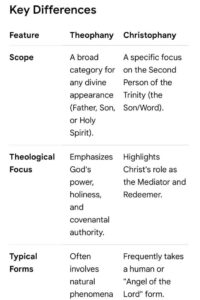
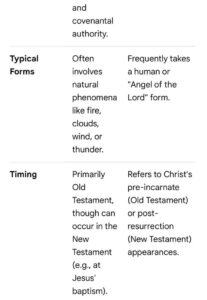
Divine Manifestations: Distinguishing Between Theophany and Christophany in Scripture
In biblical theology, the terms Theophany andChristophany describe moments when the infinite, invisible God manifests Himself in a tangible way to humanity. While they are closely related, they differ in their specific focus and theological implications within the narrative of salvation history.
Definitions and Origins
Theophany: Derived from the Greek theos (God) and phaino (to appear). It is a broad, general term for any manifestation of God that is perceptible to human senses.
Christophany: A specific subset of theophany. It comes from Christos (Christ) and phainein (to appear), referring specifically to an appearance of the Second Person of the Trinity.
The Role of the “Angel of the Lord”
One of the most significant points of overlap is the “Angel of the LORD” (or Malak Yahweh). Many theologians classify these encounters as Christophanies because this figure:
Speaks as God: Using the first person (“I am the God of your father”).
Receives Worship: Unlike created angels, who consistently refuse worship, this figure accepts it from figures like Joshua or Gideon.
Forgives Sin: Exercising authority belonging only to God.
Theological Significance
Theophanies serve as “preliminary glimpses” that foreshadow the permanent appearance of God in the flesh. While a theophany is a temporary manifestation through a created form (like a bush or a cloud), the Incarnation (the birth of Jesus) is a permanent union of divine and human natures in one person.
For believers, these appearances demonstrate that God is not distant or unknowable but has consistently “broken into” human history to guide, deliver, and reveal His character.
Visualizing the Divine: Exemplifying God’s Presence in the Burning Bush and Ezekiel’s Vision
Throughout the Holy Scriptures, God occasionally steps out of the “unapproachable light” to interact with humanity. These moments, known as theophanies, use physical forms to communicate divine attributes that words alone cannot capture. Two of the most profound examples are the Burning Bus hand Ezekiel’s Heavenly Chariot, each revealing a different facet of God’s nature.
1. The Burning Bush: The Holiness and Self-Sufficiency of God
In Exodus 3, Moses encounters a bush that burns with fire but is not consumed. This specific form—the “Angel of the Lord” appearing in a flame of fire—serves as a multi-layered revelation:
The Form of Fire: Fire in scripture often represents God’s holiness and judgment. It is a purifying force that demands a response; Moses is immediately told to “take off your sandals,” marking the ground as holy.
The “Unconsumed” Paradox: Most fires require fuel (wood, oil, oxygen) to survive. This fire required nothing. It exemplified God’s aseity—the theological truth that He is self-existent and depends on nothing else for His being.
The Voice from the Flame: By speaking through the bush, God proved He is a personal, communicating God. He is not a distant energy force but a Being who hears the cries of His people and remembers His covenants.
2. Ezekiel’s Vision: The Sovereignty and Glory of the Enthroned God
While the Burning Bush was a localized, humble encounter, Ezekiel’s vision (Ezekiel 1) is an overwhelming cosmic display. He describes a whirlwind, flashing lightning, and four “living creatures,” but the climax is the “likeness of a throne” and a figure upon it.
The Appearance of a Man: Ezekiel describes the figure as having the “appearance of a man” from the waist up and down, glowing like “gleaming metal” and “full of fire.” This foreshadows the Incarnation, suggesting that the ultimate form God chose to relate to humanity is the human form.
The Chariot-Throne (The Merkabah): The throne sits atop wheels within wheels, covered in eyes. This symbolizes God’s omnipresence (moving in any direction instantly) and His omniscience (seeing all things). It showed the exiled Israelites that God was not confined to the Temple in Jerusalem, His sovereignty travels with His people.
The Rainbow of Glory: Surrounding the throne was a radiance like a rainbow. This linked back to the covenant with Noah, signifying that even in the midst of terrifying power and judgment, God remains a God of mercy and promise.
The Common Thread: Mediated Glory
In both instances, God did not reveal His full, naked essence, which the Bible says no man can see and live (Exodus 33:20). Instead, He used mediated forms—fire, light, and symbolic imagery—to bridge the gap between the Infinite and the finite.
The Burning Bush showed God as the Near Deliverer in the wilderness, while Ezekiel’s vision showed Him as the High King over the nations. Together, these examples prove that God adapts His “form” to meet the specific needs and contexts of His people.
The Fourth Man: Divine Companionship in the Fiery Furnace
The account of the “fourth man” in the fiery furnace (Daniel 3) represents one of the most vivid and personal visible forms of God in the Old Testament. Unlike the abstract power of the Burning Bush or the overwhelming cosmic scale of Ezekiel’s vision, this manifestation is defined by presence and protection within human suffering.
The Scriptural Context
When Shadrach, Meshach, and Abednego refused to bow to King Nebuchadnezzar’s golden idol, they were cast into a furnace heated seven times hotter than usual. The king, expecting to see their swift destruction, was instead astonished to witness four figures walking freely and unharmed amidst the flames. He exclaimed that the appearance of the fourth was “like a son of the gods” (or “the Son of God” in some translations).
Theological Interpretations of the Form
Scholars and theologians generally identify this mysterious figure in three ways:
A Christophany (Pre-incarnate Christ): This is the most common Christian interpretation. It suggests the Second Person of the Trinity appeared in a human-like form centuries before His birth in Bethlehem to physically stand with His people.
The Angel of the LORD: Nebuchadnezzar himself later refers to the figure as an “angel” sent by God (Daniel 3:28). In many other Old Testament accounts, the “Angel of the LORD” speaks as God and receives worship, leading many to equate this “angel” with the pre-incarnate Christ.
A Divine Messenger: Some interpretations, particularly from a historical-cultural perspective, suggest the figure was a heavenly being sent specifically to execute God’s will of protection, like the angels who guarded Daniel in the lions’ den.
Symbolic and Practical Significance
The “form” of the fourth man carries several profound meanings for the reader:
Identification in Trials: The fourth man did not extinguish the fire; He entered it. This form reveals God as a companion who is “with us” in the “furnaces” of life—a theme later perfected in the name Immanuel.
Authority Over Nature: The figure’s ability to render the intense heat harmless demonstrates God’s absolute sovereignty over the physical laws He created.
Liberation: The king noted the men were “loose” or “unbound” (Daniel 3:25). The presence of the divine figure literally burned away the ropes that bound them while leaving their bodies and clothing untouched by the flames.
Veiled in Splendor: Why God is Often Hidden in a Cloud
In the biblical narrative, few symbols are as consistent or as mysterious as the cloud. From the Exodus to the Transfiguration, God repeatedly chooses to shroud His presence in thick, often dark, clouds. This “Glory Cloud”—frequently associated with the Hebrew term Shekinah—serves a multifaceted theological purpose, acting as a bridge between the infinite God and finite humanity.
1. Divine Protection: Shielding Humanity from the Unbearable
The most practical reason for the cloud is protection. Scripture repeatedly warns that God’s essence is “unapproachable light” and that “no man can see [God] and live” (Exodus 33:20).
A Necessary Veil: The cloud acts as a filter, tempering the lethal intensity of God’s holiness so that humans can survive His near presence.
The Weight of Glory: At the dedication of Solomon’s Temple, the cloud was so dense and the glory so heavy that the priests could not even stand to perform their duties.
2. Guidance and Provision: The Visible Sign of Nearness
While the cloud hides God’s face, it reveals His presence. For the Israelites wandering in the wilderness, the “pillar of cloud” was a constant, visible assurance that they were not alone.
A Heavenly Compass: The cloud provided literal direction; when it moved, the people moved; when it settled, they camped.
Physical Relief: In a harsh desert environment, the cloud served as a “covering” or canopy, shielding the people from the blistering heat of the sun.
3. A Tool for Communication and Authority
God frequently used the cloud as a divine podium. It localized His voice, giving weight and
Mount Sinai: God came in a “dense cloud” so that the people could hear Him speaking with Moses and learn to trust His chosen leader.
The Transfiguration: In the New Testament, a “bright cloud” enveloped Jesus, Moses, and Elijah, from which the Father’s voice identified Jesus as His “beloved Son”.
4. A Symbol of Mystery and Sovereignty
Finally, the cloud represents the incomprehensibility of God. Clouds are beyond human control or fully understanding, mirroring God’s own nature.
Divine Chariot: The Psalms poetically describe God as “riding on the clouds” or making them His “chariot,” emphasizing His sovereign rule over the natural world.
The Return of Christ: The New Testament closes this theme by promising that Jesus will return “with the clouds”—a sign of His ultimate authority, judgment, and universal recognition.
Summary of the Cloud’s Purpose
The cloud is a profound paradox: it reveals by concealing. It makes God’s presence known while simultaneously protecting His holiness and our frailty. It is an invitation to trust God in the “mystery-darkness” until the day His children can behold His face in full glory and live.
The Nature of God: Understanding the Divine Character Through Scripture
The Bible does not merely provide a list of facts about God; it reveals His very essence through a series of interconnected attributes. These characteristics are not “parts” that make up God, but rather descriptions of His singular, perfect nature as revealed through His interactions with humanity.
1. Love: The Core of God’s Relational Nature
Scripture famously declares that “God is love” (1 John 4:8). This is not just a description of His actions, but a statement about His being.
Unconditional and Initiating: God’s love is not based on human merit or performance. He chooses to love because it is His nature.
The Ultimate Sacrifice: The supreme demonstration of this love was sending His Son, Jesus Christ, to die for humanity (John 3:16).
2. Holiness: The Perfection of God’s Being
Holiness signifies God’s complete separation from sin and His absolute moral perfection.
Otherness: At its core, holiness means God is “set apart”—He is qualitatively different and superior to His creation.
A Standard for Humanity: Because God is holy, He calls His people to be holy as well, living lives set apart for His purposes.
3. Omnipotence: The Limitless Power of God
God is all-powerful, meaning He has the ability to do everything that is consistent with His nature.
Creator and Sustainer: This power is most clearly seen in the creation of the universe out of nothing and Hiscontinued sustenance of all things.
Nothing is Impossible: His omnipotence ensures that no human purpose or natural force can thwart His ultimate plans.
4. Omniscience: The Infinite Knowledge of God
Intimate Awareness: He knows every person intimately, even before they are formed in the womb.
No Hidden Thoughts: Nothing in all creation is hidden from His sight; He knows every human thought and intention (Hebrews 4:13).
5. Justice and Righteousness: The Fairness of God
Justice ensures that God always acts in accordance with what is right and fair.
Fairness in Judgment: God’s justice means He will never declare the guilty innocent without a proper basis, yet He remains perfectly upright in His dealings with creation.
Harmony with Love: God does not sacrifice His justice for His love; rather, both were perfectly satisfied at the cross.
6. Mercy and Grace: The Compassion of God
Mercy is God withholding the punishment we deserve, while grace is God giving us the favor we cannot earn.
Forgiveness: Through His mercy, God offers forgiveness and compassion to those who have sinned.
Renewed Daily: Scripture promises that His mercies are “new every morning,” reflecting a constant stream of compassion toward His children.
7. Sovereignty: The Absolute Authority of God
Sovereignty refers to God’s supreme rule and authority over all of creation.
Divine Control: He operates according to the counsel of His own will, and His purposes will always prevail.
A Foundation for Trust: Believers can trust God because His sovereignty ensures that He is in control, even when circumstances seem chaotic.
Summary of Divine Nature
These attributes work in perfect harmony. God’s sovereignty is guided by His love, His justice is tempered by His mercy, and His holiness is backed by His omnipotence. Together, they reveal a God who is both radically different from humanity and radically committed to it.
Bridging the Infinite: The Conceptual and Constructive Gap Between the Invisible and Visible God
The relationship between the invisible essence of God and His visible manifestations is one of the most profound paradoxes in theology. This “gap” is both conceptual—existing in the realm of thought and nature—and constructive—bridging the space through specific divine actions.
1. The Conceptual Gap: Essence vs. Energy
The conceptual gap is rooted in the ontological difference between the Creator and the creation.
The Invisibility of Essence: In His pure essence (ousia), God is Spirit (John 4:24) and “dwells in unapproachable light” (1 Timothy 6:16). Conceptually, the infinite cannot be contained by the finite. If God were fully visible in His essence, He would cease to be transcendent; He would become just another object within the universe.
The Necessity of Mediation: Because the human mind and senses are “wired” for the physical, a direct encounter with the naked essence of God would result in the annihilation of the creature. Therefore, a conceptual “buffer” is required—God must translate His infinite nature into a language humans can perceive.
2. The Constructive Gap: How the Bridge is Built
The constructive gap refers to the specific “mechanisms” or forms God uses to cross the divide. This is not a natural bridge but a supernatural construction.
Condescension: This is the theological act of God “stooping down.” Constructively, God chooses to limit the display of His glory. In the Burning Bushor the Pillar of Cloud, God uses physical matter as a temporary “house” for His presence. He constructs a localized point of contact that is safe for human interaction.
The Use of Metaphor and Symbol: God constructs the gap using familiar imagery. By appearing as a “Rock,” a “Shepherd,” or “Fire,” He uses the building blocks of our reality to describe a reality that is beyond us. These are not God Himself, but constructive pointers toward Him.
3. The Ultimate Bridge: The Incarnation
The greatest closure of the gap occurs in Jesus Christ. This is where the conceptual and constructive meet perfectly.
The Visible Image: Colossians 1:15 calls Jesus “the image (eikon) of the invisible God.”
Constructive Union: In Christ, the gap is not just bridged by a temporary cloud or fire, but by the permanent union of two natures. The “Invisible” becomes “Visible” not by changing His nature, but by taking on a human one.
Conceptual Resolution: In the person of Jesus, the paradox is resolved: we see the Father by looking at the Son. The gap is closed because the Mediator is fully God (Invisible Essence) and fully Man (Visible Form).
4. The Purpose of the Gap
Why does the gap remain? Why isn’t God always visible?
To Preserve Sovereignty: The gap ensures that God remains God—He is not a “genie” at our beck and call, but a Sovereign who reveals Himself at His own timing.
To Require Faith: If God were constantly and undeniably visible to all, “faith” (trusting in what is not seen) would be impossible. The gap creates the space for a relationship based on trust rather than mere sight.
Conclusion
The gap between the invisible and visible God is a “merciful distance.” It protects the holiness of God and the frailty of man, while providing enough visible “signposts” (Theophanies, Scripture, and Christ) to lead humanity back to its Creator.
The Beatific Vision: Beholding the Face of the Divine
The “Beatific Vision” (from the Latin beatus, meaning “happy” or “blessed”) refers to the ultimate self-communication of God to the individual person. It is the theological promise that in the afterlife, the “gap” between the invisible Creator and the visible creature will be closed.
A central question arises: Who exactly will we see? Is the vision of “Him” a physical sight of Jesus Christ, or a spiritual apprehension of God the Father?
1. The Person of the Vision: One God, Three Persons
In the context of the Beatific Vision, “Him” refers to the Triune God—Father, Son, and Holy Spirit. Because Christianity is monotheistic, to see one Person of the Trinity in His divine essence is to see the one God. However, theology distinguishes between how we will see the Father and how we will see the Son.
2. Seeing Jesus Christ: The Ocular Vision
Because of the Incarnation, Jesus Christ possesses a glorified physical body.
Physical Sight: We will see Jesus with our resurrected, physical eyes. This is often called the “sensible” vision. We will look upon the “Lamb who was slain” and see the nail scars in His hands.
The Bridge: Jesus remains the “image of the invisible God.” Even in heaven, He is the human face of the Godhead, making the infinite relatable to our finite human nature.
3. Seeing God the Father: The Intellectual Vision
God the Father is “pure Spirit” and does not have a physical body. Therefore, seeing “Him” is not an act of the physical eyes, but an illumination of the intellect.
The “Light of Glory”: Theologians like Thomas Aquinas argue that God strengthens the human intellect with a special grace (the lumen gloriae) so that it can “see” or “grasp” the divine essence directly.
Direct Knowledge: This is not looking at a “picture” of the Father; it is an immediate, intuitive, and total knowledge of God. It is “seeing” Him with the “eyes of the heart” in a way that is more real than physical sight.
4. Scriptural Foundation: “See Him as He Is”
The phrase comes from 1 John 3:2: “We know that when he appears, we shall be like him, for we shall see him as he is.”
The Christological Context: Most commentators believe John is referring specifically to Jesus. Because we will have resurrected bodies “like His,” we will be capable of beholding His full, unveiled glory.
The Father through the Son: However, Jesus Himself said, “Whoever has seen me has seen the Father” (John 14:9). Therefore, the vision of the glorified Christ is the primary means by which we “see” the Father.
5. The Closing of the Gap
The Beatific Vision represents the end of faith and the beginning of sight.
No More Veils: The “cloud” of the Old Testament and the “dim mirror” of our current life (1 Corinthians 13:12) are removed.
Total Union: We will not just look at God from a distance; we will participate in His life. The gap is closed because we are finally made capable—by His grace—of sustaining the sight of His holiness.
Summary
In the Beatific Vision, you will see Jesus Christ with your eyes and “see” the Father and Holy Spirit with your soul. “Him” is the total presence of the Almighty, experienced through the person of the Son.
The Happy-Making Vision: How the Beatific Vision Perfects and Transforms the Human Soul
The theological promise of the “Beatific Vision”—seeing God face-to-face—is not a passive event. It is a dynamic encounter that fundamentally reconstructs the human soul, bringing it to its ultimate state of perfection and happiness.
The following are the key ways the vision of God transforms the believer:
1. Ontological Transformation: Partakers of Divine Nature
The most profound effect of the vision is a process of “divinization” or theosis. By beholding God’s essence, the soul is infused with divine light and life.
Deification: According to the Roman Catechism, the soul comes to share in God’s own nature.
The Light of Glory: Thomas Aquinas taught that because the human intellect is finite, God must strengthen it with a supernatural “light of glory” (lumen gloriae) to enable it to “see” the infinite. This light elevates the soul’s capacity to know and love far beyond its natural limits.
2. Perfected Intellect: Direct and Unmediated Knowledge
In this life, our knowledge of God is mediated through faith, scripture, and creation—seeing “through a glass darkly” (1 Corinthians 13:12). In heaven, this mediation is removed.
Immediate Contemplation: The soul no longer needs “pointers” to find God; it possesses Him directly through an intuitive vision.
Intellectual Fulfillment: The innate human desire to know the “First Cause” is finally satisfied. The soul understands the truth of God and the order of all creation with perfect clarity.
3. Perfected Will: Total Union and Happiness
The vision doesn’t just inform the mind; it captivates the heart. The will, which often wanders after earthly desires, finds its ultimate “rest” in God.
Impeccability: Upon seeing God’s infinite goodness, the soul is so overwhelmed with love that it becomes impossible to sin or even desire to turn away.
Eternal Rest: All restlessness, anxiety, and longing are extinguished. As Augustine famously noted, the heart finally finds its rest.
4. Emotional and Personal Transformation: The Fullness of Joy
The Beatific Vision is often described as a “happy-making vision”.
Quintessence of Happiness:Theologians like Jonathan Edwardsargued that the pleasure of seeing God is so exquisite it fills the heart “brimful,” leaving no room for sorrow, boredom, or adverse nature.
Continual Growth: Far from being static, the soul’s enjoyment of God continues to “ripen” and grow deeper forever as the infinite God reveals more of Himself throughout eternity.
5. The Overflow to the Body
While the vision begins in the soul, it eventually transforms the physical body during the final resurrection.
Subtility and Agility: The body becomes perfectly subject to the soul, free from the constraints of space, time, or physical suffering.
Clarity: The glory seen by the soul “overflows” into the body, causing it to shine with resplendent beauty—what scripture calls “shining like the sun”.
The Vision That Purifies: How the Hope of Heaven Drives Holiness Today
The promise of the Beatific Vision—the moment the soul is finally transformed by the direct sight of God—is not merely a future consolation; it is a present-day engine for spiritual growth. Theology teaches that we do not simply “wait” for heaven; we prepare for it. The expectation of seeing God face-to-face provides a profound “motive for holiness” that reshapes how a believer lives in the here and now.
1. The Principle of Spiritual Anticipation
In 1 John 3:2-3, the Apostle provides the clearest link between the future vision and present conduct: “We know that when he appears, we shall be like him, for we shall see him as he is. All who have this hope in him purify themselves, just as he is pure.”
The Law of Likeness: To “see Him as He is” requires a soul that is “like Him.” Holiness is the process of developing the “spiritual eyesight” necessary to endure and enjoy the brilliance of God’s presence.
A “Dress Rehearsal”: If the life of heaven is a life of perfect love and worship, then holiness on earth is the practice of those heavenly habits.
2. The “Weight of Glory” as a Moral Compass
C.S. Lewis famously argued that the promise of future glory gives every human interaction a “weight.”
Value-Based Living: When a believer realizes they are destined to become a “creature of light” who can withstand the direct gaze of God, earthly temptations lose their luster.
Eternal Perspective: The “momentary afflictions” and pleasures of this life are weighed against the “eternal weight of glory” (2 Corinthians 4:17). This perspective motivates the soul to choose the difficult path of righteousness over the easy path of compromise.
3. The Alignment of the Will
As established, the Beatific Vision involves the perfected will—where the soul can no longer desire anything contrary to God.
Early Alignment: Seeking holiness today is the act of intentionally aligning one’s will with God’s before the vision occurs. It is the “training of the heart” to desire what is good, true, and beautiful.
Cultivating the Taste for God: Holiness is akin to developing a “taste” for the Divine. If a soul has no interest in God’s character on earth, the Beatific Vision would be an overwhelming intrusion rather than a joy.
4. Hope as an Anchor in Suffering
The transformation awaiting the soul provides the endurance necessary to remain holy under pressure.
The Prize of the High Calling: Like an athlete who endures grueling training for the sake of the medal, the believer endures the “refiner’s fire” of earthly trials because they know the end result is a soul capable of beholding God.
Sanctification Through Hope: Hope is not a passive wish; it is a “living hope” (1 Peter 1:3) that actively purifies the heart by anchoring it in a reality that is more certain than present pain.
5. The Communal Aspect: Seeing God in Others
The motive for holiness also extends to how we treat our neighbors.
Seeing the “Imago Dei”: If every believer is a “work in progress” destined for this heavenly transformation, then holiness involves treating others with the reverence due to someone who will one day shine like the sun.
Charity as Preparation: We learn to love the God we cannot see by practicing holy love toward the neighbors we can see (1 John 4:20).
Conclusion: The Beginning of the Vision
Holiness is the “morning twilight” of the BeatificVision. It is the gradual dawning of God’s light in the soul before the “Sun of Righteousness” fully rises. By pursuing purity, the believer is not trying to “earn” heaven, but is simply becoming the kind of person who is at home in the presence of God.
The Vision That Purifies: How the Hope of Heaven Drives Holiness Today
The promise of the Beatific Vision—the moment the soul is finally transformed by the direct sight of God—is not merely a future consolation; it is a present-day engine for spiritual growth. Theology teaches that we do not simply “wait” for heaven; we prepare for it. The expectation of seeing God face-to-face provides a profound “motive for holiness” that reshapes how a believer lives in the here and now.
1. The Principle of Spiritual Anticipation
In 1 John 3:2-3, the Apostle provides the clearest link between the future vision and present conduct: “We know that when he appears, we shall be like him, for we shall see him as he is. All who have this hope in him purify themselves, just as he is pure.”
The Law of Likeness: To “see Him as He is” requires a soul that is “like Him.” Holiness is the process of developing the “spiritual eyesight” necessary to endure and enjoy the brilliance of God’s presence.
A “Dress Rehearsal”: If the life of heaven is a life of perfect love and worship, then holiness on earth is the practice of those heavenly habits.
2. The “Weight of Glory” as a Moral Compass
C.S. Lewis famously argued that the promise of future glory gives every human interaction a “weight.”
Value-Based Living: When a believer realizes they are destined to become a “creature of light” who can withstand the direct gaze of God, earthly temptations lose their luster.
Eternal Perspective: The “momentary afflictions” and pleasures of this life are weighed against the “eternal weight of glory” (2 Corinthians 4:17). This perspective motivates the soul to choose the difficult path of righteousness over the easy path of compromise.
3. The Alignment of the Will
As established, the Beatific Vision involves the perfected will—where the soul can no longer desire anything contrary to God.
Early Alignment: Seeking holiness today is the act of intentionally aligning one’s will with God’s before the vision occurs. It is the “training of the heart” to desire what is good, true, and beautiful.
Cultivating the Taste for God: Holiness is akin to developing a “taste” for the Divine. If a soul has no interest in God’s character on earth, the Beatific Vision would be an overwhelming intrusion rather than a joy.
4. Hope as an Anchor in Suffering
The transformation awaiting the soul provides the endurance necessary to remain holy under pressure.
The Prize of the High Calling: Like an athlete who endures grueling training for the sake of the medal, the believer endures the “refiner’s fire” of earthly trials because they know the end result is a soul capable of beholding God.
Sanctification Through Hope: Hope is not a passive wish; it is a “living hope” (1 Peter 1:3) that actively purifies the heart by anchoring it in a reality that is more certain than present pain.
5. The Communal Aspect: Seeing God in Others
The motive for holiness also extends to how we treat our neighbors.
Seeing the “Imago Dei”: If every believer is a “work in progress” destined for this heavenly transformation, then holiness involves treating others with the reverence due to someone who will one day shine like the sun.
Charity as Preparation: We learn to love the God we cannot see by practicing holy love toward the neighbors we can see (1 John 4:20).
Conclusion: The Beginning of the Vision
Holiness is the “morning twilight” of the Beatific Vision. It is the gradual dawning of God’s light in the soul before the “Sun of Righteousness” fully rises. By pursuing purity, the believer is not trying to “earn” heaven but is simply becoming the kind of person who is at home in the presence of God.
The Language of Light: Communication in the Glorified State
In our current existence, language is a tool born of necessity and limitation. We use words to bridge the gap between two separate minds, often struggling with misunderstandings, “lost in translation” moments, and the inability to express the deepest stirrings of the soul. In the glorified state, however, communication undergoes a radical transformation. It moves from linear speech to immediate communion, characterized by total clarity, resonance, and transparency.
1. Beyond the Barrier of Words: Immediate Intuition
In the divine realm, the “gap” between thought and expression is eliminated. Theologians and philosophers often suggest that communication in glory resembles what we might call intellectual intuition or “heart-to-heart” speech.
Direct Concept Transfer: Rather than vibrating air with vocal cords to form sounds that represent ideas, the glorified soul may communicate by the direct sharing of concepts. To “speak” to another is to allow them to perceive your thought exactly as you conceive it.
The End of Ambiguity: Because the soul is perfected in truth, there is no deception, sarcasm, or confusion. Communication is “transparent,” meaning the intent behind the thought is as visible as the thought itself.
2. The Symphony of Resonance: Communal Understanding
Communication in the divine community is not just one-to-one; it is participatory.
Sympathetic Resonance: Much like how one tuning fork can cause another to vibrate without touching it, the joy or wisdom of one believer may “resonate” through the entire community. When one soul praises God, that “sound” is not just heard but experienced by others.
Universal Intelligibility: The biblical account of Pentecost—where people of different languages heard one message in their own tongue—serves as a “pre-incarnate” glimpse of heavenly speech. In glory, the limitations of dialects and linguistic barriers are replaced by a universal “Language of the Spirit” that is inherently understood by all.
3. The Role of the Glorified Body: Integrated Expression
While communication becomes more “spiritual,” it remains “embodied.” The glorified body acts as a perfect resonator for the soul.
Luminous Expression: Scripture often associates glory with light. It is possible that our “speech” involves a visual radiance—where the intensity and color of our “glory” communicate our state of worship and love.
The Perfected Voice: For those who choose to speak or sing, the voice will no longer be limited by physical frailty. The “new song” mentioned in Revelation suggests a vocal capacity capable of expressing the infinite complexities of divine truth.
4. Silence as Communication: The Peace of God
In our world, silence can be awkward or empty. In the glorified state, silence is pregnant with meaning.
Communal Contemplation: There is a form of communication that happens when a community gazes upon the same object of beauty. In the Beatific Vision, believers communicate with each other through their shared, silent adoration of God.
The “Still Small Voice”: Communication with God Himself may transcend even the “Language of Light,” moving into a realm of pure, silent union where the creature and Creator exist in a state of perfect, wordless understanding.
5. Authenticity and Transparency
In glory, the “mask” we wear in earthly society is gone.
Known as We are Known: Communication is rooted in the fact that we are fully known by God. There is no longer a need to “protect” oneself through guarded speech.
Total Vulnerability: This transparency is not frightening but liberating. Because every soul is filled with perfect love, being “totally seen” by others results in total acceptance and belonging.
Conclusion: From Dialogue to Communion
Earthly communication is a dialogue between two separate entities. Heavenly communication is communion—a sharing of life. We will not merely “talk about” God or “talk to” one another; we will participate in a singular, eternal flow of love and wisdom that originates in the Trinity and circulates through every member of the divine community.
Isaac Megbolugbe, Director of GIVA Ministries International. He is a recipient of Albert Nelson Marquis Lifetime Achievement Award in business and academia in the United States of America. He is retired professor at Johns Hopkins University, Former Vice President at Fannie Mae, Former Practice Leader at PricewaterhouseCoopers, and a Fellow of the Royal Institution of Chartered Surveyors. He is resident in the United States of America.
