

A Contrastive Narrative: A Tale of Two Doctrines of Life
Isaac Megbolugbe
April 7, 2026
Introduction
Daily life leadership fundamentally splits between self-led (driven by personal desires/flesh) and spirit-led (guided by God’s Spirit), Leadership a contrast shaping our character, decisions, and ultimate direction. Being led by the Spirit involves daily surrender to God’s direction, transformed desires, and producing visible fruit like love, joy,
A Tale of Two Doctrines: Self-Led vs. Spirit-Led
Leadership is not merely for professionals; every person leads their own life daily. The Bible presents a dramatic contrast between leading oneself—relying on personal understanding—and being led by the Holy Spirit. Romans 8:14 states, “For as many as are led by the spirit of God, they are the sons of God.”
1. The Self-Led Life (The Flesh)
This doctrine of leadership is driven by the human ego, emotions, and worldly logic—what the Bible often terms “the flesh.” It is characterized by striving, anxious planning, and prioritizing self-preservation. While sometimes appearing successful, it ultimately leads to conflict with God’s purpose and leads to spiritual fatigue.
2. The Spirit-Led Life
Being led by the Spirit means Allowing God to guide your life, choosing His path over human understanding. This is not a passive existence but an active partnership.
Following God’s Direction: The Spirit leads believers through God’s Word—acting as a lamp to the path—and inward conviction.
A Transformed Heart: The Spirit works within to change desires and attitudes, breaking the control of selfish desires. Galatians 5:16 promises that walking in the Spirit prevents fulfilling the lusts of the flesh.
Visible Fruit (Evidence): A Spirit-led life produces tangible, outward evidence. The character changes to reflect love, joy, peace, longsuffering, gentleness, goodness, faith, meekness, and temperance (Galatians 5:22-23).
Daily Surrender: This is not a one-time event, but a daily choice to listen, obey, and trust, as highlighted in Luke 9:23 where Jesus calls us to “take up our cross daily”.
What Does Being Spirit-Led Look Like?
Many wonder if being led by the Spirit is a voice, a feeling, or something else.
It is not always emotional: It is not about chasing dramatic emotional moments, but walking in a steady, daily union with Christ.
It is obedience to the Word: The Spirit rarely operates apart from Scripture; He illuminates the Bible, applying it to personal situations.
It is obedient action: Spirit-led leadership can mean being moved to act, even when it is difficult, such as when Jesus was led by the Spirit into the wilderness.
It is servant-minded: Spirit-led leadership focuses on serving others rather than ruling them over.
Conclusion
Choosing between being self-led or Spirit-led determines the trajectory of our character and legacy. Being led by the Spirit brings clarity, divine strength, and true transformation, replacing anxious striving with fruit-bearing peace.
The Concept and Practice of Daily Life Leadership
Daily life leadership is a fundamental responsibility that extends far beyond corporate boardrooms or ecclesiastical pulpits. At its core, it is the art of governing one’s own character, choices, and direction on a moment-by-moment basis. For many, this leadership is a choice between two distinct doctrines: the self-led life, rooted in personal understanding, and the spirit-led life, anchored in divine guidance.
The Self-Led Life: Relying on Personal Understanding
Leading oneself involves making decisions based on human logic, emotions, and past experiences. While this approach is the cultural norm, it often relies on “worldly strategies” and personal effort, which can be fragile—likened to building a life on sand. A self-led path is often driven by:
Human Ego: Prioritizing personal desire and recognition over broader service.
Intellectual Limits: Relying solely on what can be seen or rationalized, which may ignore deeper spiritual truths or long-term purposes.
Insecurity: Decisions made out of a need for control or a desire for worldly status.
The Spirit-Led Life: Divine Guidance in Action
In contrast, being led by the Holy Spirit is the hallmark of spiritual maturity and identity. As Romans 8:14 declares, “For as many as are led by the spirit of God, they are the sons of God.” This practice is not about a single emotional experience but a “seamless integration of faith and action”.
1. Following the Spirit’s Compass
Being led by the Spirit involves a daily dependence on God’s guidance to walk the paths He intends. This guidance is often subtle—a “sense” or internal conviction that helps a person discern how to interact with others or navigate complex situations.
2. Alignment with Scripture
The Holy Spirit acts as a counselor and teacher, revealing truth on behalf of Christ. Crucially, the Spirit’s leading will never contradict the moral truths already revealed in the Bible. A spirit-led leader filters all influences through the Spirit to avoid “biblical error”.
3. Transformation and Visible Fruit
True leadership of the self under the Spirit results in an outward reflection of an inner nature. It produces specific characteristics—tolerance, patience, and wisdom—that are best learned directly from God. This transformation enables a person to speak truth with love and act with courage even under pressure.
The Daily Practice of Surrender
Transitioning from self-led to spirit-led requires intentionality. It is a posture of “listening for God’s guidance” rather than just serving Him through blind action. Practical steps include:
Intentional Prayer: Setting aside “secret quiet time” to find peace and hear divine instruction.
Filtering Desires: Challenging one’s own motives—asking if a decision is for the good of others or for self-promotion.
Yielding Control: Resolving to allow the Spirit the freedom to move and lead, even when it feels unpredictable.
Conclusion
Daily life leadership is the ultimate test of one’s foundations. By moving from a self-centric model to one that is spirit-led, individuals find a source of “clarity, direction, and strength” that exceeds their own efforts. It is in this daily walk that a person truly embodies their identity as a child of God, leading a life of eternal impact and meaningful legacy.
The Self-Led Life: Navigating the Doctrine of “The Flesh”
In the landscape of daily life leadership, the most common—yet often most exhausting—path is the self-led life. Rooted in what biblical theology calls “the flesh,” this doctrine of leadership prioritizes human agency over divine guidance. While it can produce a veneer of success, its foundations are built on the shifting sands of the human ego, emotion, and worldly logic.
1. The Core Drivers: Ego and Emotion
At the heart of the self-led life is the human ego. This leadership style views the self as the ultimate authority, where decisions are made primarily to satisfy personal desires, bolster reputation, or ensure safety.
Emotional Governance: Instead of being led by truth, the self-led individual is often a passenger to their own feelings. Decisions are made based on how one feels in the moment—anger, fear, or a fleeting sense of excitement—rather than a steady spiritual compass.
Worldly Logic: This doctrine relies heavily on “common sense” as defined by cultural norms. It asks, “What is the most strategic move for my advancement?” rather than “What is God’s will for this situation?”
2. Characteristics: Striving and Anxious Planning
The self-led life is rarely a peaceful one. Because the weight of the future rests entirely on the individual’s shoulders, it is marked by:
Striving: There is a constant need to “make things happen.” Success is viewed as a direct result of one’s own hustle and grit, leading to a perpetual state of performance.
Anxious Planning: Every variable must be controlled. When we lead ourselves, the fear of the unknown becomes a burden because we do not trust a higher power to provide or protect. This leads to sleeplessness and the “anxious toil” mentioned in Psalm 127:2.
Self-Preservation: Every choice is filtered through the lens of safety. This can prevent a person from taking the “God-sized risks” or sacrifices that true spiritual leadership requires.
3. The Illusion of Success
One of the most dangerous aspects of the self-led life is that it often appears successful. From the outside, a self-led leader may have a thriving career, a disciplined routine, and significant influence. However, this is often a “hollow victory.”
Conflict with Purpose: Even a successful self-led life can be in direct conflict with God’s actual purpose. You can reach the top of a ladder only to find it was leaning against the wrong wall.
Spiritual Fatigue: Because the source of energy is finite human willpower, the self-led life eventually hits a wall. This results in burnout, a lack of joy, and a feeling of spiritual emptiness, no matter how many external goals are achieved.
4. The Theological Reality of “The Flesh”
The Bible describes “the flesh” not just as the physical body, but as the fallen human nature that desires independence from God. Leading by the flesh is an attempt to live a “good life” without the Holy Spirit.
Romans 8:8 warns that “those who are in the flesh cannot please God.”
Galatians 5:17 describes a constant war between the flesh and the Spirit, noting that they are in “opposition to each other.”
Conclusion
The self-led life is a heavy yoke. It demands total control but offers no ultimate security. By recognizing the symptoms of striving and spiritual fatigue, one can begin the journey of surrendering the “throne” of their life, moving from the exhaustion of the flesh to the life-giving leadership of the Spirit.
The Spirit-Led Life: A Doctrine of Divine Partnership
In a world that prizes self-reliance and the “hustle” of the self-led life, the Bible offers a radical alternative: the Spirit-led life. Contrary to popular belief, being led by the Spirit is not a passive or mystical detachment from reality. Instead, it is an active partnership with the Creator, where an individual intentionally chooses God’s path over human understanding.
As explored in Influence Magazine, this leadership style is the definitive mark of spiritual maturity, shifting the burden of life from our finite shoulders to His infinite wisdom.
1. Following God’s Direction: The Divine Compass
The Spirit does not lead us into a vacuum; He leads us through specific, established means.
The Word as a Lamp: Just as Psalm 119:105 describes the Word as a “lamp unto my feet,” the Holy Spirit illuminates Scripture, making ancient truths relevant to modern dilemmas.
Inward Conviction: Beyond the written Word, the Spirit provides a “still, small voice” of conviction. This internal nudge helps the believer discern not just between right and wrong, but between “good” and “best.” It is the difference between making a logical choice and making a God-appointed one.
2. A Transformed Heart: Changing the “Want-To”
One of the most profound aspects of Spirit-led leadership is the internal overhaul of our desires. We are no longer merely suppressing the “flesh” through willpower; we are being changed from the inside out.
Breaking Selfish Control: The Spirit works to dismantle the ego that drives the self-led life.
The Promise of Galatians 5:16: “Walk in the Spirit, and ye shall not fulfill the lust of the flesh.” This isn’t a command to try harder; it is a promise that as we lean into the Spirit’s lead, our old appetites lose their grip, replaced by a desire for what is holy and right.
3. Visible Fruit: The Evidence of Leadership
A leader is often judged by their results. In the economy of the Spirit, the “results” are not found in bank accounts or titles, but in character. A Spirit-led life produces tangible, outward evidence known as the Fruit of the Spirit.
The Character Profile: According to Galatians 5:22-23, this includes love, joy, peace, long suffering (patience), gentleness, goodness, faith, meekness, and temperance (self-control).
The Litmus Test: If our “leadership” of our own lives results in anxiety and strife, we are likely self-led. If it results in these nine graces—even in the midst of trials—we are being led by the Spirit.
4. Daily Surrender: The Rhythm of the Cross
The Spirit-led life is not a one-time destination or a “mountain-top” experience; it is a daily choice.
Taking Up the Cross: Jesus emphasized in Luke 9:23 that anyone following Him must “deny himself and take up his cross daily.”
The Habit of Listening: Surrender means starting each morning by yielding the “driver’s seat.” It involves a constant posture of “listen, obey, and trust.” By surrendering our plans at the start of the day, we open the way for divine interruptions and supernatural guidance that our own logic could never have scripted.
Conclusion
The Spirit-led life is the ultimate upgrade in daily leadership. It replaces the exhaustion of the flesh with the energy of the Divine. By following His direction, allowing Heart transformation, displaying visible Fruit, and practicing Daily surrender, we move from surviving to thriving—living under a direction that brings clarity, strength, and eternal impact.
What Does Being Spirit-Led Look Like?
Many believers wonder if being led by the Spirit is a voice, a feeling, or something more mysterious. While spiritual experiences vary, biblical leadership of one’s daily life is defined by a steady, objective reality rather than fluctuating internal states. Understanding what this looks like in practice changes how we navigate decisions and relationships.
It Is Not Always Emotional
A common misconception is that being Spirit-led requires a constant “spiritual high” or dramatic emotional moments. In reality, it is about walking in a steady, daily union with Christ.
Stability Over Feelings: Feelings fluctuate and can be clouded by fear or insecurity. The Spirit’s leading is steady and unchanging, providing a sense of peace that persists even when emotions are low.
Presence in the Ordinary: It is often found in the quiet, consistent choices to trust God during a normal workday rather than solely in high-energy worship settings.
It Is Obedience to the Word
The Holy Spirit is the author of Scripture, and He rarely operates apart from it.
Illumination: The Spirit “illuminates” the Bible, taking ancient truths and applying them directly to personal, modern situations.
The Ultimate Filter: Any internal “nudge” or “voice” must be filtered through the Word of God. The Spirit will never lead a person to do something that contradicts the moral and ethical instructions found in the Bible.
It Is Obedient Action
Spirit-led leadership is not just about internal feelings; it results in concrete action, often when that action is difficult or counter-intuitive.
Difficult Paths: Just as Jesus was led by the Spirit into the wilderness—a place of testing and hardship—the Spirit may lead a believer to have a tough conversation, stay in a challenging situation, or take a risk for the sake of the Gospel.
Moving Beyond Comfort: It requires “yielding the will” and moving physically or socially toward where God is working, even when we would prefer to stay in our comfort zones.
It Is Servant-Minded
Perhaps the clearest mark of a Spirit-led life is a shift in focus from “self” to “others.”
Replacing the Ego: Spirit-led leadership focuses on serving others rather than ruling over them or seeking self-advancement.
The Heart of Jesus: Because the Spirit’s primary role is to bear witness to Jesus, a Spirit-led person begins to emulate Christ’s servant-hearted nature, seeking the good of the community and the glory of God above personal recognition.
Conclusion
Being Spirit-led is a lifestyle of active, ever-present partnership with God. It is marked by a groundedness in the Word, a willingness to act in obedience even when it’s hard, and a heart that naturally turns toward service. This divine leadership provides the clarity, strength, and transformation needed to lead a life of true purpose.
Discerning the Divine: Distinguishing Own Thoughts from the Spirit’s Conviction
In the practice of daily life leadership, one of the most persistent challenges is distinguishing between the “voice” of the Holy Spirit and the internal dialogue of our own minds, emotions, and desires. Because the Spirit often communicates by bringing thoughts to our remembrance and leading our internal reasoning, discernment requires a structured approach to “test the spirits” as commanded in 1 John 4:1.
The Foundation: The Mirror of Scripture
The most reliable way to discern the Holy Spirit’s voice is to compare every thought against the Bible.
The Law of Non-Contradiction: The Holy Spirit will never lead you to a decision or action that contradicts the character, commands, or moral truths already revealed in God’s Word.
A “Library” of Truth: Regular immersion in Scripture provides the Spirit with a mental “library” of truth to pull from when guiding you. If a thought aligns with biblical principles—such as serving others, showing kindness, or pursuing holiness—it is more likely from the Spirit.
The Character of the Voice: Ego vs. Spirit
Discerning the “tone” of an internal prompting can reveal its origin. Human thoughts—often called “the flesh” or “ego”—carry distinct markers compared to divine conviction.
Ego/Flesh: Typically speaks first and loudest, often associated with feelings of angst, resistance, doubt, fear, and confusion. It often demands its own way and is rooted in self-preservation or a desire to be “right”.
The Spirit: Often comes as a “still, small voice” or a quiet, persistent impression. It brings peace, joy, and clarity, even when the instruction itself is difficult. Divine conviction is direct and leads to repentance or a “hard-edged” realization of what is right, whereas a guilty conscience can be vague and tormenting.
The Test of Christlikeness
Since the Holy Spirit’s primary role is to bear witness to Jesus and remind us of His teachings (John 14:26), His leading will always sound like Jesus.
The “Say It Out Loud” Test: A practical method is to state the prompting out loud. If it sounds like something Jesus would say to your face, it is likely the Spirit.
Motivation Check: Does the thought lead toward love, unity, and service? The Spirit always says, “Love your neighbor,” while the ego seeks to separate, compare, and compete.
Practice and External Verification
Discernment is a skill developed through practice and active partnership with God.
Seek Wise Counsel: Because our own emotions can cloud our judgment, seeking confirmation from mature believers or spiritual mentors is a crucial “guardrail”.
Wait for Peace: If a prompting is confusing or causes a lack of peace, it may not be the Lord’s timing or voice, as God is not the author of confusion.
By grounding ourselves in the Word and paying attention to the “fruit” of our thoughts, we can move with confidence from being self-led to being truly spirit-led in every daily decision.
From Flesh to Spirit: Biblical Case Studies in Leadership Payout
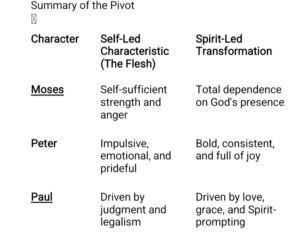
The transition from a self-led life (the flesh) to a spirit-led life is a recurring theme in the Bible. It often begins with a “wall”—a moment where human strength, intellect, or zeal reaches its limit, forcing a pivot toward total dependence on God. These case studies illustrate how God transforms ordinary, often flawed individuals into powerful vessels by shifting their leadership source.
1. Moses: From Self-Reliant Rescuer to Humble Mediator
Moses’ leadership journey began with a self-led attempt to deliver Israel. In Exodus 2, he took matters into his own hands by killing an Egyptian taskmaster, relying on his own strength and sense of justice. This act led to forty years of “wilderness training” where his self-reliance was stripped away.
The Pivot: At the burning bush, Moses was no longer the confident prince of Egypt; he was a man who argued his own inadequacy.
The Spirit-Led Result: Moses eventually learned to lead from a place of “rest rather than burnout”. He refused to move toward the Promised Land without God’s direct presence and learned to share the burden of leadership by endowing seventy elders with the same Spirit that was upon him.
2. The Apostle Peter: From Impulsive Zeal to Pentecostal Boldness
Peter is perhaps the most relatable example of a self-led leader. In the Gospels, he was defined by impulsiveness and self-confidence—promising never to desert Jesus only to deny Him three times. His leadership was driven by his own emotions and a “headstrong” personality.
The Pivot: After his failure and restoration, Peter experienced the baptism of the Holy Spirit at Pentecost.
The Spirit-Led Result: The man who cowered before a servant girl stood boldly before thousands in the very city where Jesus was crucified. He transitioned from being “self-consumed and full of pride” to a leader who was “flexible and available” to follow the Spirit’s promptings, such as when he was led to open the Gospel to the Gentiles in Acts 10.
3. Paul the Apostle: From Religious Zealot to Servant of Grace
Before his conversion, Saul of Tarsus was a “model” of self-led religious leadership. He was driven by certainty, judgment, and legalistic zeal, believing his persecution of the church was a service to God. His leadership was anchored in his own academic pedigree and status as a Pharisee.
The Pivot: On the road to Damascus, a blinding light and the voice of the risen Jesus shattered his self-led agenda.
The Spirit-Led Result: Paul’s radical transformation saw him move from “condemnation to grace”. His entire ministry became a “Spirit-led journey,” where he frequently adjusted his plans based on the Spirit’s prohibition or invitation (Acts 16:6-10). He became the primary voice for the doctrine of “walking in the Spirit” as the only way to overcome the flesh (Galatians 5:16).
Concluding Remarks
In the end, the choice between a self-led and Spirit-led life is a defining one. While the self-led path may offer temporary success, it’s the Spirit-led life that brings true transformation, purpose, and peace. By surrendering to God’s guidance and allowing the Holy Spirit to lead, we can move from striving to thriving, producing fruit that lasts and making a lasting impact.
Choosing a Spirit-led life is a profound exercise of the free will God has gifted us. By surrendering our own understanding and desires, we’re actually leveraging our authority to align with God’s perfect plan.
It’s a wise stewardship, recognizing that true freedom comes from submitting to the One who created us, and allowing the Spirit to guide our decisions and actions. This partnership with God brings a deeper sense of purpose and fulfillment, as we trust His leading and experience the abundant life He promises.
Isaac Megbolugbe, Director of GIVA Ministries International. He is a recipient of Albert Nelson Marquis Lifetime Achievement Award in business and academia in the United States of America. He is retired professor at Johns Hopkins University and a Fellow of the Royal Institution of Chartered Surveyors. He is resident in the United States of America.
