
Sorrow-Sweet Nostalgia: A Tribute to My American Parents
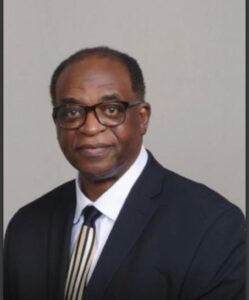
Isaac Megbolugbe
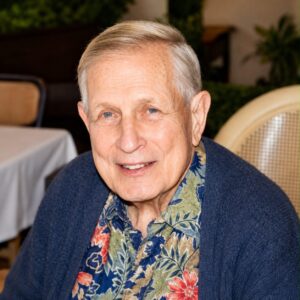
Professor Emeritus William G. Grigsby
(1927 – 2021).
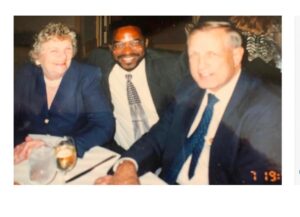
Professor Megbolugbe with the Grigsbys.
June 17, 2026
Introduction
As I look ahead to my 75th birthday on February 2, 2027, I recently found myself in a profound conversation with Professor Bola Ayeni at the University of Ibadan. We spoke about the figures who have shaped our lives. Out of our exchange, and inspired by a recent tribute article written in my honor, I decided to write this piece. Reflecting on my mentors—especially the late Professor Emeritus William G. Grigsby of the University of Pennsylvania—brings a mix of joyful sadness, but writing this remembrance offers deep therapeutic healing.
The Tapestry of Mentorship
Throughout one’s professional and personal journey, we rarely accomplish greatness in a vacuum. We stand on the shoulders of giants who provided the scaffolding for our careers. For me, that scaffolding was built by brilliant scholars and surrogate parents who took me under their wing, guided my intellectual curiosity, and nurtured my professional growth in the field of urban and housing economics or real estate economics and finance.
Among these great mentors was Professor Emeritus William G. Grigsby. He was far more than an academic advisor; he was a guiding force who treated me like family. His foundational work, such as Housing Markets and Public Policy, shaped the way we understand neighborhood dynamics, spatial poverty, and urban housing. During my formative years, he instilled in me a rigorous approach to research, alongside a quiet integrity and kindness that defined his long tenure at the University of Pennsylvania.
Reflecting on his memory—and the memory of others who have crossed the divide—evokes a powerful mixture of sorrow for their absence and profound gratitude for their presence in my life. This “joyful sadness” is a natural response to losing people who helped mold your very existence.
Connecting the Past and the Future
Conversations with esteemed colleagues like Professor Bola Ayeni remind us of the universal need to honor our intellectual and personal lineage. Just as Professor Ayeni has emotionally and publicly paid tribute to his own legendary mentors, I too look back at my American parents and teachers like Professor Grigsby to understand my own place in the world.
Putting these thoughts down on paper—a practice I have embraced in my recent autobiographical and reflective writings—provides a crucial release. It allows me to untangle the complex web of emotions, grief, and appreciation. Processing the memory of our departed mentors through writing is highly therapeutic. I have already done that extensively for the late Professor Emeritus Akin Mabogunje. It keeps their legacies alive while allowing us to find closure and celebrate the extraordinary privilege we had to walk alongside them.
Looking Forward
As I look forward to my upcoming milestones, including 2027, I will continue to process these emotions and commit my experiences to the written word. It is my hope that remembering these towering figures honors their legacy and provides a roadmap for the next generation of scholars and mentees.
Reflecting on My Academic Journey and the Legacy of Professor William G. Grigsby
Among the most pivotal influences on my career was my American father, the late Professor Emeritus William G. Grigsby. He was my professor of housing policy at the University of Pennsylvania during my doctoral program from 1980 to 1983.
Before I began my studies with him, I was heavily discouraged by senior Nigerian students who had trodden that path before me. They warned me against working with Professor Grigsby, claiming he had failed to graduate any doctorate students for many years. They painted him as an uncompromising academic who was incredibly difficult and hard to please.
Despite these ominous warnings, I took one of his courses and diligently read five of his books alongside numerous articles. This intensive study gave me the exact confidence I needed to schedule a face-to-face meeting with him. I brought along a monograph he had assigned in class, eager to reconcile a few of his policy arguments across multiple publications that seemed to create ambiguities against the logic of the monograph.
To the absolute shock of those who had warned me about him, Professor Grigsby was not offended by my critique. Instead, he was deeply impressed by my thoroughness. He hired me on the spot as a research assistant and assigned me a dedicated office in his building. I was tasked with reworking his ongoing series of research monographs, including the very text that had served as the focal point of our initial discussion in the fall of 1980.
Our professional dynamic quickly transcended the traditional student-advisor relationship. He later invited my wife and me to his residence in Newtown Square, Pennsylvania. The doctoral students who had warned me were completely stunned by the warmth and closeness of our relationship.
That meeting marked the beginning of a profound bond that ultimately blossomed into me becoming an adoptive son of the Grigsby family. As I reflect on the journey leading up to my 75th birthday, I am reminded that true mentorship shatters preconceptions and cultivates legacies that endure a lifetime.
The Gift of High Expectations: How an Academic Rejection Forged a Lifelong Family Bond
When Professor William G. Grigsby agreed to become the Chairman of my PhD Thesis Committee at the University of Pennsylvania, I felt a profound sense of validation. Armed with enthusiasm, I poured my energy into crafting a meticulous, 20-page thesis proposal. I handed it to him with high hopes, only for it to be rejected on the spot—without him reading a single word of it.
His reasoning took me completely by surprise. He looked at me and insisted that I was simply too brilliant to spend my time writing a conventional planning dissertation that merely evaluated programs developed by other people. Instead, he challenged me to build an entirely original model of the housing market from scratch—one that could be actively utilized for analysis, program development, and critical evaluation.
To guide me toward this ambitious target, he introduced me to a cutting-edge concept that was just beginning to disrupt the field of housing policy: hedonic price theory. Knowing the steep technical climb ahead of me, Professor Grigsby went above and beyond by funding two specialized tutors out of his own pocket. For two full semesters, these tutors intensively trained me in statistical theory and econometrics.
Realizing the technical direction my research was taking, he made a remarkably selfless decision to transfer his role as committee chairman to Professor Peter Linneman at The Wharton School. Professor Linneman had recently graduated from the University of Chicago, where he had written his own dissertation on hedonic indexes. Under this powerhouse guidance, I successfully produced an advanced dissertation that rivaled the empirical rigor of competitive economics and finance majors at Wharton. The true crowning moment came when I sat with Professor Grigsby in his office for a two-hour discussion of my core chapters; seeing his immense pride and satisfaction meant everything to me.
Our professional journey soon evolved into a beautiful, lifelong personal chapter. Following graduation, my wife and I stayed at the Grigsby home for about three months. During this period, we bonded deeply with his wife and children. Having five daughters of his own, Professor Grigsby and I became practically inseparable. His wife watched our close dynamic unfold, noticed how the fiancé of one of their daughters looked up to me like a big brother, and formally decided to “adopt” me as her son. Unofficially but fully in spirit, my wife and I became true members of the Grigsby family—a bond forged in the fires of academic challenge and unconditional love.
From Ibadan to Tallahassee: How a Father’s Faith Directed My Career and Destiny
Returning to Nigeria in 1983, my wife and I were eager to begin a new chapter as I accepted a faculty position at the University of Ibadan. Even across the ocean, the geographic distance did nothing to diminish the profound bond between Professor William G. Grigsby and me. At the time, we stayed in regular communication by mail as he meticulously helped me review the very first academic article extracted from my doctoral dissertation, which was being prepared for submission to the prestigious Journal of Regional Science.
While I was settling into my role in Nigeria, Florida State University was launching a competitive national search for a unique faculty member. They required an academic who possessed a finely blended expertise spanning urban planning, housing policy, and demographic science. When recruiters contacted the University of Pennsylvania seeking top-tier candidates, two legendary figures championed my name: the late Professor Seymour Mandelbaum—who served as a professor of planning theory and the Chairman of the Graduate Group in City and Regional Planning—and, of course, Professor Grigsby. In an extraordinary show of faith, both of themindependently told the search committee that I was the top doctoral student of their respective careers.
Shortly after, Professor Grigsby reached out to me with what seemed like a casual academic opportunity. He asked me to travel to Florida State University to present my forthcoming paper for the Journal of Regional Science. Naively, I agreed and made the trip, completely unaware that this presentation was actually a formal job interview. My presentation was an immediate success, and the university extended a job offer on the spot. Later, several FSU faculty members pulled me aside to share the glowing, unparalleled letters of recommendation that both Professors Grigsby and Mandelbaum had written on my behalf.
That fateful appointment in 1986 set the trajectory for the rest of my professional history. From that year until his passing in 2021, Professor Grigsby and I interacted not as former advisor and student, but as father and son, sharing a lifetime of tremendous intimacy, mutual respect, and deep fellowship.
We were, in every sense of the word, true gifts to one another. Today, as I look forward with profound gratitude to God toward my own 75th birthday next year, I carry his memory in my heart as a guiding light of unconditional love, belief, and academic excellence.
The Architects of My Mind and Career: The Enduring Influence of Professors William G. Grigsby and Seymour Mandelbaum
My journey through the doctoral program at the University of Pennsylvania from 1980 to 1983 was defined by more than just rigorous coursework; it was shaped by two towering figures who became my intellectual anchors and lifelong champions. While my relationship with Professor William G. Grigsby gave me a surrogate family and an analytical foundation in housing policy, it was the late Professor Seymour Mandelbaum who profoundly expanded my academic worldview and structurally propelled my professional career.
As the Chairman of the PhD Graduate Group in City and Regional Planning, Professor Mandelbaum possessed a rare, panoramic vision of planning theory and institutional design. Early in my doctoral studies, he recognized a capacity in me that I was still discovering myself. He extended an invitation for me to serve as his teaching assistant for his foundational planning theory course. This role was not merely an assistantship; it was a masterclass in pedagogy, critical thinking, and intellectual empathy.
Professor Mandelbaum’s mentorship was defined by an active, intentional effort to elevate my standing within the academic community. Recognizing my strength in analytical frameworks, he recommended me to Professor Britton Harris—a legendary pioneer in planning science—who taught Microeconomics for Planners. Initially brought in to assist, I began leading tutorial sessions for the students. After watching me command the classroom during one of these sessions, Professor Harris was so impressed that he confidently left the course for me to teach by myself. To be trusted with such responsibility as a graduate student at an Ivy League institution was an extraordinary validation, orchestrated entirely by Mandelbaum’s belief in my capabilities.
Beyond the lecture halls, Professor Mandelbaum enveloped me in an environment of deep affection, culture, and professional inclusion. He bridged the gap between student and colleague by taking me to opera performances and inviting me to accompany him to major academic meetings. Most remarkably, as Department Chairman, he included me in formal faculty meetings. This unprecedented access allowed me to observe the inner workings of academic governance, curriculum design, and institutional politics firsthand, fundamentally shaping how I viewed the structures of higher education.
Our bond did not conclude when I graduated or when I later returned from Nigeria to join the faculty at Florida State University in 1986—an appointment made possible because both he and Professor Grigsby wrote glowing letters naming me the top doctoral student of their careers. Years later, when I transitioned into the corporate sector to become the Head of Research at Fannie Mae, our professional roles beautifully reversed. I found myself in a position to award Professor Mandelbaum a competitive research grant. He leveraged this funding to visit me in Washington, D.C. on two separate occasions, transforming our relationship into one of mutual institutional support.
In fact, Professor Mandelbaum’s influence came full circle during my transition to corporate leadership. He was highly instrumental in Fannie Mae hiring me for that pivotal role. The company urgently needed an expert to help implement the complex Government-Sponsored Enterprise (GSE) legislation, which mandated Fannie Mae to meet and report on strict affordable housing requirements placed on their business by the United States Congress. Mandelbaum knew that my deep training under Grigsby—fused with the institutional and planning theories I honed under his own guidance—made me uniquely qualified to bridge the gap between complex federal policy and corporate research strategy.
As I look forward with profound gratitude to God toward my 75th birthday next year on February 2, 2027, I see clearly how the trajectories of my life were engineered by these extraordinary men. Professor Grigsby gave me a father’s love and an analytical compass. Professor Mandelbaum gave me an expansive worldview, pedagogical confidence, and the institutional stepping stones that defined my career. I carry their legacies forward not just as a scholar, but as a son who was profoundly blessed by their belief in my potential.
Isaac Megbolugbe, Director of GIVA Ministries International. He is a recipient of Albert Nelson Marquis Lifetime Achievement Award in business and academia in the United States of America. He is retired professor at Johns Hopkins University and a Fellow of the Royal Institution of Chartered Surveyors. He is resident in the United States of America.
