
The Embodiment of Rights, Authorities and Agencies
Isaac Megbolugbe
April 9, 2026
Introduction
The concept of embodiment is central to understanding the nature of rights, authorities, and agencies, particularly in the context of Jesus Christ and believers. In John 10:17-18, Jesus declares his authority to lay down his life and take it up again, showcasing his divinity and voluntary sacrifice. This pivotal claim highlights the distinction between Jesus’ inherent authority and the delegated authority of believers. This article explores the embodiment of rights, authorities, and agencies, examining the differences between Jesus’ divine nature and human believers, and providing practical applications for exercising authority in daily life.
Jesus Christ’s Embodiment
Jesus declared in John 10:17–18 that he has the authority to voluntarily lay down his life and the authority to take it back up again, stating: “No one takes it from me, but I lay it down of my own accord. I have authority to lay it down, and I have authority to take it up again. This commandment I received from my Father.”
This declaration is a pivotal claim to his divinity and his role as the Good Shepherd who willingly sacrifices himself for humanity.
Meaning of Possessive Rights and Authorities
These statements indicate that Jesus’ death was not a defeat or a result of helplessness against his accusers, but a voluntary, orchestrated act of redemption.
Authority to Lay Down Life (“Own Accord”): Jesus means that his life could not be taken from him by Romans or Pharisees without his consent. He had the power to prevent his death but chose to lay it down voluntarily at his own initiative to save his sheep (believers) from sin, death, and judgment.
Authority to Take Life Up Again (“Resurrection”): Jesus is claiming the divine power to raise himself from the dead, demonstrating that he is the source of life and is not permanently subject to death. While other New Testament verses say God raised Jesus, this verse shows that Jesus is also actively involved in his own resurrection, asserting his divinity.
Possessive Rights (Ownership): By referring to his life (“my life”), Jesus emphasizes his ownership of his own existence, which distinguishes his sacrifice from a mere martyr’s death or suicide.
Sources of Jesus’ Authority
Jesus explicitly identifies the source of this authority and the reason for his sacrifice:
The Father’s Commandment: He states, “This command I received from my Father,” indicating that his sacrificial death and subsequent resurrection was a deliberate, unified plan of the Triune God. His submission to this command was an act of obedience rooted in love for the Father and humanity.
The Father’s Love: Jesus implies his sacrifice is the reason the Father loves him in his mediatorial role: “The Father loves me because I lay down my life…”.
His Deity: Because Jesus is the eternal Son of God (the Logos), he has authority in himself as the creator and sustainer of life.
Completed Obedience: Having lived a sinless life and died as a sacrifice, Jesus “earned” the right to
Key Takeaways
Voluntary Sacrifice: The crucifixion was a triumph, not a tragedy.
Victory Over Death: Jesus’ power to resume life proves his mastery over death.
Divine Unity: The Father and Son were united in the plan of redemption.
Disparate Embodiment
The rights, authorities and agencies embodied by Jesus Christ and believers operate differently. It is true that Jesus shared humanity with believers. Believers too share divine connections with Jesus.
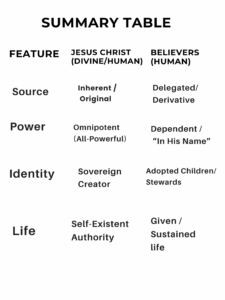
In Christian theology, the rights, authorities, and agencies of Jesus Christ are fundamentally distinct from those of human beings and believers. While Jesus is “fully human,” his identity as “fully divine” creates a unique category of authority that is original and sovereign, whereas human authority is derivative and delegated.
1. Inherent vs. Delegated Authority
The primary difference lies in the source of authority.
Jesus Christ: He possesses “all authority in heaven and on earth” (Matthew 28:18). This is ontological authority—it belongs to him by nature because he is the Creator and Sustainer of the universe. He does not merely “represent” God; he is God, and thus his rights are absolute and self-existent.
Human Beings/Believers: All human authority is delegated (or “derivative”). Romans 13:1 states that “there is no authority except that which is from God.” Believers do not possess authority in themselves; they exercise it only “in the name of Jesus”. Like a police officer whose power comes from the state, a believer’s agency is effective only as long as they remain under the higher authority of Christ.
2. Divine Agency vs. Human Agency
Agency refers to the capacity to act and make choices.
Jesus’ Agency: As the God-man, Jesus possesses a perfected agency. He has the “authority to lay down [his] life and take it up again,” a right no other human possesses [John 10:18]. His divine agency is characterized by aseity (self-existence) and omnipotence (all-power), meaning his will cannot be thwarted by external forces.
Believers’ Agency: Human agency is finite and was compromised by the Fall. While humans have the “God-given right to choose,” this agency is often limited by sin or spiritual “slavery”. Believers operate in a “partnership” or synergistic agency, where they are called to “work out [their] salvation” while recognizing it is “God who works in [them]” (Philippians 2:12-13).
3. Communicable vs. Incommunicable Rights
Theology distinguishes between attributes of God that humans can reflect (communicable) and those they cannot (incommunicable).
Incommunicable Rights (Christ alone): Only Jesus has the right to be worshiped, the right to judge the world, and the right to forgive sins by his own power. These are based on his nature as eternal and unchangeable.
Communicable Rights (Believers): Through “adoption” in Christ, believers are granted certain “legal rights,” such as the right to be called children of God(John 1:12) and the right to approach God’s throne with confidence. Believers are called to mirror Christ’s communicable attributes—like love, justice, and holiness—but only in a “creaturely measure”.
4. Scope and Jurisdiction
Jesus: His jurisdiction is universal and eternal. He holds the “keys of death and Hades” and rules over all principalities and powers.
Believers: Their authority is specific and functional. It is largely “spiritual authority” delegated for the purpose of the Great Commission—to preach, baptize, and make disciples. Believers are “stewards” or “ambassadors,” meaning they have the agency to represent the King, but they do not own the Kingdom.
Exercising Delegated Authority: Living Under the Lordship of Christ
For the believer, “authority” is not a badge of power to be wielded for self-interest, but a stewardship to be exercised in total surrender. Because Jesus claims “all authority in heaven and on earth” (Matthew 28:18), the believer’s authority is delegated—meaning it only functions effectively when the believer remains “in Christ” and under His Lordship.
Here is how a believer practically exercises this authority in daily life through the framework of obedience and surrender.
1. The Foundation: Authority Through Submission
In the Kingdom of God, authority is paradoxically linked to submission. As illustrated by the Roman Centurion in Matthew 8:9, one can only exercise authority if they are first under authority.
Daily Surrender: To exercise Christ’s authority over sin or circumstances, one must first surrender their own will to His. You cannot command peace in your home if you are rebelling against God’s command to love.
The “In the Name” Principle: Using the “Name of Jesus” isn’t a magic formula; it is a legal power of attorney. It means acting on His behalf, for His purposes, and according to His character.
2. Authority Over the Internal Realm (Self-Mastery)
The first theater where delegated authority is exercised is within the believer’s own soul.
Taking Thoughts Captive: 2 Corinthians 10:5 instructs believers to “take every thought captive to obey Christ.” This is the practical exercise of authority over fear, anxiety, and temptation.
Mortification of Sin: Through the Holy Spirit, believers have the “right” and power to say “no” to the dictates of the flesh. We are no longer slaves to sin; we exercise our new identity as “slaves to righteousness” (Romans 6:18).
3. Authority in the Spiritual Realm (Prayer and Warfare)
Believers are granted agency to engage in spiritual realities that affect the physical world.
Intercessory Prayer: Prayer is the primary mechanism of delegated authority. It is not “begging” a reluctant God, but “binding and loosing” (Matthew 16:19)—declaring God’s revealed will on earth as it is in heaven.
Resisting the Adversary: James 4:7 provides the sequence: “Submit yourselves therefore to God. Resist the devil, and he will flee from you.” The authority to resist is entirely dependent on the prior act of submission.
4. Authority in Relationships and Stewardship
Delegated authority manifests in how we handle the “spheres” God has placed us in—family, work, and community.
Servant Leadership: Following Christ’s model, the believer exercises authority not by “lording it over” others, but by washing feet. A parent or manager exercises Christ-like authority when they seek the flourishing of those under their care.
The Ministry of Reconciliation: Believers are “ambassadors” (2 Corinthians 5:20). An ambassador has the full authority of their home government to negotiate peace. We exercise this by speaking the Gospel into broken situations, acting as agents of God’s healing.
5. Authority Over Circumstances (Trust and Decree)
While believers do not control the world, they exercise authority over their response to it.
Speaking Truth to Fact: When faced with a crisis, the believer exercises authority by aligning their speech with God’s Word rather than their feelings. This is the “sacrifice of praise”—choosing to acknowledge God’s sovereignty when circumstances suggest otherwise.
Occupying the Territory: In every “secular” space—the office, the school, the gym—the believer is a representative of the Kingdom. By acting with integrity and excellence, they “occupy” that space for the Lord, pushing back the darkness through their presence.
Summary: The Key is Abiding
The “agency” of a believer is like a branch attached to a vine (John 15). The branch has the “authority” to produce fruit, but it has no power to do so if severed. Practical authority is the natural byproduct of a life that is hidden in Christ. When we live in total obedience, His power flows through our hands, His words flow through our mouths, and His kingdom advances through our lives.
The Believer’s Bill of Rights: Scriptural Promises of Our Legal Standing in Christ
In the court of heaven, the believer is not a defendant pleading for mercy from a distance; they are a justified child of God with specific, codified “legal rights.” These rights are not earned through human merit but are secured by the blood of Jesus Christ, who acts as our High Priest and Advocate.
To understand these rights is to move from a “begging” mentality to a “possessing” mentality—recognizing what has already been signed, sealed, and delivered by the Holy Spirit.
1. The Right of Adoption and Inheritance
The most fundamental legal shift for a believer is a change in status from “slave” or “stranger” to “heir.”
The Promise: “But to all who did receive him, who believed in his name, he gave the right to become children of God”(John 1:12).
The Legal Reality: Adoption is a legal act. According to Romans 8:17, if we are children, then we are “heirs—heirs of God and co-heirs with Christ.” This means that everything that belongs to the Son by nature now belongs to the believer by grace. We have a legal claim to the peace, joy, and spiritual resources of the Kingdom.
2. The Right of Justification (The “Double Imputation”)
In a legal sense, justification means being declared righteous. It is a courtroom verdict that cannot be overturned.
The Promise: “There is therefore now no condemnation for those who are in Christ Jesus” (Romans 8:1).
The Legal Reality: Through what theologians call “Double Imputation,” our sins were legally transferred to Christ, and Hais perfect righteousness was legally transferred to us (2 Corinthians 5:21). Because the “debt” of sin has been paid in full, the believer has the right to stand before God without guilt, shame, or the fear of future punishment.
3. The Right of Access (The Open Courtroom)
In ancient times, approaching a king without an invitation could result in death. In Christ, the “veil” has been torn.
The Promise: “Let us then with confidence draw near to the throne of grace, that we may receive mercy and find grace to help in time of need”(Hebrews 4:16).
The Legal Reality: We have “permanent press credentials” to the throne room. This is the right of Direct Access. We do not need a human mediator; we have the legal standing to present our petitions directly to the Father at any moment, day or night.
4. The Right of Divine Protection and Advocacy
Every citizen of a kingdom has a right to the protection of the Sovereign.
The Promise: “No weapon that is fashioned against you shall succeed, and you shall confute every tongue that rises against you in judgment” (Isaiah 54:17).
The Legal Reality: When the “accuser of the brethren” (Satan) brings charges against a believer, we have a right to an Advocate (a defense attorney). 1 John 2:1 states, “We have an advocate with the Father, Jesus Christ the righteous.”Christ doesn’t argue our innocence; He presents His own blood as the legal satisfaction for our debt.
5. The Right to Use the “Name” (Power of Attorney)
This is perhaps the most practical legal right for daily life.
The Promise: “Whatever you ask in my name, this I will do, that the Father may be glorified in the Son” (John 14:13).
The Legal Reality: Using the “Name of Jesus” is the spiritual equivalent of a Power of Attorney. In a legal setting, a person with power of attorney can sign documents and make decisions that are as legally binding as if the principal had done them themselves. When a believer speaks “in the Name of Jesus” in alignment with His will, the authority of the Principal (Christ) backs that word.
6. The Right of Sealing and Ownership
In the ancient world, a seal on a document or a crate signified ownership and authenticity.
The Promise: “In him you also… were sealed with the promised Holy Spirit, who is the guarantee of our inheritance”(Ephesians 1:13-14).
The Legal Reality: The Holy Spirit is the “earnest money” or “down payment.” Legally, this seal warns all other powers that this individual is the private property of the King of Kings. You have the right to be “kept” by God because you are His legal possession.
Conclusion: Exercising Your Rights
A legal right is useless if the citizen is unaware of it or refuses to invoke it. Believers exercise these rights not through pride, but through faith. When fear attacks, we invoke the right of Adoption. When guilt attacks, we invoke the right of Justification. When we face spiritual opposition, we invoke the right of the Name.
By standing on these scriptural promises, we move from a life of spiritual poverty to a life of “kingdom agency,” effectively representing the Lordship of Christ in every sphere of our existence.
Believers’ Legal and Secular Rights
While both the “Legal Rights of the Believer” and “Secular Human Rights” aim to protect the dignity and agency of the individual, they originate from fundamentally different foundations, serve different masters, and offer different levels of security.
The following comparative study analyzes these two frameworks across four key dimensions: Source, Nature, Scope, and Duration.
1. The Source: Creator vs. Consensus
The most significant distinction lies in the “Ground of Being” for these rights.
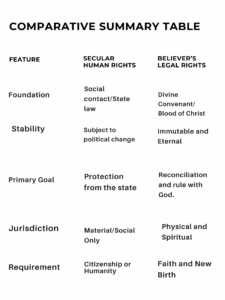
Secular Human Rights: These are typically based on social contract theory or natural law. In modern practice (such as the UN Universal Declaration of Human Rights), rights are “recognized” by the collective agreement of nations. They are horizontal—granted by humans to humans.
Believer’s Rights: These are Covenantal. They are not granted by a vote or a government but are “endowed by the Creator.” They are vertical—granted by God to the believer based on the finished work of Jesus Christ.
The Difference: Human rights can be legally amended, suspended, or revoked by the states that granted them. The believer’s rights are “immutable” because the Promiser (God) does not change.
2. The Nature: Permission vs. Power
Secular Human Rights: These are primarily negative liberties—the right not to be interfered with (e.g., freedom from torture, freedom of speech). They provide a “shield” against the overreach of the state but do not necessarily provide the internal power to live a virtuous life.
Believer’s Rights: These are positive empowerments. The right to be called a “child of God” (John 1:12) isn’t just a legal status; it comes with the “agency” of the Holy Spirit. While secular law gives you the right to speak, the believer’s covenant gives them the right to speak with authority over spiritual darkness.
The Difference: Secular rights protect your autonomy (self-law); Kingdom rights establish your theonomy (God’s law), which ironically leads to a higher form of freedom from internal slaveries like addiction or fear.
3. The Scope: Physical vs. Dimensional
Secular Human Rights: These are confined to the material and social realm. They cover property, voting, fair trials, and bodily autonomy. They stop at the threshold of the soul and have no jurisdiction over the spiritual world.
Believer’s Rights: These are multi-dimensional. A believer has “legal standing” in the physical world and the heavenly places (Ephesians 2:6). This includes the right to “bind and loose” in the spiritual realm and the right of “bold access” to the throne of God.
The Difference: A political prisoner may have their secular human rights stripped away by a dictator, yet their “Kingdom rights”—their peace, their access to God, and their eternal inheritance—remain legally untouched and operational.
4. The Duration: Temporal vs. Eternal
Secular Human Rights: These are temporary. They begin at birth (or conception, depending on the jurisdiction) and legally expire at death. You cannot take your “right to vote” or “right to property” into the afterlife.
Believer’s Rights: These are eternal. Death is actually the moment when many of the believer’s rights are “fully realized.” The right to an inheritance (1 Peter 1:4) is described as “imperishable, undefiled, and unfading.”
The Difference: Secular rights are for “citizens of earth” to navigate a fallen world; Believer’s rights are for “citizens of heaven” (Philippians 3:20) to exercise authority both now and in the age to come.
Conclusion: The Hierarchy of Rights
The believer does not discard secular human rights; rather, they view them as a “common grace” that allows for a peaceful society. However, the believer recognizes that their covenantal rights are superior. When secular laws infringe upon divine commands, the believer appeals to a “Higher Court,” as Peter did when he stated, “We must obey God rather than men” (Acts 5:29).
Exercising these rights requires a shift in perspective: seeing oneself not merely as a victim of earthly systems, but as a legally authorized representative of a Kingdom that cannot be shaken.
Biblical Case Studies
The following case studies of the Apostle Paul and Daniel demonstrate how believers navigate the tension between earthly laws and divine authority by strategically using their civil rights without compromising their higher allegiance.
Case Study 1: The Apostle Paul — Strategic Use of Citizenship
Paul provides the clearest biblical model for leveraging secular legal rights to advance the Gospel. As a Roman citizen by birth, he possessed legal protections that most of his peers did not.
Asserting Rights for Justice: In Philippi, after being beaten and imprisoned without a trial, Paul refused to be released quietly. He demanded a public apology from the magistrates, citing his rights as a Roman citizen. This forced the authorities to admit they had violated their own laws, which likely provided a layer of protection for the newly formed Philippian church.
Appealing to Higher Courts: When facing a biased trial in Jerusalem, Paul invoked his right of Appeal to Caesar (the provocatio). While this meant he remained a prisoner, it was a strategic move that allowed him to bring the Gospel to the highest levels of Roman government, including the Emperor’s own household.
The Principle: Paul viewed his Roman citizenship as a tool, but his Heavenly Citizenship (politeuma) as his true identity. He submitted to secular authorities as “God’s servants” (Romans 13) but was willing to
Case Study 2: Daniel — Integrity in the Face of Conflict
Daniel lived as an exile in Babylon and Persia, holding high-ranking political offices under kings like Nebuchadnezzar and Darius. His life highlights the boundary between civic excellence and divine disobedience.
Excellence in the Secular Realm: Daniel served the state with such integrity that his political rivals “could find no ground for complaint or any corruption” in his work. He modeled the idea that a believer should be the best possible citizen of their earthly nation.
Civil Disobedience when Laws Conflict: When King Darius signed a law forbidding prayer to any god but himself, Daniel did not stage a violent protest. Instead, he practiced quiet, persistent disobedience, continuing to pray openly as he always had. He accepted the legal consequence—the lion’s den—demonstrating that his allegiance to God’s law was absolute.
The Principle: Daniel demonstrated that believers should “seek the welfare of the city” they live in
Key Lessons for Navigating Tension
Use Legal Protections Wisely: Like Paul, believers can and should use the “rule of law” and civil rights to protect themselves and the mission of the church.
Submit Until it Sins: Biblical submission to government is the default (Romans 13), but it ends the moment a human law commands what God forbids or forbids what God commands.
Accept the Cost: Both Paul and Daniel were willing to face imprisonment or death rather than renounce their faith. Their authority came not from escaping the law, but from their moral consistency while under it.
How modern legal systems incorporate these biblical principles of “conscientious objection” and “freedom of religion”
Modern legal systems, particularly in the West, have deeply integrated biblical concepts of freedom of conscience and conscientious objection. While today’s laws are often framed in secular language, they still function as a “common grace” structure that recognizes the higher allegiance a person may have to their beliefs.
1. From “Two Swords” to Separation of Powers
The modern concept of separating Church and State is rooted in the biblical principle, “Render unto
Historical Shift: Early Christian “apologists” were among the first to argue for a theological rationale for the freedom to practice one’s chosen religion. This led to the medieval “two swords” doctrine, which eventually evolved into the modern legal distinction between civil authority and religious belief.
Inalienable Rights: Many modern constitutions are based on the idea of “inalienable rights”—rights that are inherent to human personhood because they are granted by a Creator, not the state.
2. Conscientious Objection: A Legal “Grace”
Modern law provides specific exemptions for individuals whose deeply held beliefs conflict with government mandates.
Military Service: Historically, the most famous application is the right to refuse combatant service based on religious or moral grounds.
Healthcare and Bioethics: Federal “conscience protection” statutes in the U.S. prohibit discriminating against healthcare providers who refuse to participate in services (like abortion or assisted suicide) that violate their religious or moral convictions.
The “Complicity” Claim: Modern courts increasingly recognize “complicity-based” claims, where believers seek exemptions from laws that would make them “complicit” in what they define as sinful conduct by others.
3. Freedom of Religion as a Non-Absolute Right
While the Bible views religious freedom as an eschatological gift from the Creator, modern legal systems treat it as a fundamental but non-absolute right.
The Balancing Test: Governments can limit religious manifestation if it is necessary to protect public safety, health, or the fundamental rights of others.
Legislative Grace: In many cases, conscientious objection is viewed as a “legislative grace”—a specific favor granted by lawmakers rather than an absolute constitutional override.
4. Modern Protections and Tools
For those looking to understand or defend these rights today, several resources and legal frameworks exist:
Legal Protections: The Department of Justice provides guidelines on federal protections for religious liberty.
Advocacy Groups: Organizations like the American Civil Liberties Union (ACLU) and the Christian Legal Society work to defend religious practice and expression across different faith backgrounds.
Educational Resources:
Law and the Bible: Justice, Mercy and Legal Institutions: A foundational text for those wanting to think about law from a Christian perspective, available at Christianbook.com (~$25.70) or Barnes & Noble (~$5.99).
Natural Law and Religious Freedom: Explores how natural law ethics ground basic human rights, available at Routledge (~$49.59).
Concluding Remarks
In conclusion, the embodiment of rights, authorities, and agencies is a complex and multifaceted concept that underscores the distinct nature of Jesus’ divinity and human believers. While Jesus possesses inherent authority, believers operate under delegated authority, submitting to God’s will and exercising power through faith. By understanding these differences and embracing our rights and responsibilities as believers, we can effectively navigate the tension between earthly laws and divine authority, living out our faith with confidence and integrity. As we abide in Christ and yield to the Spirit, we embody the principles of righteousness, reflecting God’s glory in our lives.
Isaac Megbolugbe, Director of GIVA Ministries International. He is a recipient of Albert Nelson Marquis Lifetime Achievement Award in business and academia in the United States of America. He is retired professor at Johns Hopkins University and a Fellow of the Royal Institution of Chartered Surveyors. He is resident in the United States of America.
