

The End of Self, The Beginning of Glory: Why Comparing We to Christ is the Ultimate Quest
Isaac Megbolugbe
April 10, 2026
Introduction
We are often told that comparison is the thief of joy, a trap that leaves us hollow and envious. In a secular sense, this is absolute truth; measuring our lives against our neighbors only breeds anxiety or pride. But for the believer, there is a “holy comparison” that does not steal—it hollows us out only to fill us with something better. When we stop measuring ourselves against the world and start looking at the stature of Jesus Christ, our self-derived joy ends, and His glory begins.
The Shift: From Horizontal to Vertical
Most comparisons are horizontal. We look at the talents, possessions, or status of others and find ourselves either despairing in inferiority or inflated by superiority. This type of comparison is “not wise” (2 Corinthians 10:12) because it distracts us from the unique purpose God has for us.
The transformative power of comparison only appears when we turn our gaze vertically. Comparing our lives to the standard of Jesus is not a tool for misery, but for maturity. By looking at His sinless, perfect character, we quickly realize our inability to meet that standard, which drives us away from self-reliance and toward a total dependence on His grace.
Forfeiting Our Joy for His Victory
The spiritual journey requires a process of moving from self-centeredness to Christ-centeredness. In this context, the “end of joy” is actually a desirable outcome. It is the death of our selfish pride and our superficial, performance-based happiness.
Relishing in His victory means we stop trying to be the hero of our own story. We cease trying to achieve our own glory and instead find satisfaction in His. Our joy is no longer dependent on being “better” than someone else, but on being loved and redeemed by the One who is the best. As we relinquish our own small victories, we find ourselves falling into a state of profound reverence and worship.
The Ache of the Almost: Longing for the Promise
When we compare our current, fractured selves to the radiant perfection of Jesus, it naturally creates a holy ache. This is not the hollow sting of envy, but the focused desire of a traveler glimpsing home. Our self-made joy must end so that a deeper, more resilient hope can take its place—a hope anchored in His victory.
The ultimate beauty of this vertical comparison is that it doesn’t leave us in a state of permanent inadequacy. Instead, it points us toward the fulfillment of His greatest promise: “We know that when Christ appears, we shall be like him, for we shall see him as he is” (1 John 3:2).
Our current quest to become like Him is the “beginning of glory”—a foretaste of the day when our mirrors will no longer show us our failures, but His reflection. We relinquish our small, earthly joys today because we are waiting for a joy that is weightier and eternal. In the quiet space where our pride used to live, we now find reverence, worship, and an unshakeable longing for the day we are finally, fully glorified alongside our King.
To Live is Christ, To Die is Gain: The Sacred Tension of the Believer’s Longing
In the heart of every believer lies a profound paradox—a deep, satisfying joy in the present life, intertwined with an ache for a world they have not yet fully seen. This tension is perhaps most famously articulated by the Apostle Paul in his letter to the Philippians: “For to me, to live is Christ and to die is gain” (Philippians 1:21).
This maxim is not a expression of worldly dissatisfaction or a “death wish.” Rather, it is a declaration of a transformed identity. It reveals the nature and consequences of a dual longing: the desire to be like Christ in this life, and the desire to be with Christ in the next.
The Nature of the Longing: To Live is Christ
To say “to live is Christ” is to acknowledge that the source, purpose, and goal of existence have shifted. The longing to be like Him is the engine of the Christian life.
A Participatory Life: This longing isn’t about following a moral code; it’s about a shared life. Paul is suggesting that his very breath, his heartbeat, and his daily labor are fueled by the person of Jesus. To live is to allow Christ’s character—His humility, His sacrificial love, and His obedience—to be replicated in our own flesh.
The Refining Fire: Longing to be like Him means welcoming the “fellowship of His sufferings” (Philippians 3:10). It is a desire so potent that the believer is willing to endure the “hollowing out” of their own ego so that the life of Jesus might be made visible.
The Nature of the Longing: To Die is Gain
The second half of Paul’s maxim—”to die is gain”—introduces the longing to be with Him. In a secular context, death is the ultimate loss: the loss of breath, family, and legacy. In the context of faith, death is a promotion.
Proximity over Property: The “gain” Paul speaks of is not a golden crown or a mansion; the gain is uninterrupted proximity. It is the transition from “seeing through a glass darkly” to seeing “face to face.”
The End of the Quest: To be with the Lord is the resolution of the “holy ache.” It is the moment when the quest to be like Him is finally fulfilled because we see Him as He is (1 John 3:2).
The Consequences: A Life of “Holy Indifference”
When a believer holds these two longings in balance, it produces a specific set of consequences that change how they move through the world.
1. Fearlessness Toward the World
If death is gain, then the world loses its ultimate weapon of fear. The believer becomes “dangerously” free. They can serve, sacrifice, and take risks for the Gospel because they know that even the worst-case scenario (death) results in the best-possible outcome (being with Christ).
2. Purposefulness in the Present
Ironically, longing for heaven makes a person more effective on earth. Paul concludes that while he prefers to be with Christ, remaining in the flesh is “more necessary” for the sake of the church (Philippians 1:24). The longing to be with Jesus doesn’t lead to laziness; it leads to a frantic, joyful diligence to finish the work He started.
3. The Dissolution of Petty Joy
When the primary goal is Christ-likeness and Christ-presence, the “joy” found in earthly comparison, status, or comfort begins to evaporate. These things are not necessarily evil, but they become “rubbish” (Philippians 3:8) in comparison to the surpassing worth of knowing Christ Jesus.
The Fulfillment of the Quest
The tension between “to live” and “to die” is the sweet spot of the Christian walk. It is the realization that we are citizens of another kingdom, currently serving as ambassadors in this one.
Ultimately, the longing to be like Him and the longing to be with Him are two sides of the same coin. We strive to resemble Him now because we love Him, and we yearn to be with Him later because He is our home. As Paul demonstrates, the believer doesn’t choose between the two; they live in the fruitful, holy pressure of both, waiting for the day when faith finally turns to sight.
The Intersection of Christ-Centered Living and Divine Rest
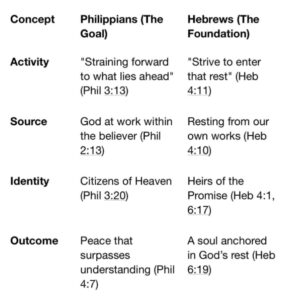
The theological frameworks presented in the ApostlePaul’s letter to the Philippians and the book of Hebrews (traditionally associated with Paul or his circle) converge on a singular vision for the believer: a life where outward labor is fueled by an inward, unshakeable state of “God’s rest.”
While Philippians emphasizes the active pursuit of Christ, Hebrews underscores the receptive posture ofentering God’s rest. Together, they form a holistic model for a normative Christian lifestyle—one that is both intensely purposeful and profoundly still.
1. The Philippian Framework: To Live is Christ
In Philippians, the Christian lifestyle is defined by “union with Christ.” For Paul, this is not a static theological fact but a dynamic, all-consuming reality.
Christ as the Source and Goal: Paul’s maxim “to live is Christ” (Philippians 1:21) suggests that his very breath and daily labor are an extension of Jesus’ life. The goal of this lifestyle is to advance the Gospel and display Christ’s character through humility and sacrificial love.
The Power of the Resurrection: A normative life in this context involves “working out” salvation (Philippians 2:12) not by human effort, but by relying on the God who “works in you” to will and to act according to His good pleasure.
The Secret of Contentment: This lifestyle is marked by a deep, spiritual joy that is independent of external circumstances, derived from the “surpassing worth” of knowing Christ.
2. The Hebrews Admonition: Living Under God’s Rest
The writer of Hebrews introduces the concept of “God’s rest” (Hebrews 4) as a continuing reality that remains available to the people of God.
Rest as Faith: In Hebrews, rest is the opposite of “unbelief” and “disobedience.” Entering God’s rest means ceasing from one’s own works—specifically the works of self-justification and legalism—just as God rested from His.
The “Today” of Rest: Unlike a one-time event, this rest is a normative, daily experience. It is accessed “today” by hearing God’s voice and refusing to harden the heart.
The Superior Joshua: While Joshua led Israel into the physical rest of Canaan, Hebrews points to Jesus as the one who leads believers into an eternal, spiritual rest that satisfies the restlessness of the soul.
3. The Intersection: Laboring from a State of Rest
The intersection of these two frameworks creates a “labor-to-rest” paradox. A believer’s lifestyle is characterized by intense activity (Philippians) that flows from a place of spiritual cessation (Hebrews).
The Normative Lifestyle: Active Stillness
When the Philippian vision meets the Hebrews rest, the resulting lifestyle is one of active stillness. The believer “works out” their salvation (Philippians) because they have already “entered” the rest of God (Hebrews).
In this normative state, the pressure to “be enough” or “do enough” is replaced by the sufficiency of Christ. The believer’s labor is no longer a means to earn God’s favor but a joyful response to a rest that is already secured. This intersection ensures that the pursuit of Christlikeness never descends into burnout, and the enjoyment of rest never drifts into spiritual laziness.
Managing Modern-Day Anxiety and Burnout
The intersection of Apostle Paul’s vision in Philippians and the admonition of rest in Hebrews provides a powerful theological antidote to modern anxiety and burnout. This “labor-to-rest” paradox suggests that the most effective way to manage stress is not through better time management alone, but by grounding active service in an internal state of divine cessation.
1. Identify the Internal “Check Engine” Light
In the Philippian context, anxiety is treated as a signal that something in our spiritual or physical “engine” needs attention.
Acknowledge the Signal: Rather than suppressing stress, recognize it as a notification that you are “running on fumes” and need to reconnect with Christ.
The “Stop” Method: When anxious thoughts arise, use them as a prompt to Seek God, Trust through thanksgiving, Open your mind to His promises, and Practice His Word.
2. Enter the Recovery Paradox
Modern research highlights a “recovery paradox” where stressed individuals often choose counterproductive ways to unwind (like phone scrolling), which compounds exhaustion.
Cease from Self-Effort: Hebrews 4:10 instructs believers to “rest from their works” just as God did. In a modern sense, this means intentionally stopping the “mental problem-solving” that leaks into rest periods.
Choose Holy Restoration: Instead of “sedentary” rest that drains the mind, engage in “active stillness”—activities that draw you closer to God, such as scripture meditation or worship, which provide genuine neural and spiritual recovery.
3. Replace Rumination with Gratitude
Paul’s strategy in Philippians 4:6–8 is replacement rather than restraint.
The Prayer-Peace Pathway: Transfer specific stressors to God through “prayer and petition with thanksgiving”. This act of gratitude shifts your focus from the problem to God’s past faithfulness, which acts as a “garrison” or guard for the mind.
Mental Refocusing: Actively replace “what-if” ruminations with thoughts that are true, noble, and commendable (Philippians 4:8).
4. Practice Rhythms of Sacred Time
A normative lifestyle under God’s rest requires “scheduling rest with the same reverence as work”.
The Weekly Sabbath: Establishing a dedicated time to abstain from work is a form of obedience that acknowledges God, not ourselves, as the ultimate source of our strength.
Daily Stillness: Incorporate “breath prayers”—short prayers combined with deep breathing—to maintain a state of rest throughout the workday.
5. Shift Identity from Performance to Presence
The ultimate cure for burnout at this theological intersection is a shift in identity.
Laboring From Victory: We do not work for God’s favor but from the rest already secured by Christ (Hebrews 4:14-16).
Contentment in Christ: When your identity is “to live is Christ,” your worth is no longer tied to productivity, but to your union with Him, which provides peace that “surpasses all understanding”.
Summary of the Framework
The biblical response to burnout is a life where the active pursuit of Christ (Philippians) is built upon the foundation of God’s rest (Hebrews). This ensures that our labor is “fruitful”
Concluding Remarks
In conclusion, the quest to be like Christ isn’t about achieving a standard, but about surrendering to a Person. As we gaze at the perfection of Jesus, our self-derived joy ends, and His glory begins. We trade our petty victories for His surpassing worth, finding peace in the knowledge that we’re already loved and redeemed.
This journey demands a holy shift – from horizontal comparisons to a vertical focus on Christ. It’s a path that hollows us out, only to fill us with a deeper, more resilient hope. We’re invited to labor from a place of rest, not striving, but responding to the One who works in us.
As we fix our eyes on Jesus, we’re transformed, becoming more like Him with each passing day. Our anxiety gives way to peace, and our burnout yields to rest. We find joy in the journey, not in our accomplishments, but in the One who’s accomplished everything for us.
Ultimately, the longing to be like Christ and the longing to be with Him are two sides of the same coin. We’re striving for something we’ve already been given – a new identity, a new heart, and a new future.
Isaac Megbolugbe, Director of GIVA Ministries International. He is a recipient of Albert Nelson Marquis Lifetime Achievement Award in business and academia in the United States of America. He is retired professor at Johns Hopkins University and a Fellow of the Royal Institution of Chartered Surveyors. He is resident in the United States of America.
